
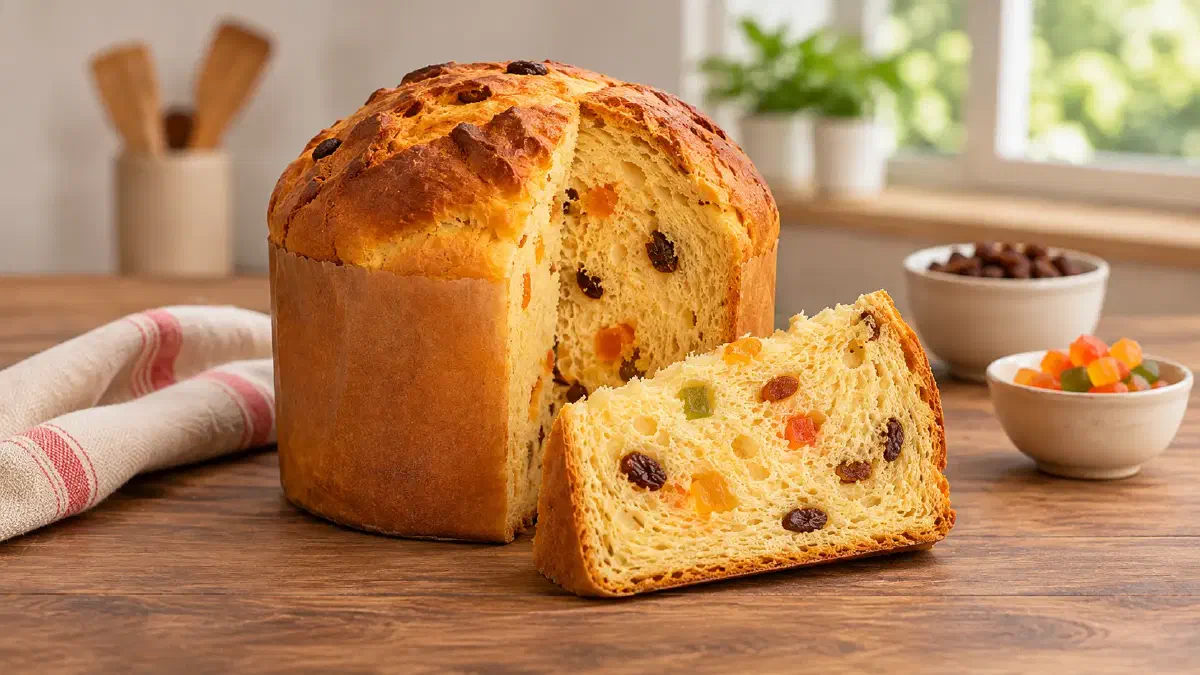

A golden-brown crust, sweet yeast dough filled with raisins and candied fruit: that’s pan dulce.
For many people in Paraguay, this sweet yeast bread is part of Christmas. You will find it in plenty of stores during the season, but you can also bake it yourself. Vanilla and orange zest give our version a pleasant citrus flavor.
📝 Pan dulce recipe step by step#
- Difficulty: medium
- Prep time: about 45 minutes
- Rising time: about 2 hours 45 minutes in total
- Baking time: about 40 to 50 minutes at 350°F (180°C) using the regular bake setting
- Total time: about 5 hours 45 minutes, including around 1½ hours of cooling
- Yield: 2 medium loaves, about 12 slices in total
🛒 Ingredients for pan dulce#
Besides the basic ingredients for yeast dough, you’ll need raisins and candied fruit for this pan dulce recipe. You can add nuts or other flavors if you like.
Main ingredients#
- 500 g all-purpose flour (in Paraguay, for example, harina 0000)
- 120 g sugar
- 100 g softened butter
- 3 eggs
- about 120 ml lukewarm milk, adjusted to the dough’s consistency
- 8 g dry yeast (levadura seca) or 25 g fresh yeast (levadura fresca)
- 100 g candied fruit (frutas confitadas, frutas abrillantadas), or candied orange peel or citron
- 100 g raisins (pasas de uva)
- 1–2 tsp vanilla extract or vanilla flavoring, following the package directions
- finely grated zest of 1 orange
- about 1 tsp salt
Optional ingredients#
- 50–100 g roughly chopped walnuts, almonds, or peanuts (frutos secos) for a little more crunch.
- Increase the sugar to up to 150 g for a sweeter loaf, or add 1 tsp honey for a light honey flavor.
- A little orange blossom water (agua de azahar) for a floral note. Use sparingly.
- Soak the raisins in a little rum or Cognac if you like, or use water or orange juice for an alcohol-free option. Drain well afterward.
Kitchen equipment#
- Kitchen scale and measuring cup
- Small bowl for the yeast mixture and a large mixing bowl
- Fine grater for the orange zest
- Stand mixer with a dough hook (optional, you can also knead by hand)
- Two tall paper pan dulce molds (about 750 g capacity each) or suitable greased baking pans
- Baking sheet
- Long wooden skewer to check doneness
- Wire cooling rack
👩🍳 Step-by-step instructions#
Preparation#
- Let the butter soften at room temperature. Warm the milk slightly.
- Cut any larger pieces of candied fruit into small cubes. Grate only the colored part of the orange peel.
- Place the paper molds on the baking sheet. If you are using other baking pans, grease them first.
Method#
Prepare the yeast mixture. Mix the yeast with about half of the lukewarm milk, 1 tbsp of the sugar, and 2 tbsp of the flour. Use the amounts already measured out above. Let the mixture stand for about 15 minutes, until bubbles appear.
Knead the dough. Mix the remaining flour with the remaining sugar and salt. Add the yeast mixture, all three eggs, vanilla, and orange zest. Gradually pour in the remaining milk until a soft dough forms. Knead until smooth, then work in the softened butter a little at a time. The dough can feel slightly sticky. By the end, it should be smooth and elastic.
First rise. Cover the bowl and let the dough rise for about 1½ hours, until roughly doubled in volume.
Add the fruit and shape. Flatten the dough on a lightly floured work surface and spread the raisins and candied fruit over it. Fold the dough over and knead briefly until the fruit is evenly distributed. Divide the dough into two equal portions, shape into round loaves, and place them in the prepared molds or pans.
Second rise. Cover the loaves and let them rise for about 1 hour 15 minutes. The tops should become visibly rounded, and the dough should have increased noticeably in volume. There should still be some room below the rim of each pan. Toward the end of the rising time, preheat the oven to 350°F (180°C) on the regular bake setting.
Bake and cool. Bake the loaves on the middle rack for about 40 to 50 minutes. Toward the end, use a long wooden skewer to check that the centers are baked through. The crust should be golden brown, and no raw dough should stick to the skewer.
Let the loaves cool completely on a wire rack. If you used solid baking pans, carefully remove the loaves after a short cooling period; you can leave the paper molds on. Allow about 1 to 2 hours in total.
💡 Practical tips for pan dulce#
- Check sooner in warm weather. Christmas falls in summer in Paraguay, so the kitchen can warm up quickly and the dough may rise much faster. During both rises, watch the volume as well as the time.
- Is the crust browning too quickly? Cover the loaves loosely with aluminum foil and continue baking until the centers are cooked through.
You can also find a shorter version of the recipe below. Go to the pan dulce recipe card
Nutrition overview#
Approximate nutritional values per slice, based on 12 servings of the basic recipe without optional ingredients:
- Calories: about 330 kcal
- Protein: about 7 g
- Carbohydrates: about 56 g
- Fat: about 9 g
- Fiber: about 2 g
These values are rounded and may vary depending on the ingredients and slice size.
🔄 Recipe variations#
If you don’t like candied fruit or want to try something different, you can make pan dulce in a few other ways.
With chocolate: Replace some or all of the 100 g of candied fruit with chocolate chunks. You can keep the raisins or leave them out, depending on what you like.
With Miel de Caña: Dark sugarcane syrup gives pan dulce a richer, slightly caramel-like flavor. Some recipes are made without yeast and use a different method.
#
More about the recipe#
Pan dulce literally means “sweet bread.” In Paraguay, you may also hear pan dulce paraguayo. Around Christmas, it’s often called pan dulce navideño (Christmas bread). You may occasionally see the spelling pandulce on packaging and in recipes.
🇵🇾 Pan dulce at Christmas in Paraguay#
Around Christmas and New Year, this sweet yeast bread is traditionally part of the celebrations for many people in Paraguay.
You can sometimes find it outside the Christmas season, but toward the end of the year, supermarkets often have separate tables or small shelves just for pan dulce, Sidra – a usually sparkling hard cider – and other holiday products.
You’ll also see canastas navideñas, or Christmas gift baskets, in stores. They are popular gifts here for employees, customers, friends, or family. We have given baskets like these to our capataz, who helps us on our property.
You can buy the baskets ready-made or put them together yourself. Along with pan dulce and Sidra, they often contain sweets and everyday foods such as Yerba Mate, rice, or canned fruit. I have even seen coolers used in place of a traditional basket.
But this cake-like bread isn’t just given as a gift. People also enjoy it with coffee or Mate Cocido at merienda, the light afternoon meal – especially during the holidays, when family or guests are visiting.
In the past, it was customary in Paraguay to welcome visitors at the end of the year with a glass of Clericó and a slice of pan dulce or another sweet treat. The drink is still part of Christmas and New Year’s Eve celebrations today. A slice of pan dulce still goes well with it, especially when guests come over.
❓ Frequently asked questions#
How do I store pan dulce?
Can I bake pan dulce without special paper molds?
Can I leave out the raisins?
Is pan dulce the same as panettone?
Conclusion#
Pan dulce does not have to taste the same every time. Whether you stick with raisins and candied fruit or later try chocolate or nuts is entirely up to you.
Especially at Christmas, this homemade sweet bread is also a lovely option for sharing or giving as a gift.
Enjoy baking, and buen provecho!
If you’d like something else for your holiday table, try a well-chilled Clericó. You’ll find more sweet ideas in our collection of Paraguayan desserts.
✨ A little something extra for you#
Recipe at a glance
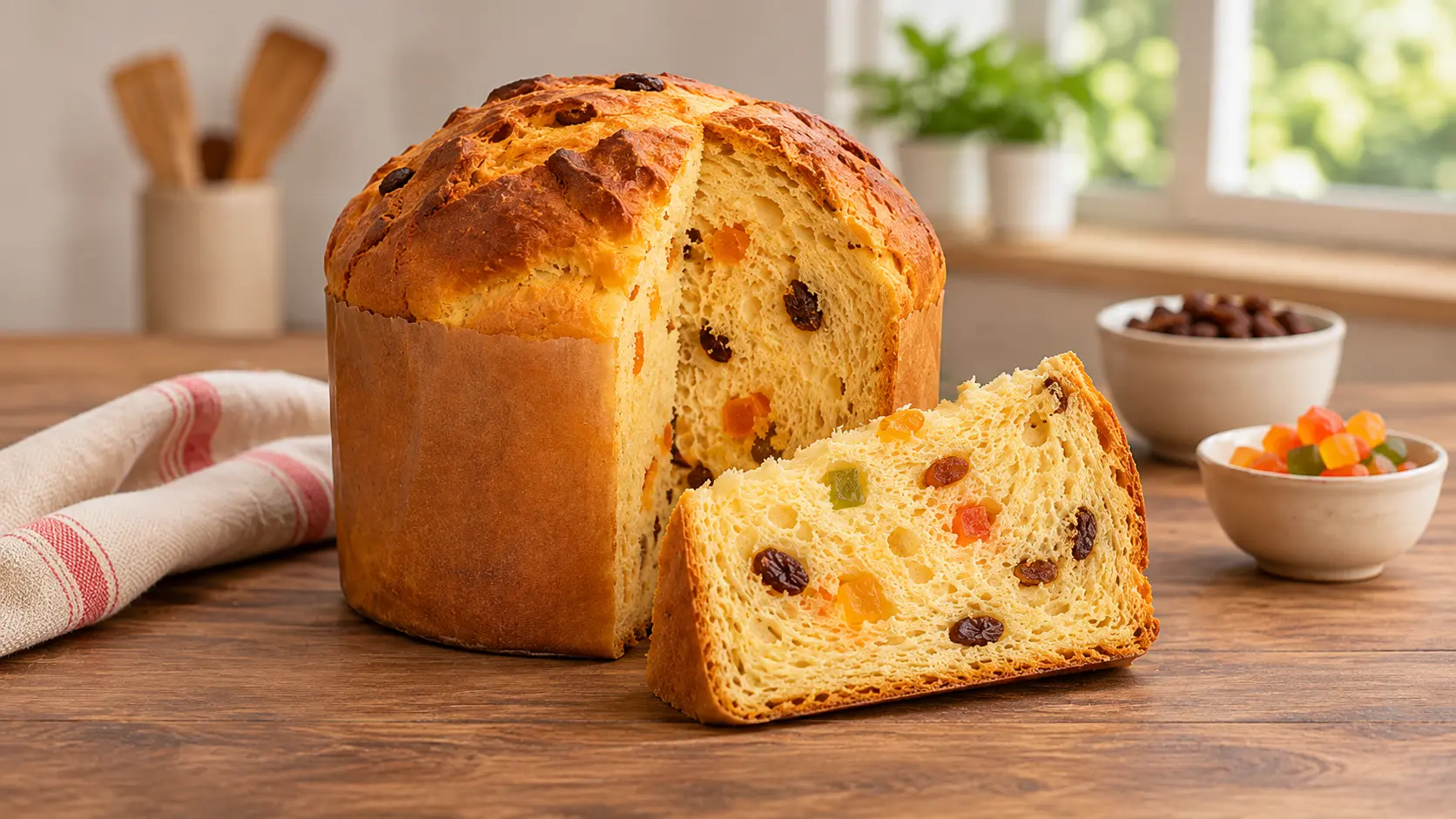
Pan dulce paraguayo
Sweet yeast bread with raisins, candied fruit, vanilla, and orange zest, especially popular in Paraguay at Christmas.
- Prep time
- about 45 minutes about 45 min
- Cook time
- about 40 to 50 minutes about 40 to 50 min
- Total time
- about 5 hours 45 minutes about 5 hours 45 min
- Servings
- 2 medium loaves, about 12 slices
- Difficulty
- medium
- Calories
- about 330 kcal per slice about 330 kcalper slice
The total time includes about 2 hours 45 minutes of rising time and 1½ hours of cooling. Allow some flexibility depending on room temperature and the pans you use.
Ingredients
Makes 2 medium loaves, about 12 slices:
- 500 g all-purpose flour
- 120 g sugar
- 100 g softened butter
- 3 whole eggs
- about 120 ml lukewarm milk, adjusted to the dough’s consistency
- 8 g dry yeast or 25 g fresh yeast
- 100 g candied fruit
- 100 g raisins
- 1–2 tsp vanilla extract or vanilla flavoring, depending on the product
- finely grated zest of 1 orange
- about 1 tsp salt
Instructions
- Prepare the yeast mixture: Mix the yeast with about half of the measured lukewarm milk, 1 tbsp of the sugar, and 2 tbsp of the flour. Let stand for about 15 minutes, until bubbles appear. Chop the candied fruit if needed.
- Knead the dough: Combine the remaining flour, sugar, and salt with the yeast mixture, all three eggs, vanilla, and orange zest. Gradually add the remaining milk until the dough is soft. Knead until smooth, then work in the softened butter a little at a time until the dough is elastic and slightly sticky.
- Let the dough rise: Cover the dough and let it rise for about 1½ hours, until roughly doubled in volume.
- Add the fruit and shape the loaves: Flatten the dough, spread the candied fruit and raisins over it, and fold it together. Knead briefly, divide in half, and shape into two round loaves. Place in two tall paper baking molds (about 750 g capacity each) or suitable greased baking pans. Cover and let rise for about 1 hour 15 minutes, until the dough has risen noticeably and there is still room below the rim.
- Bake and cool: Preheat the oven to 350°F (180°C) on the regular bake setting. Bake on the middle rack for about 40 to 50 minutes. The surface should be golden brown. A wooden skewer inserted into the center should come out without raw dough sticking to it. Let the loaves cool completely on a wire rack, about 1 to 2 hours. Carefully remove the loaves from solid baking pans after a short cooling period; you can leave the paper molds on.