

October 12, 2026, falls on a Monday – and since it is an official commemorative day, it is natural to wonder whether it is also a public holiday. In fact, the “Day of the Republic” in Paraguay is not a regular day off work.
Still, this date marks an important historical step: on October 12, 1813, Paraguay adopted a new system of government and was explicitly described as a republic. Let’s take a closer look at why this step has its own significance alongside independence in 1811, and what the day means in everyday life today.
Quick Facts at a Glance
- Date: Monday, October 12, 2026
- Official name: Día de la Proclamación del Paraguay como República
- Status: statutory commemorative day; as of October 4, 2026, not a nationwide public holiday or general day off
- Occasion: commemoration of the government regulation adopted on October 12, 1813
- Significance: Congress reorganized the government and named Yegros and Francia as consuls of the Republic of Paraguay.
- Everyday life in 2026: No nationwide day off. Local or institutional asuetos may apply independently.
What Is October 12 in Paraguay?#
October 12 is an official commemorative day in Paraguay.
It commemorates October 12, 1813, when Congress adopted the Reglamento de Gobierno, the government regulation for the new political order, and Paraguay was proclaimed a republic.
The official name is Día de la Proclamación del Paraguay como República, which roughly translates as “Day of the Proclamation of Paraguay as a Republic.” A shorter name for the day is Día de la República (Day of the Republic).
Since 2020, Ley 6576 has officially designated October 12 as an annual commemorative day. Paraguay now formally commemorates a political step taken more than two centuries ago.
Is October 12, 2026, a Public Holiday in Paraguay?#
No. As things currently stand, Monday, October 12, 2026, is not a nationwide public holiday or general day off in Paraguay.
The law establishing the Día de la Proclamación del Paraguay como República declares October 12 a commemorative day, but does not make it a general day off work. The date is also not included in the current list of national public holidays.
For everyday planning, that distinction matters. If you normally work on Mondays, go to school, or have an appointment at a government office, you should not automatically expect a day off or public holiday schedules because of the commemorative day. Shops, transport services, and private businesses also do not automatically switch to public holiday schedules on October 12.
Independently of this, local or institutional asuetos may apply. They then only affect the explicitly specified area or institution and do not turn October 12 into a nationwide public holiday.
The day is mainly historical and institutional in character and is less associated with parades or other established traditions. Daily life remains fairly quiet. The commemoration is most visible in historical or official posts and reports around the anniversary.
Why Are Both 1811 and 1813 Important for Paraguay?#
The two years represent different steps in the early development of the Paraguayan state.
On May 14 and 15, 1811, the independence movement succeeded in Asunción. Paraguay then established its own government. These events remain the central reference point for Independence Day in Paraguay.
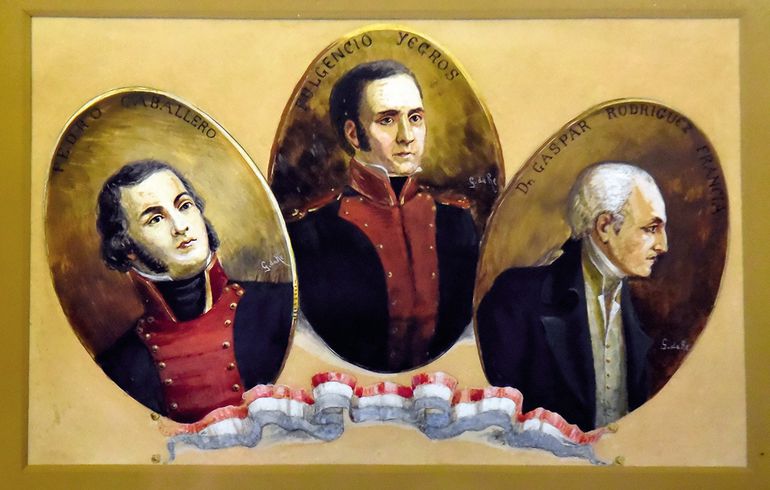
Artwork: Guillermo Da Re, 1890 · Public Domain · Source: Wikimedia Commons
In 1813, a different question took center stage: How should Paraguay now be governed and politically organized? Congress adopted a new system of government and explicitly used the name República del Paraguay.
| Year | What Does the Date Represent? | What Changed? |
|---|---|---|
| 1811 | The independence movement and the beginning of independent rule | Paraguay established its own political leadership. |
| 1813 | A republican form of government | Congress adopted a new government regulation and placed two consuls at the head of the republic. |
Independence and a republic therefore do not mean the same thing. Independence mainly concerns political self-rule free from outside control. A republic, by contrast, describes how the state is organized and governed.
What Did the Congress of 1813 Decide?#
The Second National Congress met in Asunción on September 30, 1813. Historical accounts describe more than a thousand representatives from different parts of the country.
Relations with Buenos Aires were an important political issue. Congress rejected the idea of sending Paraguayan representatives to the planned assembly there. This made clear that Paraguay wanted to decide for itself how it would be governed.
On October 12, the Reglamento de Gobierno, consisting of 17 articles, was finally adopted.
Congress met in what was then the Templo or Convento de la Merced. Today, the site lies in the area of the Plaza de la Democracia in Asunción. The former monastery building no longer exists.
What Did the Government Regulation Set Out?#
The Reglamento de Gobierno consisted of 17 articles. It set out not only who would govern Paraguay, but also how this joint government would work:
- Fulgencio Yegros and José Gaspar Rodríguez de Francia were to lead the government jointly as consuls.
- Important government business generally had to be signed by both.
- The chairmanship alternated between them every four months.
- A congress was also to meet every year to discuss the country’s well-being, improvements to the government, and possible abuses.
Another interesting point is that this arrangement was not intended to be permanent. It was to remain in place only until a later congress decided otherwise.
Yegros and Francia as Consuls#
The regulation refers to Yegros and Francia as consuls of the Republic of Paraguay. They were to lead the government together and initially had equal standing.
This office had nothing to do with a modern consulate or with a diplomat serving abroad.
The consulate lasted only a short time. In 1814, Francia took over sole leadership of the state. His later rule shaped Paraguay for many years. In Paraguayan historical accounts, Francia is still referred to as Karai Guasu, roughly meaning “great lord.” This is a historical nickname, not an official title from 1813.
What Did “Republic” Actually Mean in 1813?#
The term “republic” did not mean that Paraguay was already a democracy in the modern sense in 1813. The Reglamento de Gobierno mainly dealt with the leadership of the state and the joint government by the two consuls. Universal voting rights, today’s separation of powers, and modern fundamental rights did not yet exist in this form.
October 12 therefore commemorates an important step in the further development of Paraguay’s political system, not the creation of today’s democratic system of government. The current constitutional system came much later. You can read more about it in the article on Constitution Day in Paraguay.
❓ Frequently Asked Questions About October 12 in Paraguay#
Is October 12, 2026, a public holiday in Paraguay?
Can there still be an Asueto on October 12?
Why is 1811 the year of independence if Paraguay became a republic in 1813?
Was the government regulation of 1813 Paraguay’s first constitution?
Conclusion#
This commemorative day shows that historical significance and visibility in everyday life do not always go hand in hand. For most people in Paraguay, daily routines change very little on this day, but the date still recalls an important step in the country’s political development.
Looking at 1811 and 1813 makes it clear that independence and the further organization of the state did not happen on the same date. This also helps explain why October 12 still has its own place in Paraguay’s historical memory.
If you would like to see how Paraguay developed from those early years onward, you can find the wider context in History of Paraguay: From the Guaraní to Today.
Share & Support
Did you know the difference between independence in 1811 and the republic of 1813? Feel free to like this article and share it with others who would like to better understand Paraguay and its history.
Milestones in Paraguay’s State History:
Reply by Email