
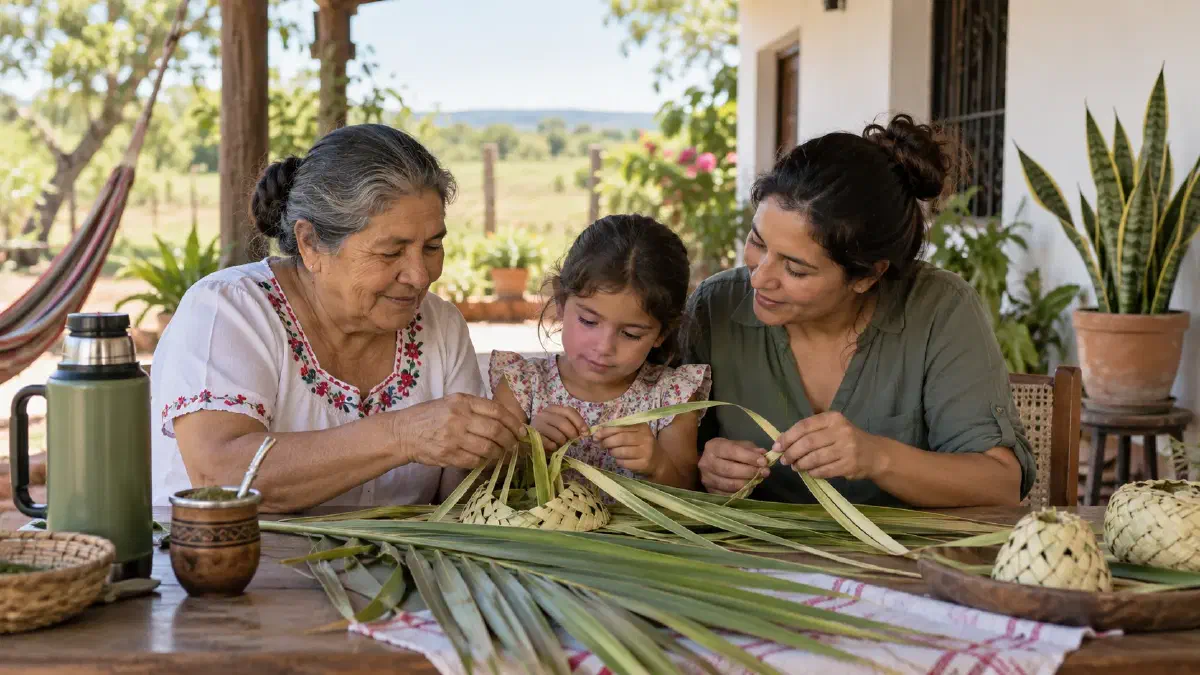
On October 1, Jopara is served. A full pot is meant to keep the feared Karai Octubre and the threat of scarcity at bay. You might notice a red bracelet around a baby’s wrist. On Palm Sunday, carefully woven palm arrangements are brought to be blessed.
You’ll come across customs in Paraguay throughout the year, at festivals and in everyday life. They bring families together, give religious celebrations their familiar character, or express hopes for good luck and protection. Some are widely known; others you may only discover through personal encounters.
Which customs people follow and what they mean to them vary from one family, region, or community to another. Here you’ll find an overview of typical examples and the beliefs behind them.
Quick Facts at a Glance
- Throughout the year: Well-known examples include Kurusu Ára on May 3, San Juan around June 24, Carrulim on August 1, and Jopara on October 1.
- Family and everyday life: Godparenthood, Tupanói (asking for a blessing), protective bracelets for babies, and sharing Tereré are also among the customs and everyday habits described here.
- Folk beliefs: Some customs and objects are associated with protection, good luck, or bad luck. People who follow these traditions do not necessarily take the beliefs behind them literally.
- Regional diversity: Arete Guasu in the Chaco and San Baltazar in Kamba Kua are examples of customs closely connected to particular communities.
- Not automatically a public holiday: Even if a custom has a fixed date, that does not mean the day is an official day off work.
Customs, Folk Beliefs, and Stories: What’s the Difference?#
Tradition is the broadest of these terms. It includes actions and rituals, as well as knowledge, habits, and stories passed down through generations. A custom is one part of this.
Customs: repeated practices#
A custom is something people do repeatedly on a particular occasion or in a particular situation. It is passed down within a family or community and often has a special meaning.
Eating Jopara on October 1, decorating a cross on Kurusu Ára, or asking older relatives for their blessing are all examples. The occasion might be a particular date, a religious celebration, or a family gathering. Everyday life has its customs, too.
Customs do not stay the same forever. As the people who practice them change, customs can also change or become less important over time.
Folk beliefs: traditional ideas#
Folk beliefs are ideas passed down over time about good luck, protection, bad luck, or supernatural influences. A custom can grow out of such a belief, but not every belief is connected to a particular action.
One example is a baby’s red bracelet: according to this belief, it is meant to protect against ojeo, the evil eye. Eating Jopara is connected to the belief in Karai Octubre and the threat of scarcity.
Myths and legends: stories about beings and events#
Myths, legends, and other traditional stories tell of extraordinary beings, events, or places. In Paraguay, these include figures such as Pombero, Jasy Jatere, and Luisón, as well as stories about ghosts, treasure, and landscapes.
These stories are part of Paraguay’s cultural heritage. Just because someone knows or retells them does not mean they personally believe in them.
The boundaries often overlap: Jopara on October 1 brings together a custom, folk beliefs, and the story of Karai Octubre.
Customs Throughout the Year#
Many customs have a fixed place on the calendar. But that does not mean they are celebrated on exactly the same date everywhere. Some local festivities take place on another day or over the weekend.
| When? | Custom | What happens? |
|---|---|---|
| Palm Sunday and Holy Week | Pindó karai and Chipa apo | Having palm arrangements blessed and baking Chipa together |
| May 3 | Kurusu Ára | Decorating crosses, praying, and sharing Chipa |
| June, especially around the 24th | San Juan | Community celebrations with games, food, and performances |
| August 1 | Carrulim | Drinking a mixture of Caña, Ruda, and Limón |
| October 1 | Jopara and Karai Octubre | Cooking and eating Jopara to symbolically keep scarcity away |
| November 1 and 2 | Todos los Santos and Día de los Fieles Difuntos | Visiting graves, bringing flowers, and remembering loved ones who have died |
| December | Caacupé and the Christmas season | Going on pilgrimages, fulfilling vows, and setting up nativity scenes |
Semana Santa: palm arrangements and baking Chipa together#
On Palm Sunday, woven palm arrangements and small palm objects are brought to be blessed. Some people then keep them at home or take them along when they go out. These objects are also associated with beliefs about protection.
During Holy Week, baking Chipa together, known as chipa apo, is a particularly visible family tradition. Preparing and baking it together also passes on each family’s way of making Chipa. This helps keep knowledge and customs alive across generations.
You can learn more about the Easter period in our detailed article on Semana Santa in Paraguay.
May 3: Kurusu Ára and decorated crosses#
Kurusu Ára, the Day of the Cross, is observed on May 3. Crosses or niches containing crosses are decorated with plants, ornaments, and Chipa. After the prayers, the Chipa may be taken down in a custom known as chipa po’o and then shared.
If you come across the different names, here’s what they mean: Kurusu Ára refers to the occasion, Kurusu Jegua to the decorated cross, and chipa po’o to taking down the Chipa.
June: San Juan, games, food, and community#
San Juan celebrations are among the most visible community festivals during Paraguay’s winter. The religious observance falls on June 24, but schools, communities, chapels, and clubs also hold celebrations on other days in June.
Traditional games include kambuchi jejoka, where a pot is broken, and carrera vosa, the familiar sack race. One of the fire-related customs is pelota tata, in which a burning cloth ball is kicked around the festival grounds.
Love also has its place around San Juan. The traditional pruebas de San Juan are small fortune-telling rituals about love and the future. For example, candle wax dripped into water is said to reveal the first letter of a future love’s name. People also look for that letter in the rust marks on a knife that has been stuck into a banana plant.
And, of course, sharing food is part of the celebration. Our collection of traditional San Juan dishes is a good place to start exploring the food.
August 1: Carrulim for good luck and protection#
For some people, August begins with a small glass of Carrulim. Its name comes from the ingredients Caña, Ruda, and Limón.
The mixture is associated with traditional beliefs about good luck, protection, and cleansing. How Carrulim is prepared and drunk varies depending on the tradition. The number of sips can vary, too.
October 1: Jopara and Karai Octubre#
On October 1, people traditionally eat Jopara, a hearty dish made with white corn (Locro) and beans. It is linked to Karai Octubre, a figure associated with scarcity and a time when food supplies run low.
A full pot is a symbolic way of saying: There is enough food in the house. In this way, people seek to keep the threat of scarcity at bay.
You can learn more about the custom and the idea of October as a time of scarcity in our article on Jopara and Karai Octubre.
November 1 and 2: visiting graves and remembering#
Around All Saints’ Day on November 1 and All Souls’ Day (Día de los Fieles Difuntos) on November 2, relatives visit cemeteries and bring flowers to graves. Families remember their loved ones who have died and observe these days in their own way.
December: pilgrimages, vows, and nativity scenes#
December 8 is closely connected to the Virgen de los Milagros de Caacupé. Many pilgrims set out for Caacupé in the days leading up to it. Prayers and personal promesas, or vows, are part of this religious tradition.
During the Christmas season, you’ll come across the pesebre, the nativity scene. Families decorate their nativity scenes with different materials and decorations. One typically Paraguayan feature is the Flor de coco, whose scent is part of Christmas for many people.
Each family decides when to set up its nativity scene. There is no single date everyone follows.
Customs in Family and Everyday Life#
Not all customs are tied to a particular day. Many are part of family life or everyday habits. Here are a few examples.
Babies and the red bracelet#
According to folk beliefs, a red bracelet around a newborn’s wrist is meant to protect against negative influences or ojeo, the so-called evil eye. Whether a baby wears one depends on the family.
This belief has been documented in Paraguay, including in a study at the Niños de Acosta Ñu children’s hospital in San Lorenzo.
Godparenthood: more than a role at baptism#
The role of godparents begins with baptism and can extend well beyond the ceremony. It also creates a social bond between parents and godparents, known as compadrazgo. Parents call the godparents compadres or comadres. They can become important people in the family’s wider circle.
You can see how this connection continues in everyday life through small things. People proudly share in status updates that they are now a comadre or compadre. At birthdays and other family celebrations, you may see messages thanking godparents who organized a party for their godchild or gave them a special gift.
How close the compadrazgo relationship becomes depends on the family. Each family decides for itself whether and how godparents contribute to celebrations, gifts, or financial support.
Tupanói: blessings and respect#
Another custom connected to godparenthood and respect for older family members is Tupanói, asking for a blessing.
Children or younger relatives may greet parents, grandparents, or godparents with their hands clasped and ask for their blessing. This religious gesture also expresses respect for older family members or those with whom they share a particularly close bond. Giving the blessing is called jehovasa.
We’ve seen this greeting several times out here in the countryside, too. For example, when the son of one of our workers came by to bring food, he first greeted his father with his hands clasped. In that brief moment, a greeting, respect for his father, and a request for a blessing came together.
Death and mourning: praying and remembering together#
After a death, relatives and neighbors come together to pray. Traditional customs include novenas lasting nine days and their special conclusion, the novena pahá. Depending on the family, sharing food may also be part of the gathering.
Prayer, remembrance, and being together can help relatives feel connected during this time. How each day is observed varies, but gathering gives people space to share their grief.
Reliques: protective objects for the home, car, or wallet#
The woven palm objects from Palm Sunday can remain part of everyday life even after they have been blessed.
These reliques, small protective objects or amulets, and similar palm items may be kept alongside religious objects such as a Bible, in a wallet, or in a car. They are believed to protect against misfortune or negative influences. Larger blessed palm arrangements may also be kept behind doors or elsewhere in the home.
Small folk beliefs around the home#
Sometimes folk beliefs are reflected in very simple actions. One traditional belief says that turning a glass upside down in a corner can help you find something you’ve lost. Sweeping at night, on the other hand, is associated with bad luck.
You’ll often see snake plants (lengua de suegra or espada de San Jorge) near home entrances, outside shops, or around properties. They are associated with protection against negative influences, good luck, and prosperity.
We’ve also been told here that the plant is supposed to protect the house and property and even attract money. So naturally, we planted a few.
Such beliefs are often passed on casually. People may know them from their family or have heard about them at some point. Some are still followed, while others are retold with a smile.
Promesas: a personal vow#
Promesas are especially visible around Caacupé, but they are not limited to that occasion. A promesa often links a request or an expression of thanks to a personal promise.
For example, someone might promise to make a pilgrimage to a shrine or carry out a particular action. What someone promises is a personal choice. The connection between asking, giving thanks, and keeping that promise is an important part of the custom.
Sharing Tereré as an everyday tradition#
Some traditions do not need a festival or religious occasion. Sharing Tereré is one of them: people sit together, drink, and talk.
The gathering also passes on habits around preparation and knowledge of the traditional medicinal herbs (pohã ñana) used in the drink. Spending time together is just as much a part of Tereré’s cultural significance as the drink itself.
You can learn more about this social side and the national day dedicated to Tereré in our article on Día Nacional del Tereré.
Regional and Community Traditions#
Some festivals and customs are closely connected to particular regions or communities. They show how varied cultural traditions can be across Paraguay.
Arete Guasu is celebrated by communities of the Guaraní Occidental people in the Paraguayan Chaco. Masks, dancing, flutes, and drums are part of the celebration, along with the corn harvest and remembrance of ancestors.
During Guaykurú Ñemondé in Compañía Minas near Emboscada, promeseros wear striking feather costumes and masks during celebrations for San Francisco Solano. Vows and religious devotion are central to this local tradition, which is passed down within families.
Around January 6, San Baltazar in Kamba Kua, in Fernando de la Mora, takes center stage. The Afro-Paraguayan community honors its patron saint with drums and dancing, passing on its own forms of cultural expression.
These celebrations are part of the history and community life of the people who observe them. They bring together customs, religious beliefs, remembrance of ancestors, and the passing on of traditions.
How Might You Encounter These Traditions Today?#
Some customs are easy to notice. Others may only catch your attention when someone explains why a palm arrangement hangs in a car or why a family member asks for a blessing with their hands clasped.
In everyday life, people do not always call something a custom. Often, they simply say: That’s just how we do things here. Talking to them can help you understand what the action means to their family and whether religion or folk beliefs play a role.
If something catches your attention, a simple question is a good place to start: How do you do this in your family or where you live? The answer can give you a better understanding of how people themselves see and practice their customs.
❓ Frequently Asked Questions About Customs in Paraguay#
What are some typical customs in Paraguay?
Are Jopara, Carrulim, or San Juan official public holidays?
How are traditions, customs, and folk beliefs different?
What does Tupanói mean?
What does a red bracelet on a baby mean?
Conclusion#
Customs show what connects people and what matters to them: family, faith, remembering those who have died, or the hope for good luck and protection. Sometimes this takes the form of a big celebration, sometimes a small gesture that barely stands out in everyday life.
That is also why traditions remain part of life in Paraguay today. They are passed on, change, or become less important over time. Knowing their background helps you understand why a plate of Jopara, a palm arrangement, or a request for a blessing can mean more than you might first think.
If you want to know when public holidays and special days take place in Paraguay and what they mean for everyday life, you can find dates and background information in our overview of public holidays in Paraguay.
Share & Support
Have you come across any of these customs in Paraguay yourself, or do you know someone who should hear about them? Then give this article a like and share it with others interested in Paraguay. Together, we can help more people discover Paraguay’s everyday life and culture.