
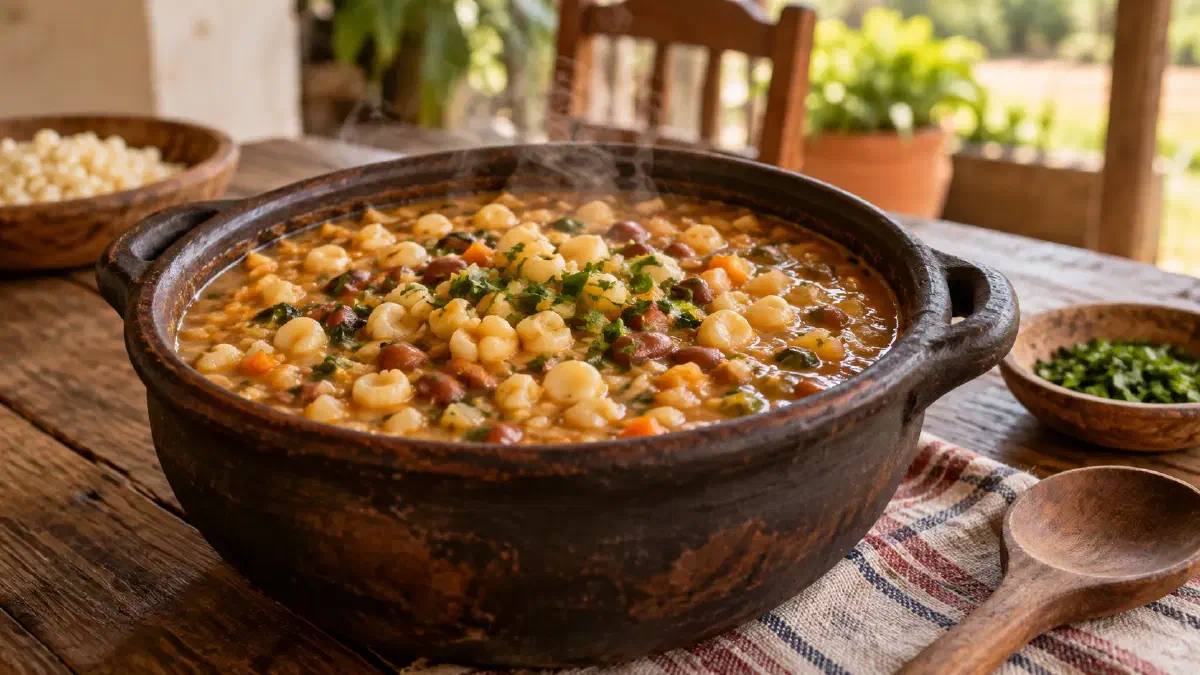

White corn, beans, squash, a few vegetables, and, above all, a little time: These simple ingredients, common in Paraguay, come together as Jopara, a hearty corn and bean stew that is surprisingly filling. From one kitchen to another, the dish can be simple or much richer.
Here, we make Jopara without meat or cheese—a budget-friendly version with just a few ingredients. Along with the step-by-step instructions, you’ll also find well-known variations and ideas for building on the basic stew.
📝 Jopara Recipe: Step by Step#
At a Glance
- Difficulty: easy
- Soaking time: 8 to 12 hours
- Prep time: about 20 to 25 minutes
- Cooking time: about 1½ to 2 hours
- Servings: about 5 main-dish servings
- Suitable for: vegan (and therefore vegetarian); gluten-free when made with water or vegetable broth labeled gluten-free
🛒 Ingredients for Jopara#
Many of these ingredients are everyday staples in Paraguay and are easy to find there.
Main Ingredients#
- 200 g locro (dried white corn)
- 200 g dried red or black beans (poroto)
- 2 onions
- 2 tomatoes
- 1 small green bell pepper (locote)
- 1 carrot
- 250 to 300 g squash (zapallo)
- 2 garlic cloves
- 2 tbsp vegetable oil
- 1 bay leaf
- about 2 liters of water or mild vegetable broth
- a little extra hot water, if needed
- salt and pepper
- parsley, green onion, or fresh cilantro (kuratũ) to taste
If possible, use just one type of bean. Different varieties may take different amounts of time to soften.
What Can You Substitute?#
Ingredient Substitutions
- Locro/Locrillo: Outside Paraguay, you may find white corn sold as maíz blanco para locro. Locrillo is another option; depending on the product, the grain size and cooking time may vary.
- Precooked white corn or canned hominy: Both can work as quicker alternatives and should be added later in the cooking process. Hominy is nixtamalized corn, however, so it is not the same as dried locro; the flavor and texture may differ.
- Beans: You can use dried red or black beans. Canned beans also work and save time. Add them later and use the drained weight when measuring.
- Squash: Hokkaido or butternut squash can work well as alternatives to Paraguayan zapallo.
Equipment#
- 2 bowls for soaking
- 1 large cooking pot
- 1 skillet or small pot for the vegetables
- strainer
- knife and cutting board
- cooking spoon
👩🍳 Step-by-Step Instructions#
Prepare the Day Before#
- Put the locro and beans in separate bowls and cover each generously with water.
- Soak for 8 to 12 hours, preferably overnight.
- The next day, discard the soaking water and rinse the locro and beans thoroughly.
- Chop the onions, tomatoes, and locote. Cut the carrot into slices or small cubes.
- Cut the squash into pieces about 2 cm (about ¾ inch) across. Finely chop the garlic.
Cook the Jopara#
- Cook the locro and beans first: Bring the locro and beans to a boil with the bay leaf and about 2 liters of fresh water. Cook over medium heat for about 50 to 60 minutes, then check them. Continue cooking until the locro and beans are almost tender. Add hot water if needed. The actual cooking time may vary depending on the product and how long it has been stored.
- Sauté the vegetables: Once the locro and beans are almost tender, heat the oil in a skillet. Sauté the onions and garlic until softened. Add the locote, tomatoes, and carrot, and cook for a few more minutes.
- Add the vegetables to the stew: Add the sautéed vegetables and squash to the locro and beans. Stir well.
- Finish cooking: Simmer everything gently for another 20 to 30 minutes, until the locro and beans are fully tender and the carrot and squash are cooked. If the Jopara becomes too thick, add hot water a little at a time.
For a thicker stew: Mash a few soft pieces of squash right in the pot.
- Season: Add salt and pepper to taste. Stir in parsley, green onion, or finely chopped kuratũ just before serving.
The finished Jopara should be thick, but still have enough liquid to remain a stew.
Nutrition Information#
For a batch of about 5 servings, the estimated nutrition per serving is:
| Nutrient | Per Serving |
|---|---|
| Calories | about 360 kcal |
| Protein | about 14.5 g |
| Carbohydrates | about 63 g |
| Fat | about 6 g |
| Fiber | about 12 g |
Note: These are calculated averages and may vary somewhat depending on the type of beans, the size of the vegetables, and the serving size. The calculation uses water; vegetable broth may especially affect the sodium content. Side dishes and variations with cheese or meat are not included.
🍽️ What Goes with Jopara?#
Jopara is already a filling main dish, but it is often served with a simple side.
- Classic: Boiled mandioca goes well with Jopara.
- Savory: Tortilla paraguaya is also served with it.
- For a heartier meal: A small serving of Sopa Paraguaya can also be served alongside it.
- Simple: Water always works and lets the flavor of the stew stand on its own.
- Fruity: A fruit juice that isn’t too sweet is an easy alternative.
🔄 Jopara Recipe Variations#
Although the basic ingredients are shared, one pot of Jopara can be quite different from another.
Jopara kesu: with Queso Paraguay#
For Jopara kesu, add about 150 to 200 g Queso Paraguay near the end. Coarsely crumble the cheese and stir it in during the last few minutes. Depending on the recipe, this version may also include a little milk.
Jopara so’o: with Beef#
So’o is Guaraní for “meat.” This variation uses beef, such as beef shank (osobuco) or other cuts. The meat is cut into pieces, browned, and then cooked with the stew. Depending on the cut, it may need more cooking time.
Kure jopara: with Pork#
Jopara with pork is another known variation. One particular version is kure pykue jopara, made with pig’s feet. This cut needs considerably more time to cook. For a simpler variation, you can use another pork cut suitable for slow cooking.
From jopara peky to joparaite#
Other known versions show just how varied Jopara can be:
- Jopara peky: a version documented in southern Paraguay, especially in the Colonias Unidas, made with fresh Poroto Peky. A preparation without locro is also described for this variation.
- Cecina piru jopara: a version also associated with the Chaco and made with dried meat (cecina piru).
- Jopara norteño: an especially rich version described as using several types of beans, along with cheese and milk.
- Joparaite: a rich mixed version described as including beef, pork, and chicken, along with other ingredients such as rice or noodles.
This variety helps explain why Jopara is hard to reduce to one definitive recipe.
🇵🇾 Jopara in Paraguay: Everyday Food, Tradition, and Karai Octubre#
Jopara isn’t tied to just one date on the calendar. This corn and bean stew is also an easy, filling meal for cooler days, and it can be adapted differently from one household to another.
However, Jopara is especially closely linked to October 1. According to folk belief, a well-filled pot is meant to show that there is enough food in the house and, in turn, keep Karai Octubre and the hardship associated with him at bay. Read more about the custom and why October was traditionally considered a difficult time in our article Jopara and Karai Octubre: Paraguay’s October 1 Tradition.
The dish also has official cultural recognition: In 2017, Paraguay’s Secretaría Nacional de Cultura ↗ recognized Jopara, Sopa Paraguaya, Vori Vori, and Locro—along with the traditional preparations, recipes, and knowledge associated with them—as part of Paraguay’s intangible cultural heritage.
Did you know? Jopara, also spelled Jopará or Yopará, roughly means “mixture.” In Paraguay, the word refers not only to the stew but also to forms that mix Guaraní and Spanish and are often heard in everyday life.
❓ Frequently Asked Questions About the Jopara Recipe#
What Kind of Corn Do You Need for Jopara?
Use dried white corn called locro.
Cornmeal, cornstarch, and sweet corn are not direct substitutes. Locrillo can also be used; cooking time may vary somewhat depending on the product and grain size.
And if you already have locro at home, try our Mazamorra too—a sweet Paraguayan dish.
Do You Need to Soak Locro and Beans?
Why Is the Locro Still Hard When the Beans Are Tender?
Is Jopara Vegetarian or Vegan?
Can I Make Jopara a Day Ahead?
How Long Does Jopara Keep in the Refrigerator?
Conclusion#
Jopara’s strength lies in its simplicity. A simple base and many ways to build on it make the dish so versatile. Depending on what you have at home or what you feel like eating, you can keep it simple or make it richer with cheese, beef, or pork. That same base can lead to a slightly different stew each time.
That makes Jopara an easy everyday meal, not just a dish for October 1.
Enjoy making it, and buen provecho!
Do you like hearty Paraguayan stews? Try our Vori Vori recipe next, or explore more dishes in our collection of soups and stews from Paraguay.
Share & Support
Have you ever eaten Jopara, or do you know someone who would like to try the recipe?
Give this post a like and share it with others interested in South America. Together, we can help more people discover Paraguay’s cuisine.