

Why is September 28 a public holiday in Paraguay in 2026 when the anniversary of the Batalla de Boquerón is September 29? That simple calendar question points back to an event from the Chaco War that still holds special meaning for Paraguay.
The Battle of Boquerón was one of the first major battles of the war. Let’s take a closer look at what happened there in 1932, why the battle became so important to Paraguay, and where its impact can still be seen in everyday life.
Quick facts at a glance
- Battle: September 9–29, 1932
- Countries involved: Paraguay and Bolivia
- Anniversary: September 29, officially Día de la Batalla de Boquerón
- Public holiday in 2026: Monday, September 28
- Special note: September 29 is also the Día del Soldado Paraguayo, the Day of the Paraguayan Soldier.
- Significance: Boquerón was an important early Paraguayan success in the Chaco War. Today, Fortín Boquerón is a historic site where the battle is remembered.
What was the Battle of Boquerón?#
The Battle of Boquerón took place in the Chaco from September 9 to 29, 1932. At the time, Paraguay and Bolivia were fighting for control of the disputed Chaco region. The battle was part of the early phase of the Chaco War, which lasted from 1932 to 1935.
Boquerón was not a large stone fortress. In the Chaco, the Spanish term fortín referred to a military outpost. These outposts were important for controlling territory, routes, and supply lines.
Fortín Boquerón was originally a Paraguayan outpost. Bolivian troops captured it on July 31, 1932. A few weeks later, Paraguay began trying to retake the position.
This also makes it clearer why people often speak of a “recapture” in connection with Boquerón. This was not an attack on some isolated point in the Chaco, but an attempt to retake a military outpost Paraguay had previously lost.
For the broader historical context, take a look at the history of Paraguay. It places the Chaco War within the country’s wider history.
How did the battle begin, and what happened there?#
The conflict between Paraguay and Bolivia over the Chaco had already intensified before September 1932. Both countries maintained military outposts in the sparsely populated and hard-to-reach region. After several armed clashes, the conflict escalated into open war.
In early September, Paraguayan troops under the command of José Félix Estigarribia advanced toward Boquerón. Manuel Marzana commanded the Bolivian garrison at the Fortín. The battle for the outpost began on September 9, 1932.
From attack to encirclement#
Paraguayan troops could not capture the Fortín right away. The initial attacks turned into an increasingly tight encirclement of the Bolivian position.
Keeping the troops supplied became increasingly important. Water, supplies, and reliable transport and communication links were already major challenges in the Chaco. For the soldiers surrounded at Boquerón, these problems grew more serious with each passing day.
Bolivian attempts to relieve the garrison could not turn the situation around. After about three weeks, the fighting ended on September 29, 1932, when the Bolivian garrison surrendered and Paraguay recaptured the Fortín.
Figures for troop numbers and casualties vary considerably depending on the source and the time period used. What is clear is that the fighting caused heavy losses and immense hardship on both sides.
Three dates for context
- July 31, 1932: Bolivian troops capture the Paraguayan Fortín Boquerón.
- September 9, 1932: The Battle of Boquerón begins.
- September 29, 1932: The fighting ends with Paraguay’s recapture of the Fortín.
Why did Boquerón become so important to Paraguay?#
Boquerón was an important early success for Paraguay in the Chaco War. To this day, official Paraguayan accounts often call it the Victoria de Boquerón, or Victory of Boquerón.
The term itself shows the national perspective from which the battle is remembered. Over time, September 29 also took on a meaning that extended far beyond the military success of 1932.
José Félix Estigarribia later described the effect of the capture of Boquerón in his memoirs ↗ with these words:
“La toma de Boquerón retempló la fe de nuestros soldados y del Paraguay entero en la victoria …”
In essence, he wrote that the capture of Boquerón had strengthened belief in victory among the soldiers and across the country. Above all, the quote shows the psychological and symbolic importance the success had from Estigarribia’s own perspective.
Another observance on September 29
September 29 is also the Día del Soldado Paraguayo, the Day of the Paraguayan Soldier. The date is therefore dedicated both to remembering Boquerón and to honoring Paraguay’s soldiers.
Historically, however, the battle should not be equated with the outcome of the entire war. The Chaco War continued for several more years after Boquerón. On June 12, 1935, Paraguay and Bolivia signed a peace protocol; the fighting ended two days later. Today, the Paz del Chaco commemorates this step toward peace.
Two perspectives
Boquerón is remembered differently in Paraguay and Bolivia. In Paraguay, the battle is closely associated with military success. Bolivian accounts place particular emphasis on the defense of the Fortín and the soldiers who held out there under difficult conditions. Both are part of the history of the same place.
Boquerón public holiday in 2026: Why September 28 is a day off#
The historical anniversary remains September 29 in 2026.
The official name of the public holiday is Día de la Batalla de Boquerón. Official commemorative events may also use terms such as aniversario de la Victoria de Boquerón or conmemoración de la Batalla de Boquerón.
This day is one of Paraguay’s movable public holidays, known as feriados móviles, and was moved to Monday, September 28, in 2026.
Specifically:
- Monday, September 28, 2026: national public holiday
- Tuesday, September 29, 2026: historical anniversary of the battle, but not a second nationwide public holiday because of this move
For people who already have Saturdays and Sundays off, this creates a three-day weekend.
What does the holiday mean for daily life?#
On Monday, expect government offices, banks, schools, and other public institutions to operate on holiday schedules or be closed. If you have a specific appointment, it is worth checking directly with the relevant office or institution.
For medical care, emergency services and dialysis continue on the holiday. Regular doctors’ offices and health centers may be closed or offer limited services. Pharmacy hours depend on the location and duty schedule, so it is best to get any essential medications beforehand.
There are no standard opening hours across the country for supermarkets, smaller stores, shopping centers, or restaurants. Larger stores and restaurants may still open on public holidays, sometimes with adjusted hours. If you need something specific, check ahead or ask.
For travel, the long weekend may also mean more people are traveling or taking day trips. That does not automatically mean traffic jams everywhere or fully booked buses. Still, it makes sense to plan a little earlier for longer bus trips, accommodation, and especially a trip into the Chaco.
Around September 29, official commemorations (acto de conmemoración) and tributes to the fallen (homenaje a los caídos) are also part of how Boquerón is remembered. These may include ceremonies or wreath-laying at the Fortín, as well as other local events.
Fortín Boquerón today: Where the history remains visible#
Anyone looking into the Batalla de Boquerón will sooner or later come across today’s Fortín Boquerón.
The historic site is in the Paraguayan Chaco, in the area around Neuland. It is about 50 to 60 kilometers from Filadelfia. A visit can therefore fit well into a stay in the Mennonite-influenced communities of the central Chaco.
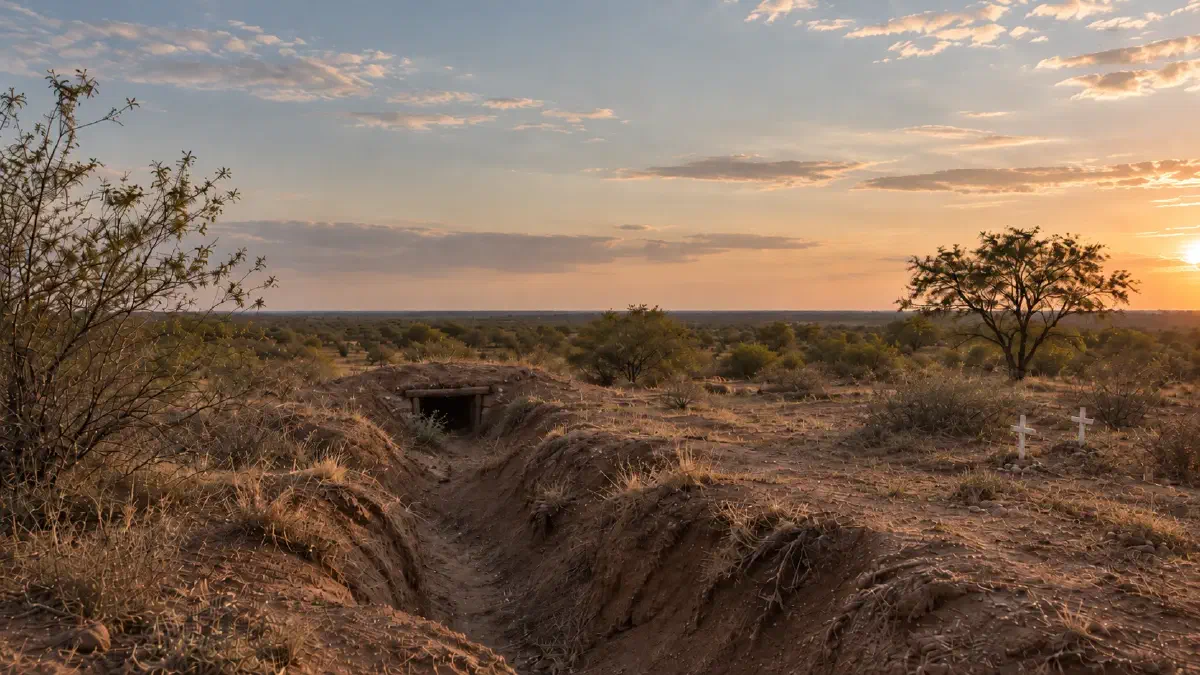
The grounds include visible traces of the former positions and trenches, along with the Paraguayan and Bolivian cemeteries. The historical museum displays photographs, maps, weapons, and other objects related to the Chaco War. The Lápida de la Amistad, a friendship plaque, is also on the grounds.
Together, these elements make Fortín Boquerón a place of remembrance today. It stands for the Paraguayan victory, but it also commemorates the people who fought and died on both sides of the war. The focus is therefore not only on military history, but also on remembering both sides.
🗓️ Quick guide: What you need to know for your plans#
- 🗹 Monday, September 28, 2026, is the public holiday. The historical anniversary remains Tuesday, September 29.
- 🗹 If you normally have the weekend off, this makes a long weekend.
- 🗹 Expect holiday schedules or closures at government offices, banks, and schools on Monday; check the opening hours of private businesses individually.
- 🗹 Plan a little earlier for longer trips, bus connections, or overnight stays that weekend.
❓ Frequently asked questions about the Batalla de Boquerón#
When is the Boquerón public holiday in Paraguay in 2026?
Are September 28 and 29 both public holidays in 2026?
When did the Batalla de Boquerón take place?
What is the Día del Soldado Paraguayo?
Did the Battle of Boquerón end the Chaco War?
Can you visit Fortín Boquerón?
Final thoughts#
Boquerón shows particularly clearly how closely history and remembrance are connected in Paraguay today. The battle gave September 29 a meaning that is still visible in the calendar, at official commemorations, and at the Fortín itself.
Understanding what lies behind this date also makes it easier to see why the Chaco War still holds a special place in Paraguay. At the same time, looking at both sides reminds us that the Victoria de Boquerón was not just a military success, but part of a war with severe consequences for Paraguay and Bolivia.
If you want to understand how the fighting in the Chaco War ended in 1935 and why June 12 is another important date of remembrance in Paraguay, read the article about the Paz del Chaco next.
Share and support
Did you already know why Boquerón matters and why the anniversary and public holiday fall on different dates? Then feel free to give the article a like and share it with others interested in South America who want to understand Paraguay and its history better.
All dates at a glance: Public holidays in Paraguay in 2026
More historical background: The history of Paraguay: From the Guaraní to today
Another historical day of remembrance: Heroes’ Day in Paraguay
Reply by Email