
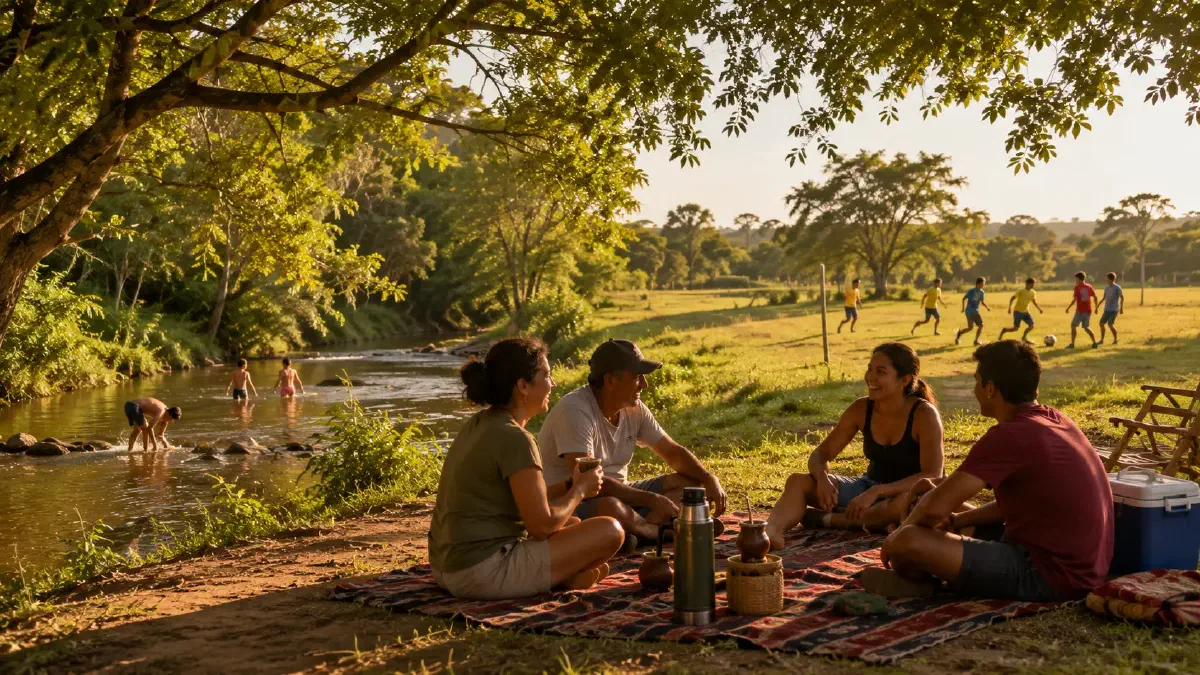
Free time in Paraguay often does not begin with a big outing plan. It can be sharing tereré in the shade, a soccer game on the cancha, a dance class after school, or a Sunday by the arroyo with family. Balnearios, fishing, markets, concerts, and a shared meal are also part of it.
Your options depend greatly on where you live. In Asunción and larger cities, the range of activities is wider and easier to find. In rural areas, local sports fields, dance schools, nature, clubs, and community events play a bigger role. Some activities are professionally advertised, but you often learn about them through WhatsApp, social media, or personal contacts.
This overview shows you which activities are part of everyday life in Paraguay, how cities and rural areas differ, and what to consider when planning.
📌 Things to Do in Paraguay at a Glance#
- Especially important in everyday life: family, friends, tereré, shared meals, and soccer
- Very visible in local culture: Danza Paraguaya, dance schools, music, and performances at celebrations
- Popular in summer: balnearios, swimming pools, arroyos, and other swimming spots
- Easier to find in larger cities: gyms, padel, running groups, movie theaters, and concerts
- Often more important in rural areas: local canchas, celebrations, fishing, cabalgatas, and nature destinations
What do Paraguayans do on weekends and in their free time?#
In Paraguay, free time is not always organized as a regular hobby. It is often closely connected to family, friends, and the neighborhood. People visit each other, sit together in the patio, the yard or outdoor area of a home, drink tereré, barbecue, or meet at the plaza, the town’s central square. Especially on Sundays and holidays, a shared lunch can take up a large part of the day.
That does not mean there are no clubs, classes, or modern activities. They are simply distributed very unevenly. What is easy to book in Greater Asunción is often organized through schools, private instructors, or personal contacts in smaller towns.
Searching also works differently than many people may be used to. Not every club has a well-maintained website. You can often find current activities through Facebook, Instagram, local WhatsApp groups, and by asking municipalities, schools, clubs, or people you know directly.
Spending time together: Tereré and Asado#
If you only look for activities you can book, you miss an important part of Paraguayan everyday life. Sitting together and talking is not a break between activities, it is often the activity itself.
A tereré gathering is rarely only about the drink. People sit together, exchange news and sometimes gossip, pass around the guampa, and often stay longer than planned.
Tereré is Paraguay’s national drink and part of everyday social life. Its cultural importance is also reflected in Día Nacional del Tereré, celebrated on the last Saturday in February.
With an asado, the preparation, conversations, and time spent together are just as important as the food. Whether it is the traditional Sunday barbecue in front of the house, in a park, or near a soccer field, families, young people, and neighbors often get together in the late afternoon and evening as the summer heat eases.
For newcomers, this is one of the easiest ways to make connections. You do not need perfect Spanish or a special hobby. Often, accepting an invitation, bringing something to share, or watching a local game is enough.
Sports in Paraguay: Which sports are especially popular?#
Soccer is the most visible sport in Paraguay. Futsal, Piki Vóley, volleyball, and dance are also part of everyday life in many places. In larger cities and regional centers, there are also gyms, running groups, martial arts, tennis, and padel. Which activities are available locally depends on where you live, the sports facilities, and local groups.
Playing soccer and following the games#
Soccer is played in clubs and soccer schools, but also in schoolyards, simple sports fields, and rented canchas. Small-sided versions such as Fútbol 5 are especially common. In rural areas, local leagues and tournaments are often not only sporting competitions but also meeting places for families, friends, and neighbors.
If you would like to play yourself, you will often find a group through neighbors, coworkers, schools, or a local cancha rather than through an official club website. Many groups are privately organized and arranged on short notice through WhatsApp.
You will also encounter soccer in Paraguay almost everywhere as a spectator. Games of La Albirroja, major clubs such as Olimpia and Cerro Porteño, or the local team are watched at home, in bars, and with neighbors.
Futsal, Piki Vóley, and other ball sports#
In addition to soccer, futsal, also called Fútbol de Salón, and volleyball play an important role in many places. They are easier to organize in schools, municipalities, and multipurpose courts than sports that require their own facilities or expensive equipment.
You will also often come across Piki Vóley in Paraguay. The ball is played over a net without using hands. This mix of soccer technique and volleyball is especially common on simple courts, in private groups, and at smaller tournaments.
Basketball, handball, and tennis are also available. How easily you can play them locally depends more on schools, clubs, and the facilities available.
Dance: from Danza Paraguaya to modern styles#
Dance is especially widespread among children and teenagers in Paraguay. Many start at an early age in a dance school or group and later perform at school events, patron saint festivals, cultural programs, or competitions. This means dance is not only an activity offered through classes, but is also visible at celebrations and in public life.
Danza Paraguaya, Paraguayan folk dance, has a special place. It is offered by dance schools, cultural groups, and sometimes municipalities. Depending on the location, classical ballet, contemporary and urban dance, Zumba, and partner dances such as salsa and bachata are also part of the program.
Dance schools and groups can be found not only in large cities but also in many smaller towns.
Fitness, running, and padel#
In larger cities and regional centers, you can find gyms, martial arts, cross-training, and private padel courts. There are also running and cycling groups, as well as organized road races and trail events. Based on our observations, running groups and local competitions are more visible in our area today than they were a few years ago. This is not a nationwide statistic, but an everyday observation.
In rural areas, these groups are often organized through WhatsApp or social media. It is worth asking at gyms, municipalities, and among people you know.
Outdoor Activities: Water, Exercise, and Outings#
Which activities are suitable at any given time depends greatly on the climate and weather in Paraguay. During the hot summer, balnearios, swimming pools, and shady places by the water are especially popular. The cooler months are often more pleasant for hiking and longer outings.
Balnearios, swimming pools, and swimming spots#
Balnearios are popular destinations, especially in summer. Some are simple swimming areas with shade and barbecue spaces, while others offer pools, slides, food service, restrooms, or accommodations.
Good to know: The name “balneario” says nothing about its facilities, water quality, or supervision. MADES lists water testing, safety measures, restrooms, and safe access among the requirements for approved facilities. Especially when traveling with children, a beautiful arroyo is not automatically a safe place to swim.
Public and private swimming pools are mainly found in larger cities and regional centers. They are often part of sports clubs, swim schools, hotels, cooperatives, or municipal facilities. Traditional indoor public pools, like those found in many cities in Europe, are less common. Many pools are outdoors and can be used through classes, memberships, or day passes.
Fishing, horseback riding, and cabalgatas#
Fishing is common at rivers, lakes, and private fishing ponds. For beginners, Pesque y Pague facilities are often uncomplicated because access and rules are explained on site. At natural bodies of water, however, there are rules on fishing methods, minimum sizes, and the annual veda pesquera, a temporary fishing ban.
Horseback riding is mainly arranged through estancias, private groups, and personal contacts. Cabalgatas, organized group horseback rides, are often easier to find. They take place as separate events or as part of patron saint festivals, expos, and regional celebrations.
Hiking, cycling, camping, and nature watching#
First, it is important to know that marked and maintained hiking trails are not a given outside well-known nature destinations. An outing can therefore be more adventurous than expected.
Depending on where you live, you may find nature and excursion destinations in Paraguay nearby, which can be combined with bird and plant watching or nature photography.
For a day trip or weekend outing, options include Cerro Tres Kandú in Guairá, waterfalls along the Ruta de los Saltos, or the Chaco’s salt lagoons during the cooler months. The Jesuit Missions in Itapúa can also be combined well with a stay in Encarnación.
Based on our experience, cycling has also become more popular in our area over recent years. Quiet side roads are usually more pleasant for rides than heavily traveled main roads. Heat, dust, heavy traffic, missing shoulders, and unpaved roads can make a trip more difficult.
Camping is possible at some nature destinations, private facilities, and sometimes at posadas or estancias. Facilities range from simple tent areas to cabins and permanent accommodations.
Eating out and spending the evening#
Sharing a meal is part of how people spend their free time. In the evening, lomiterías, pizzerias, ice cream shops, and simple restaurants with outdoor tables become popular meeting places.
The options differ greatly between cities and rural areas. Asunción and its surroundings, as well as Ciudad del Este and Encarnación, offer more restaurants, bars, cafés, movie theaters, and nightlife options. Smaller towns usually have only a few places to eat, and things are especially busy on weekends or special occasions.
Events and cultural activities#
Popular celebrations such as San Juan festivities, expos, markets, dance performances, competitions, and regional festivals shape everyday activities in Paraguay throughout the year. Music, food, crafts, sports, and socializing often come together at these events.
Religious and cultural dates are also part of family life and free time. During Semana Santa in Paraguay, many people travel to visit relatives, while processions, performances, and other activities take place in different towns. Around December 8, the pilgrimage to Caacupé attracts many visitors. Traffic and events in the area are often affected in the days before.
One of the best-known major events is Expo Paraguay in Mariano Roque Alonso. There are also many local celebrations, markets, and performances.
How easy it is to find current events depends on where you live. Larger cities usually have more concerts, theater performances, museums, and cultural programs. In rural areas, schools, municipalities, churches, and local organizers often share upcoming dates.
At local celebrations, the announced start time is not always when the main program begins. If you are traveling for a particular performance, ask about the detailed schedule beforehand.
🧭 Which activity fits your day?#
| If you … | Then you could try … | Check beforehand |
|---|---|---|
| only have a few hours | a park, café, local game, swimming pool, or a short tereré gathering | opening hours, heat |
| are out with children | a park, playground, swimming pool, balneario, movie theater, market, or expo | shade, restrooms, safety |
| want to be active | soccer, dance class, gym, running group, or padel | class times, registration, costs |
| are looking for nature | an arroyo, hiking trail, fishing pond, or viewpoint | access, weather, trail conditions |
| want to get to know Paraguay better | a local celebration, market, soccer game, dance performance, or outing | program, start time, return trip |
| have a full day free | a balneario, cabalgata, nature destination, or trip to a nearby town | travel time, road access, food |
✅ Practical Tips for Activities and Outings#
Ask in advance#
Many businesses, sports groups, and organizers announce changes on Facebook, Instagram, or WhatsApp rather than on a regularly maintained website. Municipalities and neighbors are also often good sources of information about activities and events. Before you go, check opening hours, prices, class times, reservations, and the current daily schedule.
Check access and facilities#
For nature destinations, balnearios, and outings, these questions are especially important:
- Is the destination open and publicly accessible?
- What is the access road like after rain?
- Are there parking spaces, shade, and restrooms?
- Can you bring your own food or barbecue there?
- Is swimming allowed, and is there a designated swimming area?
- Is there cell phone coverage or someone to contact on site?
Plan for travel time and cash#
Distances often look shorter on a map than they are in reality. Road conditions, passing through towns, and construction can make a trip take longer. If you do not know a destination, it is sensible to visit for the first time during daylight.
Card payments are widely accepted in cities. For smaller events, rural destinations, parking areas, and vendor stands, you should also bring cash and small bills.
Keep school breaks and holidays in mind#
During long weekends, school vacations, and major holidays in Paraguay, popular destinations are often crowded or fully booked early. At the same time, there are often additional programs for families.
🗣️ Useful activity vocabulary in Paraguay#
| Term | Meaning |
|---|---|
| cancha | sports field, often a soccer or multipurpose field |
| balneario | swimming and recreation area with widely varying facilities |
| arroyo | creek or small stream |
| plaza | central public square, often with green areas and seating |
| cabalgata | organized group horseback ride |
| veda pesquera | temporary fishing ban |
| seña | deposit or reservation fee |
| patio | yard or outdoor area of a home |
❓ Frequently asked questions about activities in Paraguay#
Is dancing popular in Paraguay?
What is a balneario in Paraguay?
What activities are available outside Asunción?
What can you do with children in Paraguay?
Where can you find current activities in Paraguay?
Can you hike or fish in Paraguay?
Conclusion#
Things to do in Paraguay are not limited to well-known attractions and major events. Often, it is the local cancha, a dance school, the nearest balneario, a local celebration, or an invitation for tereré that shapes a free afternoon or weekend.
Anyone who lives in Paraguay for a while quickly notices that soccer and dance are part of everyday life in many families and communities.
In Asunción and larger cities, it is easier to find padel courts, movie theaters, concerts, and organized classes. In rural areas, activities are often closer to local life: at the cancha, by an arroyo, on a cabalgata, or at a community event. When you get to know Paraguay this way, you quickly notice that free time here is often much more closely connected to everyday and social life than you might expect.
Soccer is a particularly good example: it shows how closely free time, community, and everyday life are connected in Paraguay. If you want to get to know this side of the country better, read on about soccer in Paraguay.
Then share this overview with friends, acquaintances, or in your Paraguay group. A like lets us know that practical overviews like this are helpful to you.