
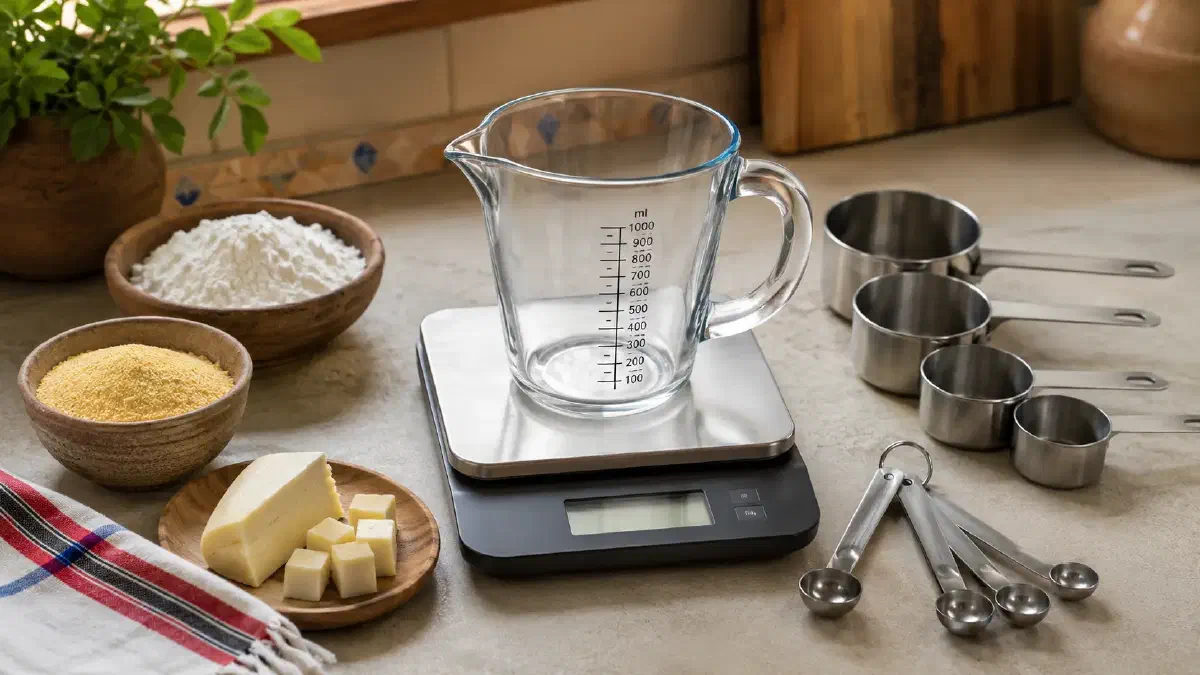
At Paraguay4Life, our recipes primarily use grams, milliliters, and degrees Celsius. These metric measurements are precise and commonly used in Paraguay and many other countries.
This guide provides practical conversion tables and reliable reference tools for readers who normally cook with US measurements.
Celsius to Fahrenheit for cooking#
Temperatures can be converted reliably. In our English recipes, the Fahrenheit temperature therefore appears directly after the original Celsius measurement:
180°C (350°F)Here are some common oven temperature conversions:
| Celsius | Fahrenheit |
|---|---|
| 150°C | 300°F |
| 160°C | 320°F |
| 170°C | 340°F |
| 180°C | 350°F |
| 190°C | 375°F |
| 200°C | 400°F |
| 220°C | 425°F |
The Fahrenheit values are rounded to commonly used oven settings. Since ovens can heat differently, check the dish a little earlier the first time you prepare a recipe.
Milliliters, teaspoons, tablespoons, and US cups#
Milliliters can be converted into common US volume measurements such as teaspoons, tablespoons, fluid ounces, and cups.
| Metric measurement | Approximate US measurement |
|---|---|
| 5 ml | 1 tsp |
| 10 ml | 2 tsp |
| 15 ml | 1 tbsp |
| 30 ml | 2 tbsp or about 1 fl oz |
| 50 ml | about 1.7 fl oz |
| 60 ml | 1/4 cup |
| 80 ml | about 1/3 cup |
| 100 ml | about 3.4 fl oz |
| 120 ml | 1/2 cup |
| 125 ml | about 1/2 cup |
| 150 ml | about 5 fl oz |
| 180 ml | 3/4 cup |
| 200 ml | about 6.8 fl oz |
| 240 ml | 1 cup |
| 250 ml | about 1 cup |
| 480 ml | 2 cups |
| 500 ml | about 2 cups |
| 1 liter | about 4 1/4 cups |
The abbreviations mean:
- tsp: teaspoon
- tbsp: tablespoon
- fl oz: fluid ounce
- cup: US measuring cup
One US cup is approximately 240 ml. Common metric quantities such as 250 ml and 500 ml are therefore slightly more than one or two US cups. The original metric quantity in the recipe remains the more precise measurement.
Grams, ounces, and pounds#
Grams and kilograms measure the weight of an ingredient. They can be converted to ounces or pounds regardless of the type of ingredient.
| Metric measurement | Approximate US measurement |
|---|---|
| 28 g | 1 oz |
| 50 g | 1.8 oz |
| 100 g | 3.5 oz |
| 150 g | 5.3 oz |
| 200 g | 7.1 oz |
| 250 g | 8.8 oz |
| 300 g | 10.6 oz |
| 500 g | 17.6 oz or 1.1 lb |
| 750 g | 1.65 lb |
| 1 kg | 2.2 lb |
oz is an ounce by weight. fl oz is a fluid ounce and measures volume. The two units are not interchangeable.
Why we do not automatically convert grams to cups#
Grams measure the weight of an ingredient, while cups measure its volume. A reliable conversion therefore depends on the specific ingredient being measured.
One cup of cassava starch does not weigh the same as one cup of sugar, cornmeal, shredded cheese, or cooked cassava. Moisture, texture, processing, and the way an ingredient is placed in the cup can also change the result.
For that reason, a general conversion such as “100 grams equals half a cup” would not be reliable.
Our tip: Use a digital kitchen scale for flour, starch, and other dry ingredients whenever possible. It is usually easier and more accurate than converting the quantities to cups.
Which measurements should you use in our recipes?#
The metric measurements are the original and most precise quantities in our recipes. Use them whenever you have a kitchen scale or a measuring cup marked in milliliters.
Fahrenheit is provided alongside Celsius for relevant cooking and oven temperatures. The conversion tables on this page offer practical guidance for liquids and weights, but rounded values may differ slightly from the original metric quantities.
When accuracy affects the texture of a dough or batter, follow the metric measurement.
Ready to start cooking? Explore our Paraguayan recipes.
External cooking measurement references#
The following independent third-party references may help with additional conversions. Paraguay4Life is not affiliated with either provider.
NIST Metric Kitchen#
The National Institute of Standards and Technology provides an official reference for milliliters, teaspoons, tablespoons, cups, fluid ounces, and other common kitchen measurements.
NIST Cooking Measurement Equivalencies ↗
Ingredient-specific conversion chart#
The King Arthur Ingredient Weight Chart provides cup, ounce, and gram measurements for many individual ingredients.
King Arthur Ingredient Weight Chart ↗
For regional ingredients, check that the listed ingredient and preparation are comparable. Cassava starch, cooked cassava, cornmeal, and Paraguayan cheese can vary in moisture, texture, and processing.
Frequently Asked Questions#
How many milliliters are in one US cup?
One US measuring cup is approximately 240 ml. A metric quantity of 250 ml is therefore slightly more than one US cup.
This small difference usually has little effect in soups, sauces, or drinks. For baking and other recipes that require precision, follow the original milliliter measurement.
Can I convert grams directly to cups?
Not without knowing the ingredient. Grams measure weight, while cups measure volume. The number of grams in one cup varies considerably between ingredients.
A cup of sugar, flour, cassava starch, shredded cheese, and cooked cassava will each have a different weight. Use an ingredient-specific conversion chart or, preferably, a kitchen scale.
Do I need a kitchen scale for Paraguayan recipes?
A kitchen scale is not required for every recipe. Eggs, onions, teaspoons, and tablespoons can be measured without one.
A digital scale is especially helpful for cassava starch, cornmeal, flour, cheese, and other ingredients where accurate quantities affect the texture of the dish.
Are US cups the same as metric cups?
Not exactly. A US customary cup contains approximately 236.6 ml and is commonly rounded to 240 ml for cooking. A metric cup contains 250 ml.
The difference often has little effect in everyday cooking, but it can matter in baking and dough-based recipes. Use the original metric measurement when accuracy is important.