When Paraguay plays, the rhythm of the country changes. After a late match, the next morning often starts more slowly: People continue discussing the game on the radio, and the result is the main topic at the supermarket. Soccer in Paraguay is everywhere.
But soccer is much more than a sport watched on television. It is part of daily life and a popular activity that brings people together and starts conversations. This sense of unity is especially clear when La Albirroja plays.
Whether over Tereré or on the Cancha, understanding the meaning of soccer helps you connect more easily. This article explains La Albirroja, major clubs and local structures. You will also learn how soccer shapes life in Paraguay and helps you meet people.
- Soccer is part of daily life and leisure in Paraguay and quickly brings people into conversation.
- The Paraguayan national soccer team is known as La Albirroja.
- Along with the major clubs, local teams and the UFI play an important role in the Interior.
- At the 2026 World Cup, Paraguay reached the Round of 16 after defeating Germany and was then eliminated by France.
Why Is Soccer So Popular in Paraguay?#
Soccer is a topic almost everyone can talk about. Even people who rarely watch matches usually know when La Albirroja is playing or which club everyone is discussing. The sport brings families, neighbors and entire communities together.
With the Paraguayan national team, it is about more than results. It is about pride and the feeling that: “We may be a small country, but we do not back down.” One expression that captures this perfectly is garra guaraní.
The expression describes fighting spirit and the will not to give up, even against stronger opponents. It stands for strength, heart and determination and is closely linked to both La Albirroja and Paraguayan identity.
The history of Paraguay also helps explain why garra guaraní has such a strong meaning in the country.
What Does “La Albirroja” Mean, and Why Is Paraguay’s National Team Called That?#
La Albirroja is the nickname of the Paraguayan national team, the Selección Paraguaya de Fútbol. The name means “the red-and-white team” and refers to its traditional jersey colors.
During matches, however, all three national colors are often visible: red, white and blue. Flags, jerseys and car stickers appear everywhere, and the country seems to glow in these colors.
You may also hear the name Los Guaraníes, which puts more focus on cultural identity. This fits daily life in Paraguay, where Spanish and Guaraní often exist side by side and are naturally mixed as Jopara.
In Guaraní, soccer or a ball can be called vakapipopo. In daily conversation, however, most people simply say fútbol.
🪅 La Albirroja at the 2026 World Cup: A Return to the Round of 16#
After 16 years without a World Cup appearance, Paraguay returned to the world stage in 2026. Under coach Gustavo Alfaro, La Albirroja qualified in September 2025. The celebration was so great that the government declared September 5 a national holiday.
The first group match on June 12 also fell on a special date. While Paraguay played the United States, the country also observed Día de la Paz del Chaco, the day that marks the end of the Chaco War.
Group D: United States, Paraguay, Turkey and Australia
- June 12, 2026: United States vs. Paraguay – 4–1
- June 19/20, 2026: Turkey vs. Paraguay – 0–1
- June 25/26, 2026: Australia vs. Paraguay – 0–0
Record: 1 win, 1 draw and 1 loss – 4 points and 3rd place.
Paraguay advanced as one of the best third-place teams and faced Germany. After a 1–1 draw following extra time, La Albirroja won 4–3 on penalties. Reaching the Round of 16 was so important that the government briefly declared June 30 a national holiday.
For the first time since 2010, Paraguay was among the final 16 teams. The journey ended on July 4 with a 1–0 loss to France.
Paraguay will be one of six host countries in 2030 and will stage one of the three centenary matches in South America. The other two will take place in Argentina and Uruguay, while most of the tournament will be held in Spain, Portugal and Morocco. All six host countries qualify automatically.
⚽ How Is Soccer Organized in Paraguay?#
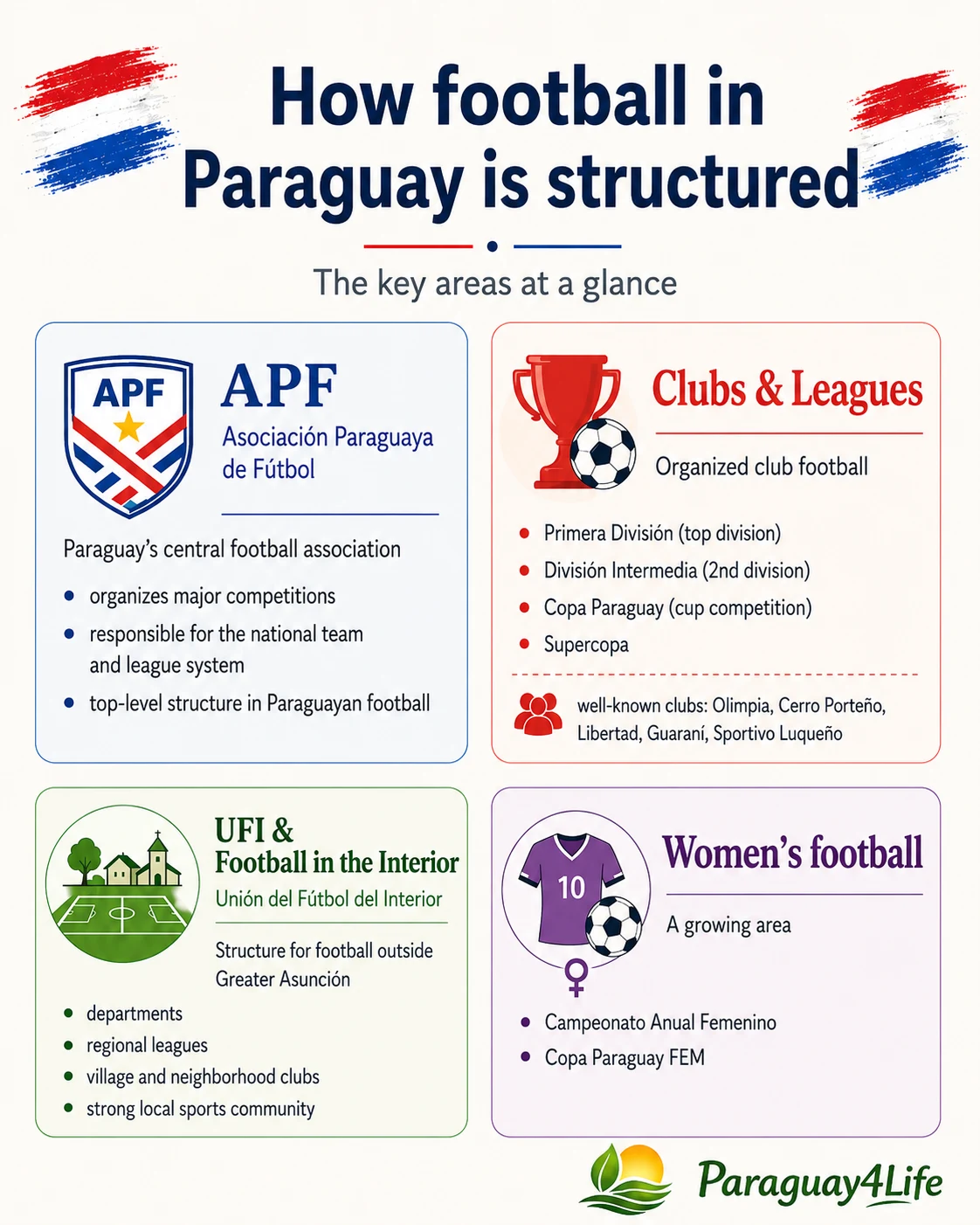
Organized soccer is overseen by the Asociación Paraguaya de Fútbol (APF). It manages competitions including the Primera División (the top division), the División Intermedia (the second division), the Copa Paraguay (the national cup), the Super Cup and women’s soccer.
The best-known clubs include Olimpia, Cerro Porteño, Libertad, Guaraní and Sportivo Luqueño. Many major clubs are based in Asunción and the surrounding area.
The season usually consists of two separate championships: the Torneo Apertura during the first half of the year and the Torneo Clausura during the second half.
The Clásico paraguayo between Olimpia and Cerro Porteño is especially famous. When La Albirroja plays, however, club rivalries usually pause and the national team takes center stage.
Soccer in the Interior: The Importance of the UFI#
In the Interior, the Unión del Fútbol del Interior (UFI) plays an important role. It is connected to the APF and oversees regional leagues and local clubs outside the greater Asunción area.
Soccer in the Interior is often a social and community event. People support their local club or their own team (Equipo), help maintain the field or organize small Asaditos to raise money for travel or jerseys.
At clubs and league events, you may also see Madrinas or Reinas: women who represent the club at festivals and special competitions. In many places, this is also part of club culture.
Women’s Soccer in Paraguay#
Women’s soccer is also growing through competitions such as the Campeonato Anual Femenino and the Copa Paraguay FEM. There are also more opportunities for girls and youth teams.
Even so, women’s soccer is still less visible than men’s soccer in daily life and the media.
🧩 How Does Soccer Appear in Daily Life?#
Soccer is not limited to stadiums. It is both a hobby and a meeting point.
Playing Soccer in Paraguay#
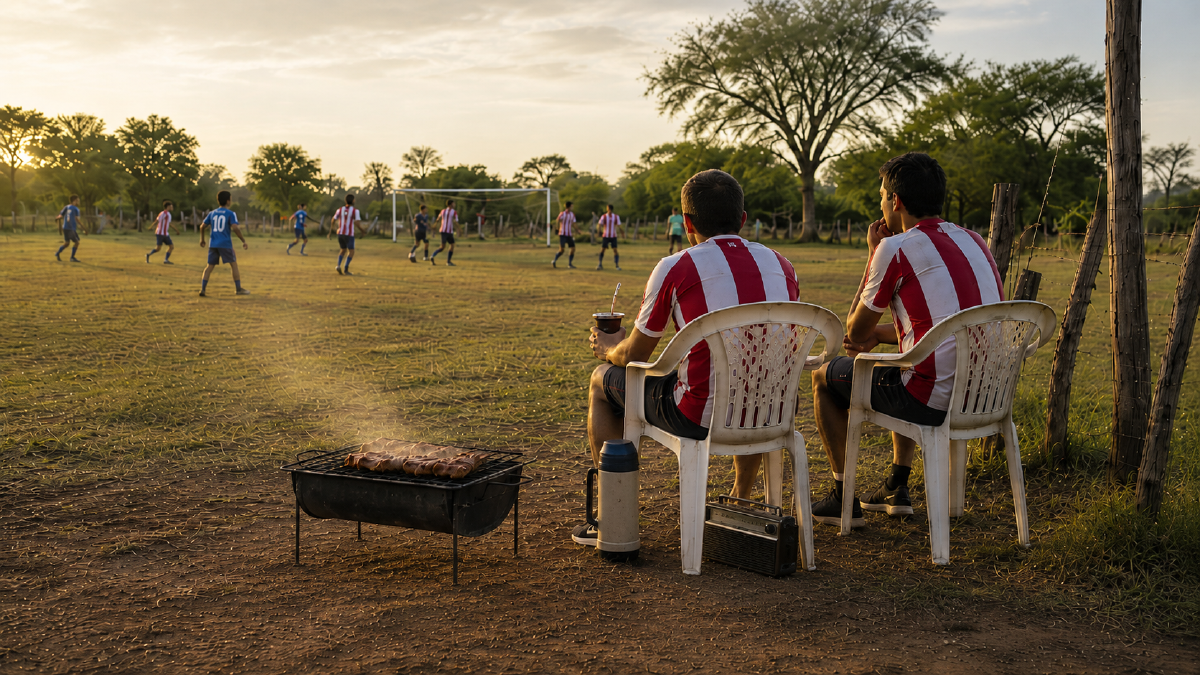
Children play in the street, teenagers meet after school, and adults gather for their weekly game on the Cancha. Fútbol 5 and other small-sided formats are especially popular.
Competition is not the only thing that matters. The match is often followed by the Tercer Tiempo, the “third half.” People share Tereré, have a beer or eat together afterward.
Along with these relaxed and mostly private games, there are organized competitions in local leagues and through the UFI, ranging from friendly and school tournaments to larger championships.
Watching a Match Spontaneously#
People who do not play often watch instead. Large public broadcasts are most common in Asunción and during special matches. Most people, however, watch in smaller groups: at a bar, in someone’s yard or even in front of a television at the supermarket.
When Paraguay plays late, do not schedule the next morning too tightly. After important matches, many people start the day more slowly.
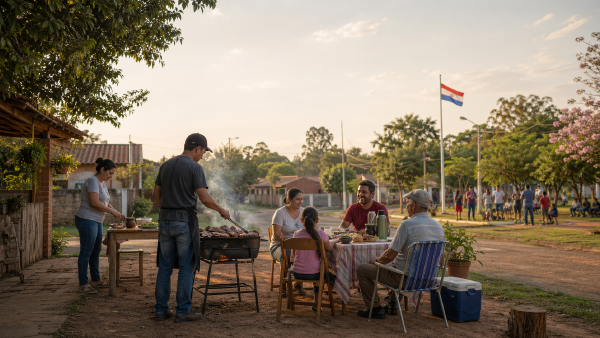
Community: Neighbors or friends often gather spontaneously for evening matches. One person provides the television, while someone else brings Tortillas paraguayas, empanadas or peanuts. Larger gatherings may also include an Asado, for example with Chipa Guasu. Tereré or beer is usually close at hand.
Atmosphere: People cheer, discuss the match and eat together. You may hear the neighbors celebrating before you see the goal on your own television. The next morning, even a conversation at the checkout may begin with the question: “¿Viste el partido?”
Radio and Jerseys#
Despite smartphone streams, traditional radio is still common during farm work or in workshops. Jerseys from Olimpia or Cerro Porteño are also part of the street scene. On match days, they show clear support and provide an easy conversation starter.
💡 Expats and Visitors: Why Soccer Opens Doors#
You do not have to be a major soccer fan (Hincha) or play yourself to use the sport as a way into social life in Paraguay.
An icebreaker: You do not need perfect Spanish. A simple question such as “¿Cómo salió el partido?” is often enough to start a conversation. → Here are more useful phrases for match day.
Understanding the local mindset: Soccer shows part of Paraguay’s resiliencia (resilience). After a loss, people first discuss and complain about the match, but soon they begin looking ahead to the next one. Seeing this can teach you a lot about pride, disappointment and unity.
Leaving the expat bubble: Watching or playing soccer puts you in the middle of local life and can help you go from being “the foreigner” to being “the neighbor.”
To play soccer yourself in Paraguay, ask your neighbors or the local Municipalidad about the town team.
- Practicing Spanish: The short and often repeated phrases are ideal for using Spanish in daily life and learning the local way of speaking.
🗣️ Useful Soccer Phrases for Daily Life#
Here are a few simple phrases for the next match day:
Questions to Start a Conversation#
- “¿Cómo salió el partido?” – How did the match end?
- “¿A qué hora juega Paraguay?” – What time does Paraguay play?
- “¿Hay partido este fin de semana?” – Is there a match this weekend?
Phrases for the Atmosphere#
- “¡Dale, dale!” – Come on! / Let’s go!
- “¡Qué partido!” – What a match!
- “¡Vamos, Albirroja!” – Let’s go, Albirroja!
📺 TV Guide: Where Can You Watch Soccer in Paraguay?#
Whether it is a league match, the Clásico paraguayo or an appearance by La Albirroja, people who cannot attend the stadium can almost always follow the game on television, through an app, on the radio or with others at a bar. The broadcaster depends on the competition and current media rights.
Paraguayan Club Soccer#
For the Primera División and many other APF competitions, Tigo Sports is one of the main broadcasters. Depending on the agreement, matches are available on cable television or through an app.
You can usually find the current broadcaster in the APF schedule, through Tigo Sports or from the club involved.
La Albirroja Matches#
Broadcasters may change for international matches. The APF usually names the channel in its match announcement. Some recent matches were shown through Tigo Sports and APF TV.
Radio and Watching Together#
Radio remains a useful alternative when traveling, in rural areas or where the internet connection is weak. Without the right subscription, you can often still find the match at a bar, with friends or at a neighbor’s home.
Outside Paraguay#
Outside Paraguay, broadcast rights vary by country and competition. Before the match, check the official channels of the APF, the competition and local broadcasters.
Broadcast rights and platforms may change. Research last updated: July 21, 2026.
❓ Frequently Asked Questions About Soccer in Paraguay#
Why Is Paraguay’s National Team Called La Albirroja?
How Far Did Paraguay Go at the 2026 World Cup?
Which Soccer Clubs in Paraguay Are the Best Known?
What Is the UFI in Paraguayan Soccer?
Can You Play Soccer in Paraguay?
Where Can You Watch La Albirroja and Paraguayan League Matches?
Where Can You Buy Tickets for Soccer Matches in Paraguay?
Conclusion#
Soccer in Paraguay is sport, leisure and community. You find it on local fields and in major stadiums, on the radio and in daily life, especially when La Albirroja plays.
Understanding what soccer means to people also helps you understand Paraguay. The sport starts conversations, creates connections and reveals much about the Paraguayan way of life.
The 2026 World Cup showed this once again: The victory over Germany and the Round of 16 appearance are now part of the country’s recent soccer history. But the sport’s power to bring people together can be seen every week, far from the world stage.
Share & Support
Did this article help you understand soccer as part of daily life in Paraguay? Give it a like and share it with someone who may also find these insights useful.
📖 Related Articles#
- Tereré: Why This Drink Matters in Daily Life
- History of Paraguay: From the Guaraní to Today
- Overview of Paraguay’s Public and Cultural Holidays