
The smell of cheese melting in the pan, mixed with the aroma of roasted cassava starch, is the taste of Paraguay for me. Mbejú is one of those Paraguayan dishes that shows very clearly why simple ingredients are so important in the local kitchen. A little cassava starch, cheese, fat and milk are enough to make something that feels warm, easy and comforting. This specialty tastes best straight from the pan, when the cheese is still soft and the edges are crispy.
Mbejú, also written as Mbeju, Mbeyú or Mbejú de almidón in everyday life, looks simple at first. But it is surprisingly flexible. It fits almost any time of day: in the morning with coffee or a traditional Cocido, in the evening as a quick main meal, as a side dish with hearty stews or in small pieces as finger food for guests.
The traditional Mbejú recipe is simple, but it needs a little feeling. The secret? The dough is not kneaded. It is mixed into crumbs and then gently pressed together in the hot pan. This gives Mbejú its typical light texture. If you want to make Mbejú yourself, I will show you step by step how this classic cheese cassava flatbread works, what to watch out for with the texture and which versions are most popular in our home.
📝 Easy Mbejú Recipe from Paraguay - Step by Step#
At a glance
- Difficulty: easy to medium
- Preparation time: about 30 minutes
- Servings: 4 large Mbejú or 6 smaller flatbreads
- Typical for: Paraguayan breakfast, quick dinner, side dish
🛒 Ingredients you need#
You probably already have most of the ingredients at home. The following overview shows what you really need for the basic recipe and what you can add if you like.
Main ingredients#
For about 4 large Mbejú, you need:
- 500 g cassava starch
In Paraguay, it is usually sold as almidón de mandioca, sometimes also as fécula de mandioca.
- 250 g Queso Paraguay or another mild, slightly salty cheese
- 100 g butter, pork fat or margarine
- 150 to 200 ml milk or water, as needed
- 1 level teaspoon salt
Make sure you use real cassava starch and not coarse cassava flour. The difference between cassava flour and cassava starch is important: the fine starch creates the typical binding and texture, while coarse cassava flour would make the Mbejú dry and crumbly.
Optional ingredients#
- a little grated hard cheese for more flavor
- pepper or dried herbs for aroma
Which ingredients can you replace?#
Flexible alternatives for availability or diet
Naturally gluten-free: As a gluten-free recipe from Paraguay, Mbejú is made without wheat flour in the basic version. Just make sure that the cassava starch you use was processed gluten-free.
Replacing cassava starch:
- If you cannot find almidón or fécula de mandioca, tapioca starch, pure starch from the cassava root, is usually the best substitute.
Replacing Queso Paraguay:
- Mild feta, white cheese or young farmer’s cheese work well.
- Mozzarella makes the inside of the Mbejú softer and more elastic.
- A mix of mozzarella and a little feta comes closest to the original Paraguayan taste.
Replacing the fat:
- Butter gives a round, fine flavor.
- Pork lard tastes more traditional and adds a hearty note.
- Margarine works as a plant-based option, but tastes more neutral.
Replacing milk:
- Water is enough if you want to make the recipe simpler or lactose-free.
- Milk makes the flatbread a little richer and softer.
Kitchen tools you need#
- large bowl
- non-stick pan or well-seasoned iron pan
- spatula
- kitchen scale or measuring cup
👩🍳 Step-by-step preparation#
Preparation#
- Let the butter soften in time or melt it gently over low heat.
- Crumble the cheese roughly with your hands or grate it.
- Measure the milk or water and keep it ready.
Cooking process#
- Put the cassava starch and salt into a bowl and mix them briefly.
- Add the soft butter or lard in small pieces. Rub the fat into the starch with your fingertips until you get a fine, slightly sandy texture.
- Add the crumbled cheese and mix it in evenly.
- Now add the liquid little by little. Important: The mixture must not become smooth or elastic. It should stay moist and crumbly. If you press a handful together firmly, it should hold its shape, but fall apart again with light pressure.
- Heat the pan over medium heat. It should be hot, but not smoking. You usually do not need extra fat for the pan because the mixture already contains enough fat.
- Add a generous portion of the crumbly mixture to the pan and spread it evenly into a round shape. Press it down gently with the back of a spoon or a spatula.
- Cook the Mbejú for about 3 to 5 minutes on each side, until the edge becomes lightly golden and the flatbread holds together.
- Turn the flatbread carefully. If you are unsure, place a flat plate on the pan, turn it over with one quick movement and slide the Mbejú back into the pan.
- Serve the dish hot, straight from the pan, while the cheese is still soft.
💡 Practical tips for Mbejú#
How to make the flatbread work well
Use the liquid carefully: Too much liquid makes the mixture heavy and sticky. Too little liquid makes the Mbejú crumble in the pan. The goal is a moist crumb mixture, not a smooth dough ball.
Keep the heat medium: If the heat is too high, the outside burns while the starch inside stays dry or crumbly.
Press gently: Press the mixture lightly in the pan at the beginning, but not so hard that the flatbread becomes compact and hard like a stone.
Small size for guests: It is easier to cook smaller Mbejú rounds. They are much easier to turn and work very well as small bites.
Nutrition overview#
The values refer to 1 smaller Mbejú when the basic recipe makes 6 portions.
- Calories: about 530 to 590 kcal
- Protein: about 9 to 12 g
- Carbohydrates: about 70 to 80 g
- Fat: about 18 to 24 g
- Fiber: about 1 to 2 g
The nutrition values are average values and can vary depending on the ingredients, amount of cheese, fat and portion size.
🍽️ What goes well with Mbejú?#
To make your meal feel complete, here are a few ideas for side dishes and drinks that go well with it.
- Classic: Mbejú plain, with a fried egg or scrambled eggs.
- Hearty: with ham, cheese or fried vegetables.
- Paraguayan: with soups, stews or rustic dishes.
- Fresh: with tomato salad, coleslaw or avocado cream.
- Authentic: Hot traditional Cocido or strong coffee go perfectly with it.
- Refreshing: On warm days, ice-cold Tereré is an ideal drink with it.
- Mild: A light herbal tea or a glass of milk, especially if children are eating too.
🔄 Recipe variations#
Mbejú is easy to change. Some versions are well known in Paraguay, others are good for guests or modern cooking.
Well-known variations#
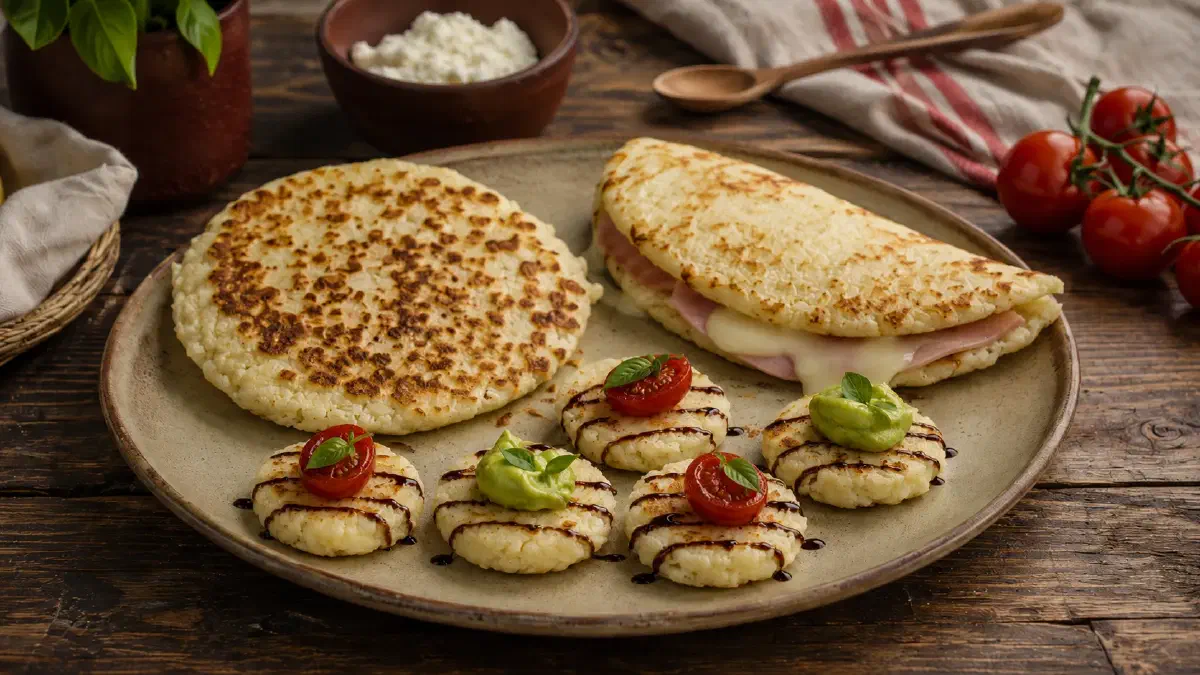
Mbejú relleno with ham and cheese: First add a thin layer of Mbejú mixture to the pan, then cheese and ham, then another thin layer of mixture. Cook it as usual and turn it carefully. This version is richer, very filling and works especially well as a warm dinner.
Comfort food: When a cold south wind blows on a cool winter morning and the fire is burning inside, this version is popular here in Paraguay as a typical winter dish. Add a hot Cocido, and the morning already feels a little warmer.
Mbejú mestizo: In this version, a little cornmeal is added to the mixture. This makes the flavor more rustic and the texture a bit heartier. Start with only 1 to 2 tablespoons of cornmeal so the Mbejú does not become too dry.
Mbejú cuatro quesos: A version with several types of cheese. It tastes more intense and becomes softer inside. A mix of mild cheese such as Gouda, mozzarella, a little stronger hard cheese such as Parmesan and a small amount of blue cheese, for example Gorgonzola, works well.
Mbejú with anise: A little anise gives the flatbread a special aroma that is also known from other traditional Paraguayan recipes. Not everyone likes it, but if you enjoy anise, it adds a warm and pleasant note.
Modern variations#
Mbejú bites Caprese style: Bake small Mbejú rounds and top them while still warm with half a cherry tomato, a little balsamic reduction and fresh basil. Alternatively, you can place tomato and basil between two thin layers of Mbejú mixture and make a filled vegetarian Mbejú. This is not classically Paraguayan, but it looks beautiful and works well as an elegant starter for special days like a Valentine’s Day menu.
Mbejú with avocado cream: A small spoonful of avocado cream with lime and salt makes Mbejú fresher. Small, not too thick Mbejú rounds work well as a summer dish on warm days and also as finger food for a buffet or for guests.
Mbejú with honey or fruit: A sweet modern variation: served warm with a little honey, banana or fresh fruit, Mbejú becomes an unusual breakfast or a small dessert.
🇵🇾 Background information about the recipe#
What makes Mbejú special?#
Mbejú is neither a classic pancake nor bread. The secret is its structure: the crumbly mixture only comes together through the heat and the melting cheese in the pan. A fine crust forms on the outside, while the center stays soft.
The starch from the cassava root is the key. It binds differently from wheat flour and gives the flatbread its typical structure.
From my everyday experience here: moisture is the key to success. If the mixture keeps its shape for a short moment when you press it together in your hand, the ratio is usually just right.
What role does Mbejú play in Paraguay?#
In Paraguay, Mbejú is a fixed part of the kitchen and culture. You can find it in a cozy café in the city as well as in a simple kitchen in the countryside. Because it is made without an oven, the dish is quick, affordable and flexible.
This fits an everyday kitchen where cassava and products made from it, such as flour or starch, are among the most important basic foods in daily life. Mbejú is served on special occasions or as a traditional comida típica at the San Juan festival, but it tastes just as good on a normal weekday.
Mbejú is also specifically named in Resolution No. 370/2026 as one of the culinary expressions of the Fiesta de San Juan – San Juan Ára, which has been recognized as national intangible cultural heritage since 2026.
Which ingredients shape Mbejú?#
Cassava starch and Queso Paraguay in Paraguayan cooking#
Cassava, called mandioca in Paraguay and also yuca in other Spanish-speaking countries in Latin America, is one of the most important basic ingredients in daily life. If you live in Paraguay or visit the country, you will hardly find a meal where it does not appear in some form. In most cases, the root is served boiled as a side dish. But there are also many cassava recipes where the root itself or the starch made from it is used, for example Mandi’o Chyryry, Pastel Mandi’o or Chipa.
Queso Paraguay is a traditional cheese made from cow’s milk. It is mild, slightly salty and not as firm as many European hard cheeses. It gives the dish flavor, moisture and binding.
❓ Frequently asked questions#
Why does my Mbejú fall apart in the pan?
Which pan is best for Mbejú?
Can I prepare the dough in advance?
Can I make Mbejú with tapioca starch instead of cassava starch?
How do I store leftovers and make them fresh again?
What is the difference between Mbejú and Chipa?
Conclusion#
Mbejú shows beautifully how much flavor can come from only a handful of simple basic ingredients. The dish is easy, wonderfully flexible and brings a real piece of South American joy to the table.
Have fun cooking and buen provecho!
Mbejú already shows how versatile cassava can be. If you’d like to try it in a completely different and much heartier form, Pajagua Mascada with beef is a great option. You’ll find more Paraguayan recipes with cassava in our cassava recipe collection.
Share & support
Did this traditional Mbejú recipe inspire you and make you more curious about Paraguay? Then feel free to give this post a like and share it with other South America fans, helping to make Paraguay’s culinary diversity more visible.