
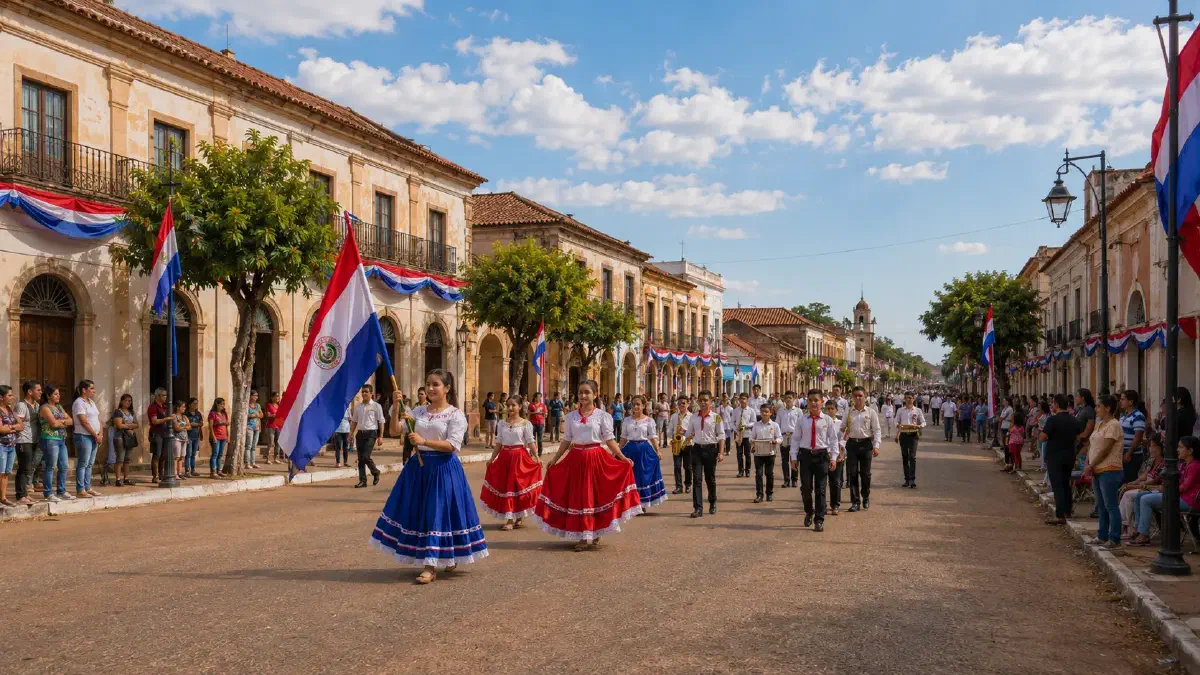

When red, white and blue suddenly appear everywhere in May, school classes practice for parades and the Fiestas Patrias are being prepared in Asunción, one of Paraguay’s most important holidays is just around the corner: Independence Day.
Independence Day is traditionally celebrated as a fixed holiday on May 14 and 15. In 2026, these two days fall on a Thursday and Friday, so many people can look forward to a long weekend. While schools are busy preparing their programs, families experience their own mix of patriotism, Mother’s Day on the same date and, of course, shared food.
In this article, you will learn why Paraguay has two Independence Days and what you should plan now for your long weekend, so you do not end up in front of closed doors. This is useful whether you live here, are visiting or are planning to move to Paraguay.
Quick Facts at a glance
- Date 2026: Thursday, May 14 and Friday, May 15
- Fixed or movable: fixed, not movable
- Status: official national holiday
- Extra: May 15 is also Día de la Madre, Mother’s Day, in Paraguay
- Who celebrates: nationwide, especially schools, families, state institutions and local communities
- Why: it remembers the independence movement from May 14 to May 15, 1811
- Peak: parades and official events usually in the morning, cultural programs often in the afternoon and evening
- Short summary: You notice the holiday through flags, school parades, closed offices, many family visits and sometimes heavier traffic.
🧭 What and When Is Independence Day in Paraguay?#
Independence Day in Paraguay is called Día de la Independencia Nacional, or simply Día de la Independencia. It is celebrated every year on May 14 and 15 and is a fixed national public holiday, meaning it cannot be moved (feriado inamovible).
What may seem unusual to readers from countries with only one national day has a long tradition in Paraguay: Independence Day includes both dates. May 14 and 15 are commemorated together because both are connected with the beginning of Paraguay’s independence.
In 2026, Paraguay therefore celebrates 215 years of independence. Since the holidays fall on a Thursday and Friday, many people can enjoy a long weekend. With Mother’s Day also falling on May 15, this period becomes an especially important family occasion for many people.
Historical Background: Where Does Independence Day Come From?#
The events during the night of May 14 to 15, 1811, brought the independence movement in Asunción to a decisive point. However, the new political order did not emerge in a single night.
Among the figures from this independence period who are remembered today as Próceres are Pedro Juan Caballero, Fulgencio Yegros, Vicente Ignacio Iturbe, and José Gaspar Rodríguez de Francia. Their names can still be found throughout Paraguay today in the names of cities, neighborhoods (barrios), streets, and public institutions.
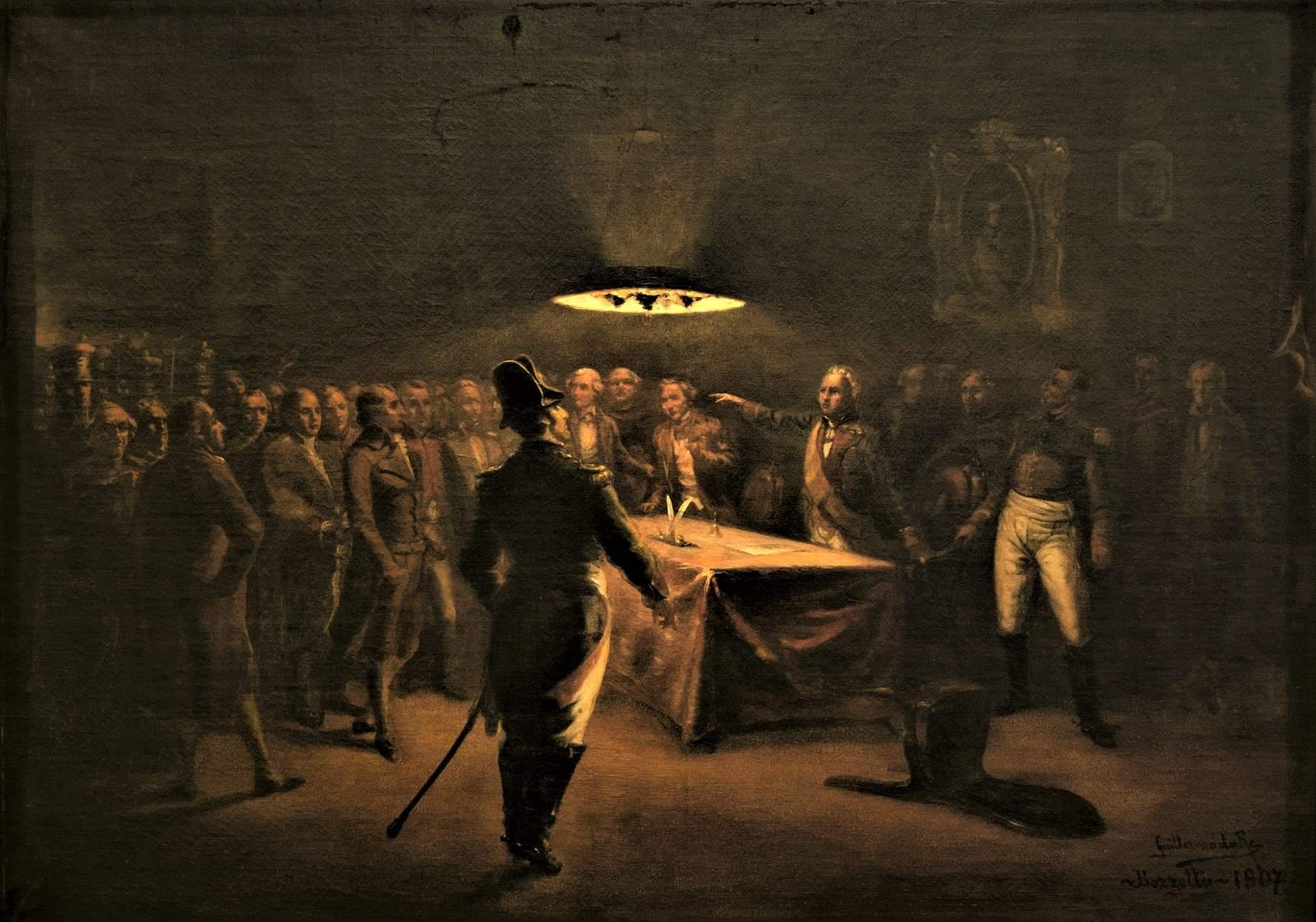
Artwork: Guillermo Da Re, 19th century · Public Domain · Source: Wikimedia Commons
One of the key locations was the Casa de la Independencia in Asunción. This was where plans for the independence movement were prepared. At the time, Paraguay belonged to the Viceroyalty of the Río de la Plata and sought to secure its political independence not only from Spain but also from the center of power in Buenos Aires.
After the events of May, a provisional government was formed. On May 16, 1811, Bernardo de Velasco, Juan Valeriano Zeballos, and José Gaspar Rodríguez de Francia formed a triumvirate that was to govern the country temporarily.
The Congress held from June 17 to 20, 1811, then established a five-member Junta Superior Gubernativa. Fulgencio Yegros became its president; the other members were Fernando de la Mora, José Gaspar Rodríguez de Francia, Pedro Juan Caballero, and Francisco Javier Bogarín.
This meant that Yegros, Francia, and Caballero were still part of the political leadership together in 1811. When the Junta was replaced by a new system of government in 1813, their roles changed: Yegros and Francia became consuls of the Republic, while Caballero was no longer part of the new two-person leadership.
This development shows that Paraguay’s political order continued to take shape step by step after 1811. In 1813, the country adopted a new system of government with the government regulation of October 12 and was explicitly described as a republic. Even then, however, the process of formal state-building was not yet complete.
Did you know? Paraguay’s Acta de Independencia does not date from 1811, but from 1842. Independence in 1811 was already regarded as a fact, but there was no formal declaration in a separate official document. The Congress of 1842 later completed this formal step.
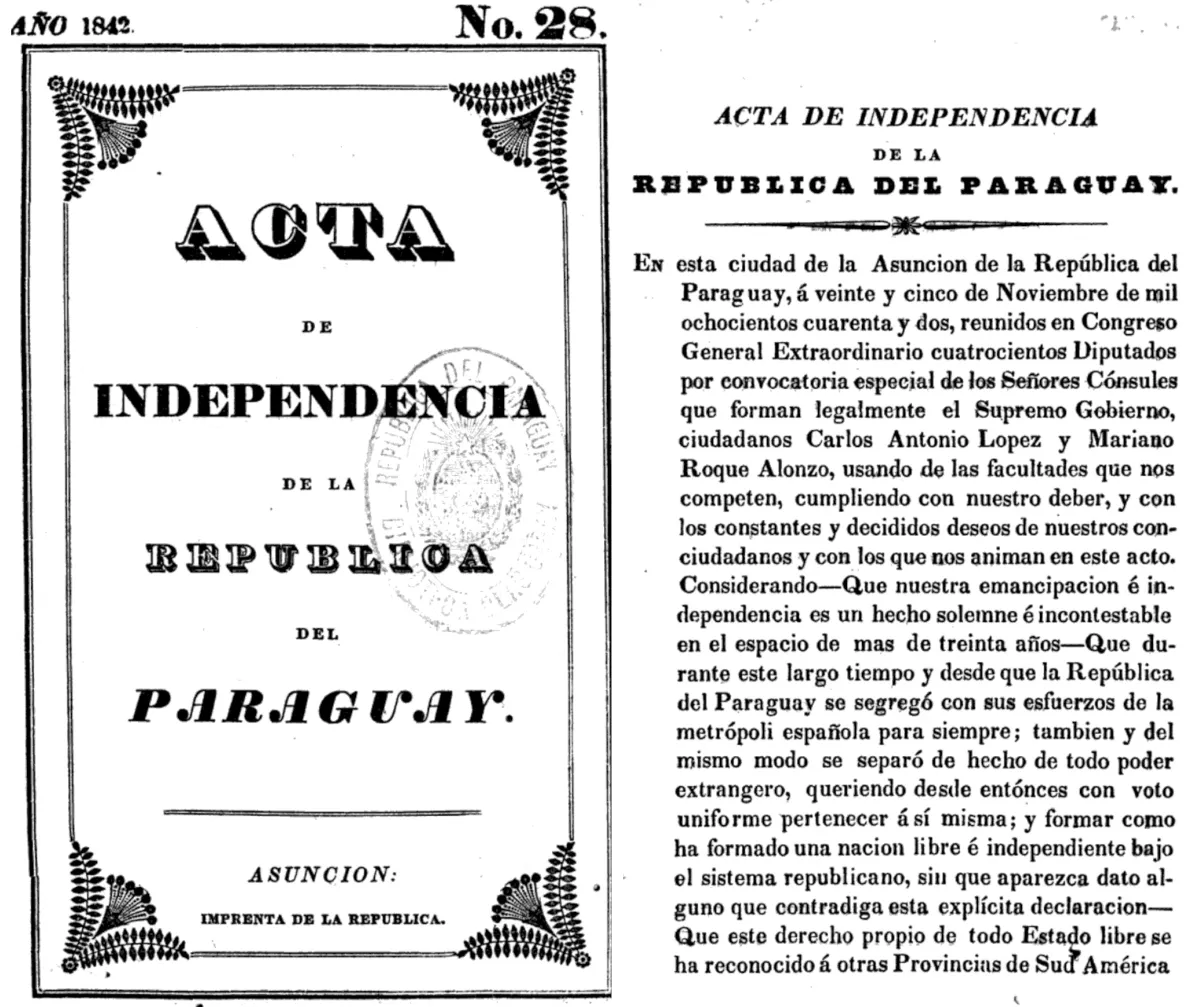
Imprenta Nacional, 1842 · Public Domain · Source: Wikimedia Commons
🪅 How is Independence Day seen and lived in society?#
Independence Day is one of the emotionally important holidays in Paraguay. It is patriotic and shaped by traditional customs, but it is not only official or military. You feel it in schools, families, flags and local events.
Flags, colors and national symbols#
All over the country, you see Paraguay’s national colors: red, white and blue. Houses, schools, public buildings and squares are decorated with Paraguayan flags, coats of arms and red-white-blue ribbons.
The Paraguayan flag has a special role because the front and back show different coats of arms. On the front, you see the national coat of arms with a star, a palm branch and an olive branch. On the back, there is the seal with a lion, the liberty cap and the motto “Paz y Justicia”. This detail makes the flag especially symbolic on national holidays.
Parades and local celebrations#
In many schools and universities, the holiday is prepared in advance. Children and young people practice dances, wear traditional clothing or take part in school parades.
In Asunción, student and youth parades are typical in the historic center and on streets such as Calle Palma. But also outside the capital, schools organize their own desfiles with music, uniforms, flags and strong family participation.
In our small neighboring town, the main street is also used for a school parade. Then the neighborhood watches, families stand along the road and you can clearly feel how important this day is for Paraguayans themselves.
Official events in Asunción#
One of the official events in Asunción is often a solemn Te Deum in the Catedral Metropolitana. Depending on the year, representatives of the government, state institutions and other officials take part in this church service of thanks.
Flag raisings, wreath-laying ceremonies, military parades and official desfiles can also be part of the program, for example near the Costanera (riverfront promenade) or Avenida José Asunción Flores. There, troops, marching bands and state delegations often take part.
Music, dance and Grito de Libertad#
Music plays a big role in official and cultural events. At concerts, school programs or official ceremonies, these pieces may appear:
- Himno a la Independencia: a solemn song about independence, composed by Natalicio Talavera.
- Paraguaya Independiente: a patriotic piece by José Asunción Flores.
- Patria Querida: a traditional song often played during patriotic moments, concerts and cultural programs. In addition, there is Guarania, harp and guitar music, and depending on the year, concerts with orchestras, choirs or well-known groups.
At folklore programs, the Danza de la Botella can also appear. This is a well-known Paraguayan bottle dance in which women balance bottles on their heads. This dance looks elegant and traditional, and many visitors remember it well.
Some programs also recreate the historical moment of the declaration of independence. Actors appear as Próceres (national heroes / founding figures of independence) and remember the night from May 14 to May 15 with the Grito de Libertad, the call for freedom. In this way, history is not only told, but made visible.
🧩 What does this mean in everyday life?#
In everyday life, Independence Day is important mainly because many things work differently than on normal working days. Not everything is closed, but you should plan offices, banks, shopping, traffic and restaurant visits in advance.
In 2026, planning ahead is especially important because the two holidays fall on Thursday and Friday. This creates a long weekend, which can affect shopping, traffic, restaurants and family visits. Some shops may also open for shorter hours or remain closed on the Saturday after the holidays.
Shopping and errands#
Large supermarket chains such as Superseis or Stock, as well as shopping centers, are often open on holidays, sometimes with changed hours. Markets such as Mercado 4 or Abasto often run in a reduced way. Small shops, despensas and local stores usually decide individually, which is quite typical for shopping in Paraguay.
You should not plan post office visits, bank matters or classic services on these days. ATMs, online banking and digital transfers usually still work. Even so, some cash is useful because smaller shops, parking or spontaneous purchases cannot always be paid digitally.
Pharmacies and doctors are a special case. Many may be closed, but there are usually farmacias de turno (pharmacy emergency service) or other medical emergency services. If you need certain medicine, do not wait until the holiday to look for it.
Gas stations are often the best emergency option. Many have small shops with ice, drinks, snacks, yerba, charcoal or basic items.
Many restaurants are open, especially in shopping centers and around streets or squares where events take place. Because of Mother’s Day, making a reservation can be useful.
For holidays in Paraguay, a small stock routine is useful: water, yerba, ice, simple food, some cash and the medicine you need regularly. You can find more practical ideas in the basic food supply guide for Paraguay.
Traffic and travel#
On the holidays, it can get busier around Asunción, larger cities and event areas. In Asunción, this especially affects the historic center, the Costanera, the area around the Casa de la Independencia, the Palacio de los López and the Panteón de los Héroes.
Do not rely only on your normal routes on these days. Because of parades, security areas and sudden road closures or detours, traffic in the city center can change quickly. Local news or radio updates are your best helpers on these days.
Inside cities, public transport is often reduced on holidays. Taxis and ride services such as Uber, Bolt or TaxiPy are good alternatives, but demand can rise during events, rain or in the evening.
For long-distance trips or overnight stays, you should organize bus tickets and accommodation early. Even if gas stations are usually open, filling up in time is more relaxed.
Schools, work and public offices#
Schools are normally closed on the actual holidays. Programs, performances or parades often take place before the holidays and are organized differently depending on the school and place.
Public offices and public institutions remain closed.
Where is Independence Day especially visible?#
You feel Independence Day most strongly in Asunción, because many historical places and official events come together there. The Casa de la Independencia, the Catedral Metropolitana, the Palacio de los López, the Panteón de los Héroes, the Cabildo and Calle Palma are typical reference points.
But the holiday is not only a capital-city topic. Smaller cities and villages often also have their own music groups, events by the Municipalidad (city administration) or school programs.
If you want to know what is happening near you, it is best to check:
- Facebook page of your Municipalidad
- local radio stations
- neighbors or local groups, for example on WhatsApp
- Instagram or Facebook pages of cultural offices
- pages of the Secretaría Nacional de Cultura
- notices in communities, churches or around the main square
In 2026, several cultural activities were announced for Asunción, including fairs, music, folklore, student parades and programs in the historic center. For other places, you should still check locally because communities have their own times and plans.
Typical food & drinks on this day#
In Asunción and at larger programs, there are sometimes gastronomic ferias (markets/fairs) around the Fiestas Patrias (national holidays / patriotic celebrations). Typical Paraguayan food is offered there, sometimes together with stands from institutions, cultural groups or local providers.
Food also plays a big role in families. People often grill, eat together or prepare something for a picnic. Typical foods are, for example, asado with Sopa Paraguaya, Chipa Guasu and mandioca (boiled cassava). Chipa, empanadas and mbejú work well as finger food and for sharing. As a drink, tereré almost automatically belongs to it when people celebrate outside.
Because May 15 is also Mother’s Day, many families do not only celebrate patriotically. They also cook, grill or bake in honor of mothers. Then there is often also a piece of cake for dessert. If you need ideas for this day, you can find suitable Mother’s Day recipe ideas in Paraguay.
If you are invited, it is often relaxed. You bring something, help at the table, share tereré or simply sit together.
🤝 Joining as a visitor: What is polite and what is not?#
As a visitor or newcomer, you can experience Independence Day well if you are respectful and open. Nobody expects you to know all historical details. But interest is usually received positively.
✅ Do#
- Greet people: “¡Feliz Día de la Independencia!” or “¡Felices Fiestas Patrias!” almost always fits.
- Show respect: Stand still for a moment when the anthem plays or the flag is raised. Locals notice this in a positive way.
- Respect privacy: Always ask politely before taking photos of people, especially children in school uniforms.
- Clothing: For official events, church visits or school events, neat clothing (ropa formal) is suitable.
- Small gifts: Bring something small to private invitations, such as drinks, something for the grill or a dessert.
⛔ Don’ts#
- Criticizing patriotism: Avoid ironic comments about national pride or long ceremonies.
- Standing in the way: Do not push in front of marchers or musicians just to get the “perfect photo”.
- Errands and appointments: Do not plan important office visits, bank matters or business appointments on May 14 or 15. The weekend directly after can also be limited.
- Underestimating Mother’s Day: Do not expect to get a restaurant table everywhere without planning.
Insider tip: One simple sentence is often enough to show interest: “I am just learning about the customs, but it is impressive” (Todavía estoy aprendiendo sobre las costumbres, ¡pero me parece increíble!). This feels respectful and often starts a nice conversation.
💬 Phrase sheet: Useful sentences on the road#
Spanish 🇪🇸#
“¡Feliz Día de la Independencia!”
English: “Happy Independence Day!”“¡Felices Fiestas Patrias!”
English: “Happy national holidays!”“¿Hay desfile hoy?”
English: “Is there a parade today?”“¿Está abierto hoy?”
English: “Is it open today?”
Guaraní 🇵🇾#
“Vy’apavẽ Paraguái retã ára sãso rehe.”
English: “Congratulations on Paraguay’s day of freedom.”“Toikove Paraguay!”
English: “Long live Paraguay!”
🗓️ Quick & concise: The essentials for your planning#
- 🗹 May 14 and 15 are official holidays and in 2026 fall on Thursday and Friday.
- 🗹 May 15 is also Mother’s Day, so restaurants, family visits and excursion places can be fuller.
- 🗹 Public offices, banks and many schools are closed.
- 🗹 Supermarkets and shopping centers may be open, but check local opening hours.
- 🗹 Small despensas often close or open only briefly, especially in rural areas.
- 🗹 Gas stations are usually the most practical emergency option for ice, drinks and small items.
- 🗹 Book long-distance trips, accommodation and restaurants early, especially when many families travel.
- 🗹 Expect road closures in Asunción, especially around the historic center.
- 🗹 Check local sources for events, for example Municipalidad, Secretaría Nacional de Cultura, local radio and Facebook pages.
- 🗹 Shop in advance, especially if you want to grill, receive guests or travel over the weekend.
❓ Frequently asked questions (FAQ)#
When is Independence Day in Paraguay in 2026?
Why does Paraguay celebrate independence on two days?
Is Independence Day in Paraguay moved to another date?
What happens if May 14 and 15 fall on a weekend?
Is May 15 also Mother’s Day in Paraguay?
Are shops open on Independence Day in Paraguay?
Conclusion: Two days when Paraguay becomes especially visible#
Independence Day in Paraguay is more than a date in the calendar. On May 14 and 15, history, national pride, school, family and everyday life come together in a very Paraguayan way.
For visitors, future expats and newcomers, this holiday is a good chance to understand Paraguay better. On these days, you can clearly see how living culture is kept alive here through music, dances, symbols and family rituals.
In 2026, some planning is especially useful because the two holidays fall on Thursday and Friday. If you are prepared, you can experience these days more calmly and get a real insight into Paraguay.
If you would like to learn more about why May 15 is also Mother’s Day in Paraguay and how this special day is celebrated, continue with our article on Mother’s Day in Paraguay.
Share & support
“Did you know that Paraguay has two Independence Days? Do you know someone who wants to understand Paraguay better?” Then feel free to give this post a like and share it with other South America fans, and help share the meaning of Paraguayan holidays.
- All dates at a glance: Holidays in Paraguay 2026
- More holidays in May:
- Milestones in Paraguay’s national history: