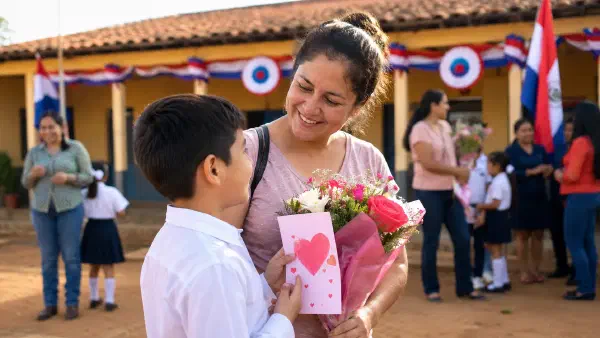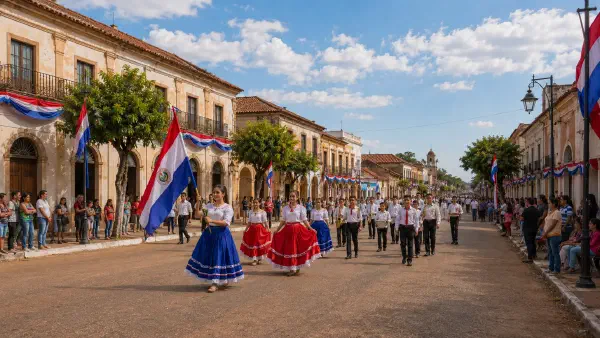
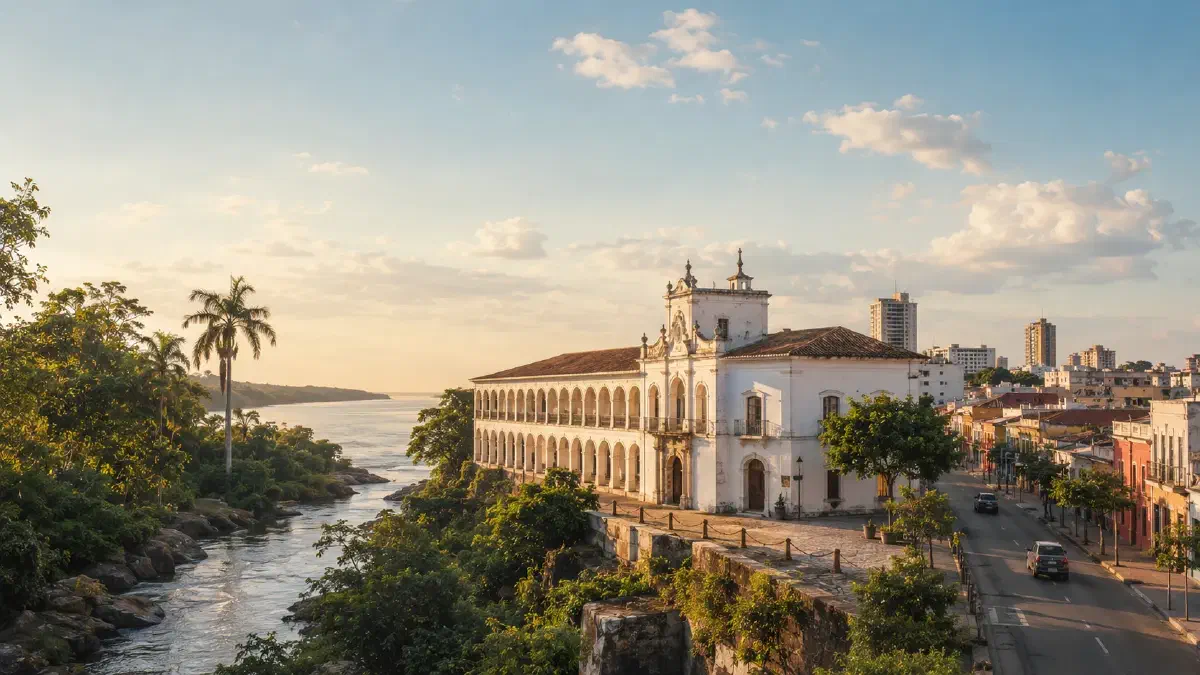

If you live in Paraguay, you encounter the country’s history surprisingly often — even without setting foot in a museum. Guaraní and Spanish are part of everyday life, streets are named after historical figures, and holidays such as Heroes’ Day or Chaco Peace Day go back to defining moments in the country’s past.
Many issues that still matter in Paraguay today - national identity, political structures, or the importance of the Chaco - also become easier to understand once you know how the country developed.
This article takes you through the main stages of Paraguay’s history: from Indigenous cultures and the Spanish colonial period to independence, wars, dictatorship, and today’s democracy.
Paraguay History in Brief#
Paraguay’s history has been shaped by very different influences and major turning points. Indigenous cultures and Spanish colonization, political independence in 1811, two major wars in the 19th and 20th centuries, and the long Stroessner dictatorship all left lasting marks on the country.
The timeline below gives you a quick overview of the main periods.
Indigenous cultures
before 1500
Guaraní-speaking communities and other Indigenous peoples live in the area of present-day Paraguay long before Europeans arrive.Spanish colonial period
from 1537
A Spanish fortified outpost is established at the site of present-day Asunción in 1537. From there, Spanish influence expands further into the interior.Jesuit reductions
17th and 18th centuries
Jesuit missions shape parts of Paraguay and neighboring regions. Visible traces remain in southern Paraguay today.Independence
1811
Paraguay breaks from Spanish rule and develops as an independent state.War of the Triple Alliance
1864 to 1870
The war against Brazil, Argentina, and Uruguay becomes the greatest catastrophe in Paraguayan history.Chaco War
1932 to 1935
Paraguay fights Bolivia over the disputed Chaco region and gains military control over much of the contested territory.Stroessner dictatorship
1954 to 1989
Alfredo Stroessner rules Paraguay as an authoritarian leader for almost 35 years.Democratic transition
since 1989
After Stroessner’s fall, Paraguay begins the transition toward its present democratic system.
Before the Europeans arrived: the Guaraní and the land between the rivers#
Long before the Spanish arrived in South America, different Indigenous peoples lived in the area of present-day Paraguay. Various Guaraní-speaking communities were especially influential.
Their ways of life were not all the same, but many were closely connected to rivers, forests, farming, hunting, and fishing. Crops included corn, cassava (manioc), and sweet potatoes.
The Guaraní are not simply a chapter from the distant past. Their language and cultural influence remain clearly visible in Paraguay today.
Language is perhaps the most obvious example. Guaraní is an official language alongside Spanish, and both are widely used. In everyday conversation, you will also often hear Jopara, which combines elements of Guaraní and Spanish.
This linguistic reality sets Paraguay apart from many other Latin American countries and shows how strongly Indigenous influences have remained part of the country’s culture.
The Spanish colonial period: Asunción and the development of a distinct culture#
A new chapter began with the arrival of the Spanish in the 16th century.
On August 15, 1537, Juan de Salazar y Espinosa established a fortified casa fuerte on the Paraguay River. Asunción developed from this outpost and formally received city status in 1541.
These events are commemorated every year on August 15 with the Founding of Asunción.
Asunción became an important base for Spanish expansion into the interior of South America. Relationships and families formed between Spanish settlers and Guaraní women, and over time a society developed in which European and Indigenous influences were closely intertwined.
This process, however, took place within unequal colonial power structures. Missionary activity, dependency, coercion, and social inequality were just as much a part of the colonial period as cultural exchange and intermixing.
Paraguay therefore did not simply become a Spanish copy in South America. Its distance from major coastal centers and trade routes also helped distinct social and cultural structures develop in the interior.
The Jesuit reductions: missions, Guaraní, and historical traces#
The Jesuit reductions are among the most visible legacies of Paraguay’s colonial period.
These were mission settlements in which Jesuits converted Indigenous communities to Christianity and organized life in permanent settlements. The reductions were religious centers, but they were also places of farming, craftsmanship, music, and economic production.
For the Guaraní communities living there, the system meant major changes to religion, society, and everyday life. At the same time, the missions could offer some protection from other forms of colonial exploitation and allowed certain local structures to continue.
Numerous reductions were established in present-day Paraguay and neighboring regions during the 17th and 18th centuries. After the Jesuits were expelled from Spanish territories in 1767, many missions lost their previous organization. Some were abandoned, while others continued as settlements.
Today, Paraguay’s best-known Jesuit sites are the historic ruins of Trinidad and Jesús de Tavarangue. San Cosme y Damián is another place where this chapter of Paraguayan history remains visible.
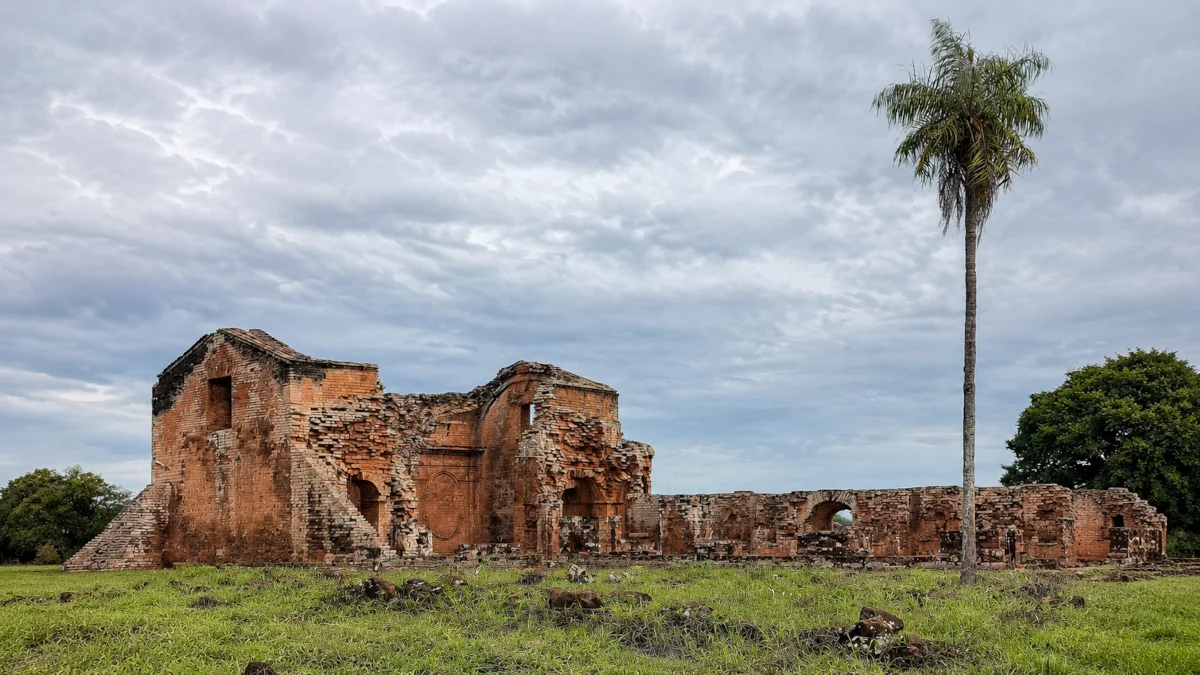
At these sites, history becomes more than a list of dates. Walls, church ruins, and entire settlement layouts still show how religion, Indigenous communities, and European colonial rule were connected.
Independence: Paraguay becomes its own state#
Paraguay became independent in 1811.
The break was not only about separating from Spain. Paraguay also wanted to preserve its political autonomy from Buenos Aires rather than become part of a larger political project in the Río de la Plata region.
This early drive for political independence shaped the first decades of the new state.
Under José Gaspar Rodríguez de Francia, Paraguay became highly centralized and largely isolated. Francia ruled in an authoritarian manner and severely restricted many contacts with the outside world. The country remained internationally isolated, but at the same time strengthened its political independence from neighboring states.
Under Carlos Antonio López, Paraguay gradually opened up. State institutions, transportation, the military, and the economy were expanded. The government also looked increasingly to European technology as it modernized the country’s infrastructure.
Did you know? Paraguay’s first train left Asunción in 1861. The railway network was expanded over the following decades. The later main line from Asunción through places such as Pirayú and Sapucai to Encarnación eventually reached around 376 kilometers. Old stations and railway workshops still recall this period of infrastructure development.
The importance of independence is especially visible every year on May 14 and 15. During the Fiestas Patrias and Independence Day, schools, families, and public institutions commemorate the events of 1811.
The War of the Triple Alliance: the great national catastrophe#
Only a few decades after independence, Paraguay entered the most devastating war in its history.
The War of the Triple Alliance lasted from 1864 to 1870. Under President Francisco Solano López, Paraguay fought Brazil, Argentina, and Uruguay.
The causes cannot be reduced to a single event. Power struggles in the Río de la Plata region, the political crisis in Uruguay, Brazilian intervention, regional rivalries, and decisions made by the Paraguayan government under López all played a role.
These conflicts developed into a war whose consequences were especially severe for Paraguay.
The country lost a significant share of its population. Towns, farms, and economic structures were destroyed, territory was lost, and reconstruction took decades. The exact number of deaths remains the subject of historical debate and widely differing estimates. What is not disputed is the enormous scale of the disaster.
The war fundamentally changed Paraguay’s population, economy, state, and society.
For Paraguay, it is therefore not simply a closed chapter of the 19th century. Many places, memorial days, and national symbols still refer to the conflict.
This is especially visible on Heroes’ Day on March 1. The day commemorates, among other things, the death of Francisco Solano López at Cerro Corá in 1870 and the country’s war dead.
Paraguayan Women’s Day on February 24 also has a connection to this period. The memorial day refers to a women’s gathering in 1867, when women donated jewelry and other valuables to support the national cause.
Places such as Cerro Corá, Humaitá, and Piribebuy still represent some of the most important and painful events of this war.
After the war: reconstruction and political unrest#
After 1870, Paraguay had to rebuild its political, economic, and social structures under extremely difficult conditions.
Brazilian troops remained in the country for several more years, political institutions had to be reorganized, and major economic changes followed.
The party system that would later shape Paraguayan politics for generations also began to take form during this period. Political power struggles, frequent changes of government, and military influence repeatedly caused instability.
The late 19th and early 20th centuries were therefore not simply a quiet period between Paraguay’s two major wars. They were decades in which a severely weakened country tried to rebuild state institutions while continuing to navigate a politically unstable region.
The Chaco War: the conflict with Bolivia#
From 1932 to 1935, Paraguay fought Bolivia over the Chaco Boreal, a large and sparsely populated region in the west.
The war followed decades of disagreement over the border. Large parts of the Chaco were only lightly settled, and the boundary between the two countries had never been clearly established. The region also had strategic importance, including access to the Paraguay River.
Conditions for the soldiers were extreme. Heat, lack of water, disease, and the enormous distances made the fighting even more difficult and deadly.
One of the best-known early battles was the Battle of Boquerón in September 1932. After weeks of fighting, Paraguayan forces captured the Bolivian-held position on September 29.
Boquerón became important not only militarily but also as a powerful symbol in Paraguay’s memory of the war. September 29 is still commemorated today.
As the conflict continued, Paraguay gained control of large parts of the disputed territory. The fighting ended on June 12, 1935. The final border settlement between Paraguay and Bolivia followed several years later.
Chaco Peace Day on June 12 and the Día de la Batalla de Boquerón (Battle of Boquerón) on September 29 show how strongly the war remains part of Paraguay’s national memory.
If you travel through the Chaco today, you will come across names such as Boquerón, Fortín Toledo, and Mariscal Estigarribia. They are reminders that the history of this region goes far beyond its landscape and agriculture.
Stroessner and the long dictatorship#
One of the defining chapters of Paraguay’s more recent history is the dictatorship of Alfredo Stroessner.
Stroessner came to power in 1954 and ruled Paraguay until 1989. For almost 35 years, the country was shaped by authoritarian government, close ties between the state, the military, and the Colorado Party, and extensive political control.
At the same time, the government carried out major infrastructure projects and benefited during some periods from economic growth and international support in the context of the Cold War.
Alongside this were repression, censorship, political persecution, torture, exile, and serious human rights abuses.
The memory of this period is not the same for everyone in Paraguay. In family and public conversations, you still hear different views: some associate the era mainly with economic development, infrastructure, or a sense of order. For others, political violence, fear, and the lack of freedom stand at the center of their memories. Both perspectives are therefore part of how the period is remembered.
Did you know? Itaipú also belongs to this historical period. The enormous hydroelectric power plant on the border with Brazil was planned and built during the Stroessner era. It still plays a central role in Paraguay’s electricity supply, economy, and relationship with Brazil.
The effects of the long dictatorship did not disappear automatically when Stroessner fell. Political networks, party structures, and personal continuities remained influential during the democratic period that followed.
Since 1989: democracy, changes of power, and political continuity#
In February 1989, Stroessner was overthrown in a military coup.
This marked the beginning of Paraguay’s transition toward democratic government. An important institutional milestone was the 1992 Constitution, which still provides the framework for the country’s political system. Paraguay commemorates it on Constitution Day.
The democratic transition, however, was not a straight path.
The Colorado Party, which had been closely connected to the state during the Stroessner era, remained Paraguay’s dominant political force for many years.
A major change came in 2008, when Fernando Lugo became the first president in decades who did not belong to the Colorado Party.
His presidency ended in 2012 after a controversial impeachment process. The proceedings took place within a very short period and drew international criticism over the way they were carried out.
Vice President Federico Franco then took over the presidency.
In 2013, the Colorado Party returned to power under Horacio Cartes. He was followed by Mario Abdo Benítez, who served as president from 2018 to 2023.
Since August 15, 2023, Santiago Peña has been president of Paraguay.
Paraguay today is a constitutional democracy with regular elections. At the same time, strong political parties, local power structures, economic interests, and personal networks continue to play an important role in political life.
The country has also changed economically and socially in recent decades. Services, the financial sector, digital payments, construction, and new developments in energy and agriculture have become more visible.
For younger generations, the internet, digital communication, and international connections are a much more natural part of everyday life than they were only a few decades ago. Education, work, and periods spent abroad also play a greater role for many people.
At the same time, regional differences, traditional ways of life, and strong local ties remain important.
This combination of change and continuity is itself part of Paraguay’s recent history.
What does this history mean for everyday life in Paraguay?#
In Paraguay, history is not limited to books and museums.
Many streets, towns, schools, and public squares are named after historical figures. Holidays commemorate independence, wars, and political turning points. Monuments and historic sites refer to many of the same events.
Historical symbols also appear on banknotes, in public buildings, and during state ceremonies.
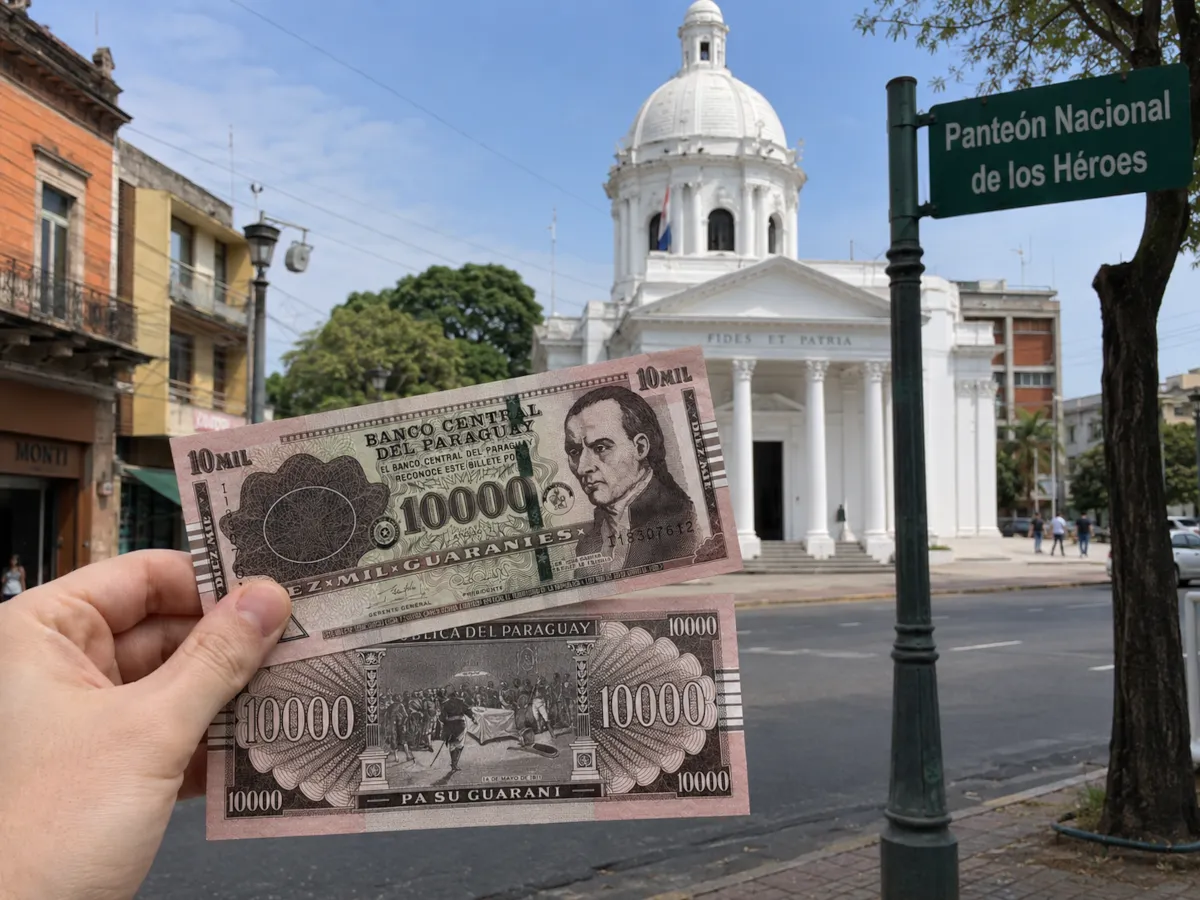
The country’s two major wars are particularly present. The War of the Triple Alliance and the Chaco War appear again and again in place names, memorial days, and national narratives.
The Stroessner era is also still relatively recent history. Many people experienced the dictatorship themselves or know its effects through their own families.
Language is another visible example. The strong presence of Guaraní alongside Spanish makes much more sense when Paraguay’s Indigenous and colonial history is taken into account.
History does not explain every modern habit or automatically explain how individual people behave. But it does provide important context for understanding why certain subjects, symbols, and political developments have particular significance in Paraguay.
This perspective also helps avoid seeing the country only through romanticized images or only through its problems.
Paraguay faces real challenges, including corruption, social inequality, political entanglements, and major regional differences. At the same time, it has developed a remarkably distinct culture and has repeatedly rebuilt itself after deep historical disruptions.
Knowing that background makes many things you encounter in Paraguay easier to place in context.
❓ Frequently Asked Questions About Paraguay’s History#
When was Paraguay founded, and when did it become independent?
Where does the name Paraguay come from, and what does it mean?
Why is Guaraní so important in Paraguay?
What was the War of the Triple Alliance, and how did it affect Paraguay?
What was the Chaco War, and how did it end for Paraguay?
Who was Alfredo Stroessner, and how long did he rule Paraguay?
Is Paraguay a democracy today?
Which historical places can you visit in Paraguay?
Which holidays and memorial days commemorate Paraguay’s history?
Conclusion: Paraguay is easier to understand when you know its history#
Paraguay’s history brings together Indigenous and European influences, early political independence, two devastating wars, a dictatorship that lasted for decades, and a democratic transition that continues to shape the country today.
Many of these chapters remain visible in modern Paraguay — in language, holidays, street names, monuments, political structures, and national symbols.
You do not need to memorize dates to understand the country. But knowing the basic history makes it easier to place current events, public debates, and many things you encounter in everyday life in context.
Our Paraguay A to Z shows how history, culture, and everyday life come together today — from Guaraní and tereré to many of the small details that make Paraguay distinctive.
Share & support
“Did this overview help you understand Paraguay better?” If so, feel free to give the article a like and share it with others interested in Paraguay and South America.
- History in everyday life: Holidays in Paraguay - Current Dates & Practical Tips