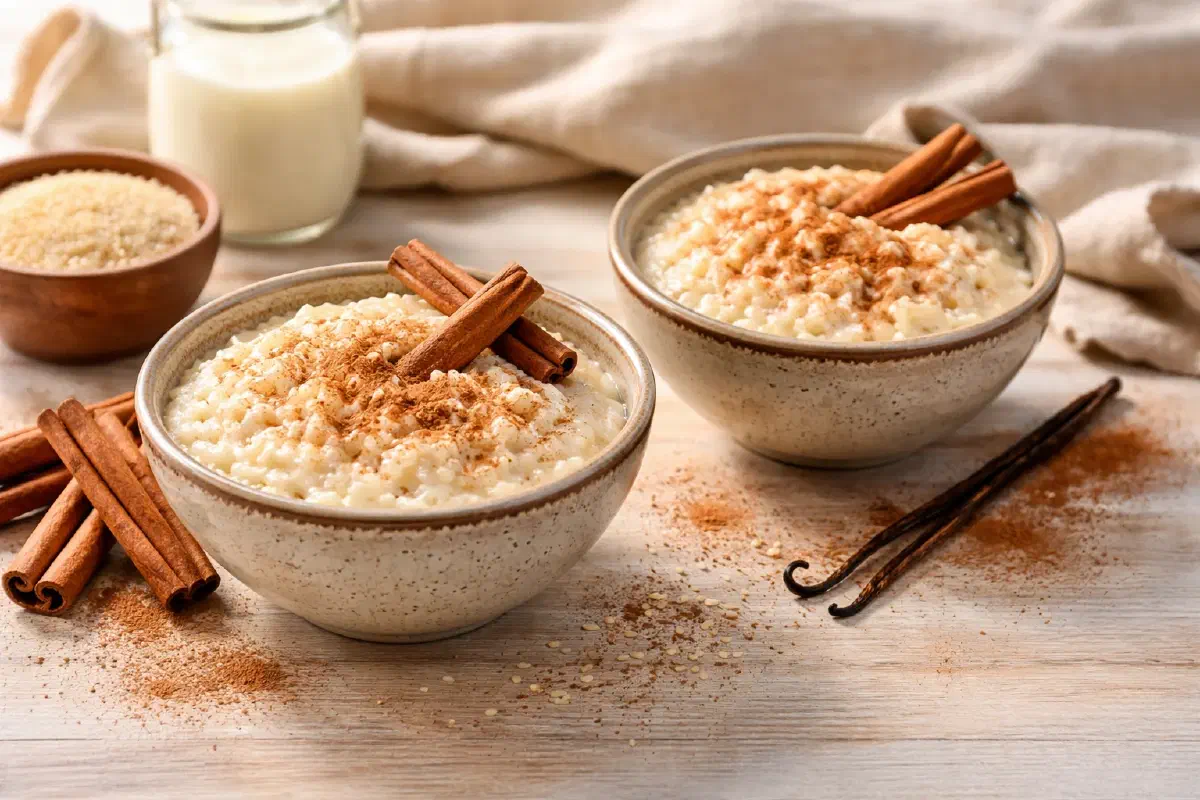

Arroz con Leche is a creamy rice pudding dessert known in Paraguay as Kamby Arró. You will also often see it written as Kamby Arro, without the accent.
The basic recipe is simple: rice, milk, sugar, cinnamon, and a little citrus peel. The main trick is getting the texture right. This recipe shows you step by step what to watch for while cooking, cooling, and reheating it.
📝 Kamby Arró recipe: Arroz con Leche step by step#
At a glance
- Difficulty: easy
- Preparation time: about 10 minutes
- Cooking time: about 35 to 40 minutes
- Chilling time: optional, at least 2 hours
- Total time: about 45 to 50 minutes, longer if serving cold
- Servings: about 6 small dessert portions
🛒 Ingredients for Arroz con Leche#
Main ingredients#
- 200 g white short-grain rice
- 1 liter whole milk
- 200 ml water
- 80 to 100 g sugar, depending on how sweet you like it
- 1 cinnamon stick
- Peel of 1 untreated lemon or orange
- Ground cinnamon for serving
With 80 g of sugar, the rice pudding is pleasantly sweet. If you prefer it noticeably sweeter, use 100 g.
Optional ingredients#
- 1 tsp vanilla extract or 1 packet vanilla sugar
- 1 pinch of salt
- A little butter for a richer flavor
- Raisins to taste
Which ingredients can you substitute?#
Ingredient substitutions and dietary options
The basic recipe is vegetarian and gluten-free, as long as any extra products you use are also free from gluten-containing ingredients.
Rice:
- White short-grain rice works best for a creamy texture.
- Long-grain rice usually stays a little more separate and grainy.
Milk:
- Lactose-free whole milk works without major changes.
- Unsweetened oat or soy milk also works, but it can change the flavor and texture slightly.
- Coconut milk makes the dessert much richer and gives it a stronger flavor.
Sugar:
- You can reduce the amount for a less sweet version.
- Honey or agave syrup can also be used, but they change the flavor slightly.
Flavors:
- Orange peel works well instead of lemon peel.
- It is best to add ground cinnamon near the end or directly before serving.
Kitchen tools you will need#
- Pot with a thick bottom, preferably at least 2.5 liters
- Wooden spoon or silicone spatula
- Fine-mesh sieve
- Measuring cup and kitchen scale
- Vegetable peeler or fine grater for the citrus peel
- Dessert bowls or one larger bowl
👩🍳 Step-by-step preparation#
Preparation#
Rinse the rice briefly and let it drain well. There is no need to wash it until the water runs completely clear because some starch helps make the dessert creamy.
Wash the lemon or orange and peel off a thin layer of the colored skin. Try to avoid the white pith because it can taste bitter.
Measure the milk and water and have the remaining ingredients ready.
Cooking process#
Flavor the liquid: Add the milk and water to the pot. Add the sugar, cinnamon stick, and citrus peel, then heat slowly over medium heat. Stir regularly, scraping the bottom of the pot as you go.
Add the rice: Once the liquid reaches a gentle simmer, stir in the rice and reduce the heat. The mixture should simmer gently, not boil vigorously.
Cook slowly: Simmer the rice gently for about 30 to 35 minutes. Stir regularly and more often toward the end. Make sure to scrape the bottom of the pot as you stir so the milk does not stick.
Check the texture: The rice is ready when the grains are soft and the milk has thickened noticeably. At this point, the mixture can still look a little looser than you want the finished pudding to be. The rice will absorb more liquid as it cools.
Finish the pudding: Remove the cinnamon stick and citrus peel. You can now stir in vanilla, a pinch of salt, or a little butter.
Serve or chill: Arroz con Leche tastes good warm or lukewarm, but it can also be served cold. For the cold version, spoon the rice pudding into smaller containers, cool it quickly, and then place it in the refrigerator.
Serve: Sprinkle with a little ground cinnamon before serving.
💡 Practical tips for creamy Arroz con Leche#
How to get the texture right
Do not cook it too thick: Take the pot off the heat while the mixture still flows and looks creamy. It will become much thicker as it cools.
Too thick? Stir in a little milk at a time until it is creamy again. Warm milk works especially well when reheating.
Still too runny? Let it simmer for a few more minutes over low heat, stirring regularly.
Prevent burning: Low heat and a pot with a thick bottom help. If the pudding starts to scorch, immediately transfer it to a clean pot without scraping up the layer on the bottom.
Store leftovers: Cool Arroz con Leche quickly, refrigerate it, and try to use it within 24 hours.
Nutrition overview#
For the basic recipe above, divided into six small dessert portions of about 180 to 200 g each, the approximate values are:
- Calories: about 270 to 290 kcal
- Protein: about 7 to 8 g
- Carbohydrates: about 47 to 52 g
- Fat: about 5 to 6 g
- Fiber: less than 1 g
These are calculated average values. The type of rice and milk, the amount of sugar, the actual serving size, and any extra ingredients can change these values considerably.
🍽️ Serving Arroz con Leche#
Whether you keep it simple with cinnamon or add a few extras, this rice pudding is easy to adapt to the occasion and season.
Classic: A little ground cinnamon is all you need and lets the milk and citrus flavors stand out.
Fruity: Mango, banana, or a few pieces of fresh fruit add a light contrast to the sweet rice pudding.
Crunchy: Chopped or toasted nuts add more texture.
Sweeter: A little Dulce de Leche turns the basic recipe into a much richer dessert.
Classic: Black coffee or coffee with milk goes well with the mild sweetness.
Paraguayan: Mate cocido pairs well with the dessert as a warm drink. On hot days, Tereré provides a refreshing contrast.
Simple: Cold water with a little lemon keeps the focus on the dessert itself.
🔄 Recipe variations#
Arroz con Leche is prepared differently from household to household and from country to country. Not every variation is specifically Paraguayan.
- Richer with condensed milk: For a richer version, replace part of the milk with sweetened condensed milk. Start without the regular sugar, then taste near the end and add some only if needed.
- With vanilla or raisins: Both are easy to add to the basic recipe and mainly change the flavor.
- As a trifle in a glass: Layer a small cookie or cake base with cold Arroz con Leche and a little Dulce de Leche. Well chilled, this version works especially well for guests or a celebration.
- Arroz con cuatro leches: This especially rich variation combines the rice pudding with ingredients such as condensed milk, cream, and Dulce de Leche. It is much sweeter and richer than the simple basic recipe.
🇵🇾 Arroz con Leche and Kamby Arró in Paraguay#
Name and spellings#
Arroz con leche literally means rice with milk in Spanish. In Paraguay, you will also come across the name Kamby Arró. Kamby means milk in Guaraní. Arró comes from the Spanish word arroz, meaning rice.
The spelling Kamby Arro, without the accent, is also common. Both names refer to the same dish. For most English-speaking readers, Arroz con Leche remains the easiest main name to recognize.
What role does Arroz con Leche play in Paraguay?#
Arroz con Leche is one of Paraguay’s traditional desserts. It is not an elaborate celebration dessert, but a simple homemade recipe that is part of everyday cooking in many families. A bowl of Kamby Arró can be eaten after lunch, as a small merienda in the afternoon, or simply when there is rice and milk in the kitchen.
Another familiar dessert is Mazamorra. It is made with white corn (locro) instead of rice and may look a little like Arroz con Leche, but its texture is quite different.
Which ingredients shape the flavor of Arroz con Leche?#
The base is simple: rice, milk, and sugar. Short-grain rice releases starch as it cooks slowly, which helps create the creamy texture together with the milk.
Cinnamon and lemon or orange peel shape the flavor. The cinnamon stick adds a warm note, while the citrus peel gives the sweet rice pudding a little freshness.
Tip: Peel off only the colored outer layer. The white pith underneath can taste bitter.
❓ Frequently asked questions#
What does Kamby Arró mean?
What type of rice is best for Arroz con Leche?
Why does Arroz con Leche thicken as it cools?
How should I store and reheat Arroz con Leche?
Is Arroz con Leche served warm or cold?
Can I make Arroz con Leche with plant-based milk?
Conclusion#
For me, Kamby Arró belongs to Paraguay, especially because it is so simple and easy to adapt to your own taste. Just a few ingredients are enough for a homemade dessert that is part of everyday life in many families.
If you are just getting to know Paraguayan cuisine, this is a good recipe to start with. The ingredient list is short, the preparation is not complicated, and the rice pudding tastes good warm or well chilled. A little patience at the stove and taking the pot off the heat at the right moment make the biggest difference.
Have fun cooking and buen provecho!
If you like creamy desserts, try Torta Tres Leches next. It’s much more elaborate and works especially well for guests or a special occasion. Or browse more sweet ideas among our Paraguayan desserts.
Share & support
Did this Arroz con Leche recipe make you curious about Paraguayan cuisine? Then feel free to give the article a like share it with others who are interested in South America. Together, we can help bring more attention to Paraguayan cuisine.