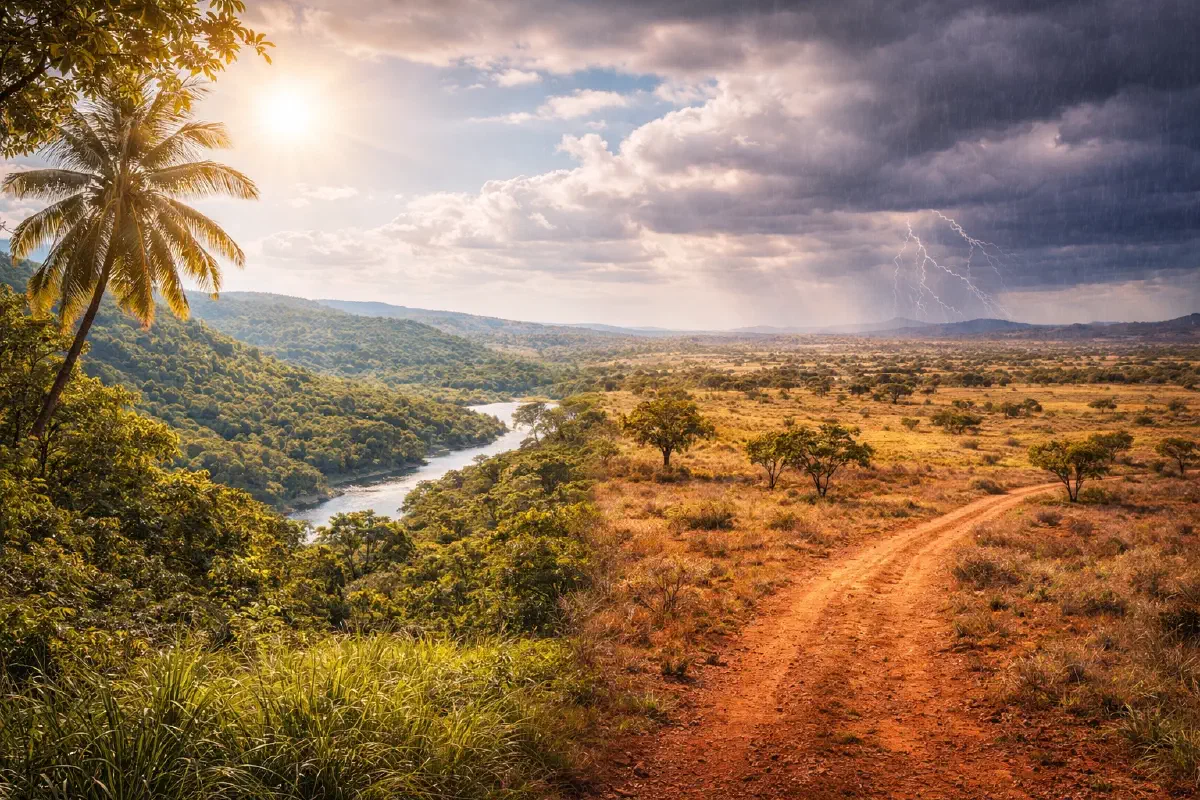

Paraguay is often associated with sunshine, heat, and warm weather almost all year. But the weather is more varied than that. The climate in Paraguay ranges from hot, humid summer weeks to surprisingly cool winter days. Rapid weather changes and clear differences between the wetter east and the drier Chaco are also part of life here.
There are two useful ways to look at Paraguay’s weather through the year. The country has four meteorological seasons: spring, summer, fall, and winter. People also often speak of a rainy season and a dry season. Both have typical times of year, but the actual conditions can vary considerably by year and region.
This guide explains how the weather in Paraguay changes through the year, when rainy and drier periods usually occur, and why location matters so much.
Quick Facts
- Four seasons: spring: September–November, summer: December–February, fall: March–May, winter: June–August
- Rainy and dry seasons: the rainy season is roughly October–April; May–September are usually drier
- Hot season: summer-like weather can begin in October and continue into March
- Regional differences: the Región Oriental is much wetter, while the Chaco is drier and more affected by extreme heat and longer dry periods
- Common weather patterns: quick weather changes, local aguaceros, high humidity, and sometimes major differences within only a few days
🌤️ What Is the Climate Like in Paraguay?#
Paraguay lies in a transition zone between tropical and subtropical climate zones. Overall, the country is warm to hot, but the climate is not the same everywhere or throughout the year.
The clearest contrast is between the wetter Región Oriental in the east and the drier Chaco in the west. Season, elevation, and the local microclimate also matter. When looking at weather in Paraguay, it is almost always important to ask where and when.
Climate Table: Average Monthly Temperatures in Paraguay#
Temperature patterns also vary by region. The following climate table shows the average temperature by month for five locations in Paraguay and gives a quick sense of the typical annual pattern.
| Month | Asunción | Villarrica | Ciudad del Este* | Encarnación | Mariscal Estigarribia |
|---|---|---|---|---|---|
| January | 27.8 °C (82.0 °F) | 27.2 °C (81.0 °F) | 26.3 °C (79.3 °F) | 26.5 °C (79.7 °F) | 28.6 °C (83.5 °F) |
| February | 27.0 °C (80.6 °F) | 26.6 °C (79.9 °F) | 26.0 °C (78.8 °F) | 25.8 °C (78.4 °F) | 27.6 °C (81.7 °F) |
| March | 25.9 °C (78.6 °F) | 24.9 °C (76.8 °F) | 25.0 °C (77.0 °F) | 24.4 °C (75.9 °F) | 26.6 °C (79.9 °F) |
| April | 23.2 °C (73.8 °F) | 22.6 °C (72.7 °F) | 22.2 °C (72.0 °F) | 21.7 °C (71.1 °F) | 23.9 °C (75.0 °F) |
| May | 19.4 °C (66.9 °F) | 19.2 °C (66.6 °F) | 18.1 °C (64.6 °F) | 17.9 °C (64.2 °F) | 20.6 °C (69.1 °F) |
| June | 18.1 °C (64.6 °F) | 17.8 °C (64.0 °F) | 17.2 °C (63.0 °F) | 16.4 °C (61.5 °F) | 19.2 °C (66.6 °F) |
| July | 17.5 °C (63.5 °F) | 17.2 °C (63.0 °F) | 16.6 °C (61.9 °F) | 15.7 °C (60.3 °F) | 19.1 °C (66.4 °F) |
| August | 19.5 °C (67.1 °F) | 19.3 °C (66.7 °F) | 18.7 °C (65.7 °F) | 17.6 °C (63.7 °F) | 21.7 °C (71.1 °F) |
| September | 21.6 °C (70.9 °F) | 21.2 °C (70.2 °F) | 20.7 °C (69.3 °F) | 19.5 °C (67.1 °F) | 23.9 °C (75.0 °F) |
| October | 24.3 °C (75.7 °F) | 23.4 °C (74.1 °F) | 23.4 °C (74.1 °F) | 22.2 °C (72.0 °F) | 27.1 °C (80.8 °F) |
| November | 25.2 °C (77.4 °F) | 24.7 °C (76.5 °F) | 24.3 °C (75.7 °F) | 23.7 °C (74.7 °F) | 27.7 °C (81.9 °F) |
| December | 26.9 °C (80.4 °F) | 26.3 °C (79.3 °F) | 25.7 °C (78.3 °F) | 25.8 °C (78.4 °F) | 28.5 °C (83.3 °F) |
Monthly mean temperatures for the 1991–2020 climate normal period. For Ciudad del Este, the reference is the station at Guaraní International Airport near Minga Guazú.
Source: JMA ClimatView / World Climate ↗, 1991–2020 climate normal period.
These are long-term climate normals, not a forecast for the current year. Actual temperatures can be considerably higher or lower during heat waves, cold fronts, or unusually warm or cool years.
🗓️ Does Paraguay Have Four Seasons?#
Paraguay is in the Southern Hemisphere, so its seasons are opposite to those in the Northern Hemisphere. When it is winter in the Northern Hemisphere, it is summer in Paraguay, and vice versa. Most people who come to Paraguay need a little time to get used to that.
Paraguay has four meteorological seasons:
| Season | Months | Typical weather |
|---|---|---|
| Spring | September to November | changeable, increasingly warm to hot, and wetter in many areas |
| Summer | December to February | hot to very hot, often humid, with possible storms and heavy showers |
| Fall | March to May | often still summer-like at first, then more cool nights and cold fronts |
| Winter | June to August | usually mild to cool, with some strong cold spells and possible local frost |
In real life, the weather does not follow the calendar exactly. This is especially noticeable during the months between the seasons.
Spring: September to November#
Spring in Paraguay is very much a transition season. In September, you may still need a jacket and long pants in the morning, while the afternoon already feels warm. Temperatures and humidity rise noticeably in October, and by November the weather already feels like summer in many areas.
The landscape changes, too. Lapacho trees may already be in full bloom in August. As the weather gets warmer, many other plants put out new growth and flowers.
Summer: December to February#
Summer in Paraguay is hot, and the heat can be exhausting. Normal daytime highs are roughly 29 to 35 °C (84 to 95 °F), depending on the region. During heat waves, temperatures can rise much higher, and more than 40 °C (104 °F) is possible. High humidity, intense sunlight, and warm nights can make the heat feel even more intense.
Thunderstorms and heavy rain showers are also common during the summer months. These local downpours are known as aguaceros and can hit one area while leaving another nearby dry.
Heat waves with several very hot days in a row also occur. Shade, air conditioning or a fan, plenty of water, and a flexible daily routine become especially important. Outdoor work is often much more comfortable in the morning or later in the afternoon than in the midday heat.
🎄 From Our Daily Life: Christmas in Summer
One memorable moment after moving here was spending our first Christmas in 30 °C (86 °F) heat. These days, we prefer lighter meals and a chilled glass of traditional Clericó during the holidays. Mulled wine and heavy winter dishes simply suit the cooler months better for us.
Fall: March to May#
Meteorological fall begins in March, but the weather does not always feel different right away. March and sometimes April can still be hot and humid. Cooler mornings and nights become more common as the season goes on.
The change is often most noticeable when a cold front arrives with strong southerly winds. This contrast between warm days and suddenly cool nights is typical of fall in Paraguay.
Fall is less about colorful leaves and more about quick weather changes. After a long, hot summer, the first cool nights can therefore feel surprisingly cold.
Winter: June to August#
Winter in Paraguay is generally mild, but it can be very changeable. On sunny days, highs are often around 20 to 25 °C (68 to 77 °F), and afternoons can feel pleasantly warm. Nights and cold fronts show a very different side of winter.
When strong southerly winds push cold air into the country, a shift often called a Surazo, temperatures can drop quickly. Nights then become cold, and local frost is possible during stronger cold spells. This mainly affects parts of the Región Oriental, but temperatures around or below freezing can also occur in the Chaco.
Warm spells also occur. One well-known example is the Veranillo de San Juan, a warm to hot and usually dry period around June 24. It does not occur with the same strength or exactly at that time every year, but it shows how changeable winter can be.
Housing also makes a difference. Many homes are designed more for heat than cold. Tile floors, little insulation, and unheated rooms can make a cold night feel uncomfortable indoors. When a stronger cold front is forecast, it helps to prepare for winter in Paraguay in advance, from having firewood ready to protecting sensitive plants on the property.
When the cold does arrive, warm socks and a hot drink help. For us, warming winter dishes from Paraguay are also part of those days.
🌧️ When Are the Rainy and Dry Seasons in Paraguay?#
Alongside the four seasons, people in Paraguay often distinguish between a rainy season and a dry season. This is another useful way to describe the annual weather cycle.
The rainy season is roughly from October to April. May through September are drier on average and are often called the dry season. How distinct these periods are depends strongly on the region, the year, and larger climate patterns such as El Niño and La Niña.
This does not mean that it rains constantly during the rainy season or that the dry season has no rain.
Summer showers and thunderstorms are also often very local. A strong aguacero, or heavy downpour, can bring heavy rain just a few miles away while completely missing your own property.
We have seen this firsthand in rural Guairá. During one summer, strong downpours repeatedly moved through the surrounding area, while our property received almost nothing. In the summer of 2025/26, we also had several weeks with hardly any significant rain, even though it was right in the middle of the usual rainy season.
How Much Does It Rain in Paraguay?#
Rainfall varies widely across the country.
In the Región Oriental, annual rainfall in many areas is roughly 1,400 to 1,600 mm (55 to 63 in). In the Paraná Basin, it can exceed 1,800 mm (71 in).
The Chaco receives much less rain. Depending on the area, annual totals are roughly 400 to 800 mm (16 to 31 in), with considerable differences within the Región Occidental.
For gardens, farms, and larger properties, annual rainfall totals are only part of the picture. It also matters how regularly the rain falls, how well the soil absorbs or stores water, and how long the dry periods between rain events last.
A year with enough total rainfall can still feel dry in daily life if most of the rain falls during a few heavy events with long dry periods in between.
Humidity also has a major effect on how the weather feels. Two days with the same temperature can feel completely different depending on humidity and wind. On very humid days, the air can quickly feel heavy and muggy.
🗺️ How Does the Climate Differ by Region?#
Regional differences are one of the most important aspects of Paraguay’s climate. The Río Paraguay forms a natural boundary. The more densely populated Región Oriental lies to the east, while the Región Occidental, better known as the Chaco, lies to the west.
Región Oriental: More Humid and Greener#
Most of Paraguay’s population lives in the Región Oriental. It is considerably wetter than the Chaco, and rain falls during much of the year. The landscape is especially green and lush in many parts of the east and southeast.
High humidity, thunderstorms, and heavy rain can also affect daily life. On unpaved roads, red clay can quickly become slippery. In cities, streets with poor drainage and low-lying areas can flood within a short time.
Chaco: Drier and Often More Extreme#
The Región Occidental covers a large part of Paraguay but is much more sparsely populated.
On average, the Chaco is much drier. Rainfall is less regular, longer dry periods play a greater role, and very high temperatures occur more often.
However, a dry climate does not mean that water drains away easily everywhere. Flat terrain, certain soil conditions, and intense downpours can also cause local flooding or leave standing water for longer periods in the Chaco.
The Local Microclimate#
Conditions can vary considerably even within the same region. Elevation, open land, forests, cities, valleys, vegetation, and the immediate surroundings all affect the local climate.
An open field heats up differently from a property with large trees, while a low-lying area may become colder on winter nights. In densely built urban areas, heat often builds up more than it does in the countryside.
Elevation also makes a difference. Around the Ybytyruzú Mountains, summer temperatures can be a little lower than in the surrounding lowlands.
If you are planning to move to Paraguay or buy land here, climate tables are a useful starting point. Local conditions matter just as much.
🌊 What Do El Niño and La Niña Mean for Paraguay?#
El Niño and La Niña can help explain why weather patterns vary from one year to the next. Both are phases of the ENSO climate pattern, which originates in the tropical Pacific Ocean.
El Niño is more often linked to above-average rainfall in eastern Paraguay, especially during parts of the warmer half of the year. La Niña is more often associated with below-average rainfall and drier periods. However, the strength of this influence varies from one event and season to another.
This does not mean that it rains everywhere throughout an El Niño event or that La Niña automatically causes a drought. ENSO changes probabilities. Actual conditions during a particular season or month also depend on other weather and climate factors.
🏡 What Does the Climate Mean for Daily Life?#
Climate in Paraguay is something you notice in everyday life. It affects housing, land, gardens, travel, and often your daily routine.
Housing and Indoor Comfort#
Homes in Paraguay need to handle very different conditions.
In summer, shade, airflow, high ceilings, covered patios, fans, and air conditioning can help. During cooler winter periods, you quickly notice whether windows and doors are drafty and whether there is any way to heat individual rooms.
Humidity should not be underestimated either. After longer periods of rain, rooms with poor ventilation can quickly feel damp.
Gardens, Plants, and Property#
If you have a garden, a larger property, or a farm, you feel the effects of the climate very directly. During longer dry periods, a reliable water supply becomes especially important. Depending on the region and year, weeks without significant rain can make irrigation necessary and put more pressure on water reserves.
Heavy rain brings different challenges. It quickly shows where water collects and where drainage may need improvement. Strong winds, summer heat, and occasional cold nights also matter.
What makes sense depends largely on the season, region, and the property itself.
Travel and Outdoor Plans#
Weather can easily affect travel and day trips.
Extreme heat makes longer outings more tiring. Heavy rain can quickly change the condition of unpaved roads. In rural areas especially, it is worth checking the weather before a longer drive.
Spring, fall, and many winter days are often especially pleasant for outings and other things to do in Paraguay, because it is usually warm without the oppressive summer heat.
How to Read Weather Forecasts#
Weather apps are useful for general planning, but they do not always predict local thunderstorms and aguaceros accurately. An app may show a high chance of rain for the afternoon, while your location stays dry. A strong shower may also develop when the earlier forecast looked uneventful.
I still use weather apps as a general guide. When strong storms, cold fronts, or other severe weather are possible, it is also worth checking the official forecasts and warnings from Paraguay’s Dirección de Meteorología e Hidrología (DMH) ↗.
Over time, you also develop another kind of weather app: looking at the sky. Clouds, wind direction, and quick changes in the air can sometimes tell you a surprising amount about what may happen next.
❓ Frequently Asked Questions About Paraguay’s Climate#
Does Paraguay have four seasons?
Is Paraguay hot all year round?
When is the rainy season in Paraguay?
Does it snow in Paraguay?
Can it freeze in Paraguay?
What does El Niño mean for Paraguay?
Conclusion#
One of the most important things we have learned is that Paraguay’s climate is about more than “warm and sunny.” Over time, we have learned to factor heat, cold fronts, and rainy or dry periods into everyday plans, whether we are driving somewhere, working on our property, or simply deciding what to wear in the morning.
The seasons and their usual timing are a useful guide, but they do not guarantee the weather on a particular day. If you also keep your region and the current forecast in mind, it becomes much easier to plan daily life, travel, and outdoor work.
If you want to explore a particular season in more detail, you can find all our articles about spring, summer, fall, winter, and seasonal weather on Seasons in Paraguay.
Share & Support
“Did you realize how much Paraguay’s climate and weather can vary by season and region?” If this article was helpful, feel free to give it a like and share it with others interested in Paraguay. This helps practical and realistic information about life in Paraguay reach more people.