
Sooner or later, after the first few days in Paraguay, some very practical questions usually come up:
- Where can I get everyday essentials, fruit, meat, or tools?
- What do Despensa, Carnicería, or Ferretería mean?
- And why does shopping here often work in a more fragmented and spontaneous way than you might expect?
This article is exactly about that: you will get a practical everyday overview of which shopping places really matter, what you should be prepared for, and why it helps to understand the logic behind shopping in Paraguay early on.
Quick facts at a glance
- Type: A mix of supermarket, despensa, market, shopping center, pharmacy, and small specialty shops
- Availability: nationwide, but very different depending on the region
- Typical for: weekly shopping, spontaneous errands, fresh products, and pragmatic everyday solutions
- Special feature: In Paraguay, modern shopping environments and very personal local supply exist side by side
- Busy times: often in the morning, late afternoon, and before weekends or holidays
- Short conclusion: Anyone new here quickly notices: shopping works well, but not always according to the same logic as in Germany. Many things are more personal, more spontaneous, and more regional.
🛒 How shopping in Paraguay works in everyday life#
Shopping in Paraguay is not just a trip to the supermarket. In everyday life, many things are spread across several places. One part comes from the large market or the supermarket, small items are quickly picked up at the despensa around the corner, and fresh goods are often bought wherever they look best at the moment. That is exactly what makes the difference.
If you come from Europe, you may expect a fairly uniform system at first. In Paraguay, it is more of an interaction between different habits. In the cities, you will find modern supermarkets, apps, delivery services, and shopping centers. At the same time, the small neighborhood shop remains a completely normal part of everyday life for many people. And in the countryside, things often work differently again.
At first, that may sound confusing, but in real life it is actually quite practical. You quickly get used to not looking for everything in one single place.
Background and context#
Why is this topic so important? Because shopping reveals a lot about how everyday life in Paraguay really works. Anyone living here quickly notices that supply is not just a matter of assortment and price. It is also about distance, accessibility, weather, roads, transport, and often simply about what can be done easily at that moment.
I think that is exactly what is so typical of Paraguay. Many things are less rigidly organized, but often more pragmatic. If something is missing in the supermarket, that does not automatically mean stress. Then you simply stop briefly at the despensa, the market, or another shop. This flexible approach is somehow part of life here.
For expats, it helps to understand this early on. Not everything works worse than in Europe. It just works differently. Once you accept that, shopping usually becomes much more relaxed.
Everyday perception, habits, and special features#
In everyday life, shopping here is often more fragmented. Many people do not do just one big weekly shop, but keep adding things in between. That may be because of the heat, spontaneous changes of plans, or simply because the shop around the corner is closer than the big supermarket.
What I keep noticing here is this: people shop more practically. If you know you will have to go out again in the afternoon anyway, you may only take the essentials in the morning. If visitors arrive, something else is bought spontaneously. If rain is coming, you may prefer to postpone the bigger shopping trip.
For families, this is especially relevant because pantry goods, fresh products, and spontaneous small purchases are often spread across different places. For people without a car, what matters most is what can be reached easily. And anyone living in the countryside usually plans bigger errands differently from someone in Asunción or the greater Central area.
It is also typical that many people have their regular shops. Not necessarily out of nostalgia, but because they know what works reliably there. At some point, you know the shop for drinks, the shop for meat, the pharmacy with good service, and the despensa that saves your evening in an emergency.
Tip: If you are new to Paraguay, do not look for the one perfect shop right away. It is much more helpful to have two or three reliable addresses for different things.
🏬 Typical shopping places in everyday life#
Shopping in Paraguay is often spread across several stops.
For the weekly shop or special errands, people are more likely to go to the supermarket or, in larger cities, also to the shopping center.
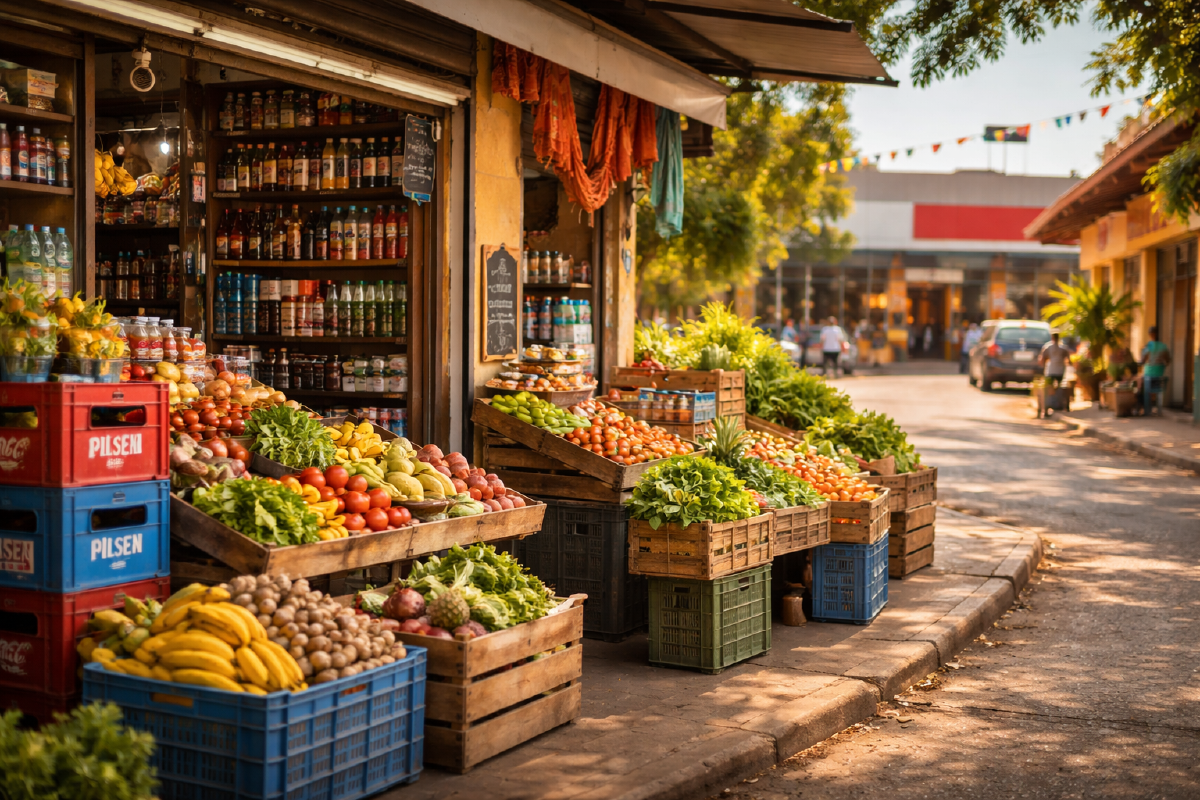
Many prefer to buy fresh fruit and vegetables from small vendors, at market stalls, or at the Verdulería (vegetable shop). Depending on where you live, meat is often bought at the Carnicería (butcher shop) or also at the supermarket.
If you suddenly run out of bread rolls or soap, people often just go quickly to the Despensa (small neighborhood shop) around the corner.
Then there are specialty shops that quickly become important in everyday life: the Farmacia (pharmacy) for medicines and everyday products, the Ferretería (hardware store or small home improvement store) for tools, repair supplies, and building materials, or the Agroveterinaria (shop for animal supplies, gardening, and agricultural products) when you need something for animals, the garden, or the property.
Especially in rural areas, neighbors, small private sales, and informal offers also play a bigger role than many people from Europe are used to. Not everything there runs through classic store structures.
🧺 Products, price impression, and quality#
One thing that stands out is that everyday shopping in Paraguay often clearly separates basic supply, freshness, and specialty purchases. Everyday products are usually easy to get. With imported or more special items, it quickly becomes more selective depending on where you are. In Asunción or larger cities, the selection is naturally broader. In smaller towns, the range is often more down to earth, but still completely sufficient for normal everyday life.
At first glance, many things may seem simpler than in Germany. But that is not automatically a disadvantage. Especially local products are often uncomplicated, fresh, and well suited to everyday life here. With fruit, vegetables, meat, or baked goods, you quickly notice that origin, season, and place are often more important than packaging or brand.
Anyone new to the country is sometimes surprised that certain familiar products are not available everywhere. On the other hand, there are things in Paraguay that are completely normal and that many people in Germany barely had on their radar. That is also part of what makes shopping here a little exciting.
🧭 What does that mean in practical everyday terms?#
Opening hours and availability#
First the good news: in many areas, you can often get more in everyday life than you expect at first. Supermarkets, pharmacies, gas station shops, and small stores complement one another quite well. Especially in larger cities, that gives you a lot of flexibility.
Still, you should not rely too much on rigid habits. Opening hours can vary depending on the place, owner, holiday, or weekday. In the countryside, the selection is often smaller, and small shops sometimes follow the actual local daily rhythm more than a perfectly scheduled logic.
That is why I quickly got used to allowing a bit of buffer time for more important errands. Especially when you need something specific, shopping earlier is often the more relaxed option.
Especially on Sundays, holidays, and long weekends, it is worth planning a bit more ahead. Depending on the place, some shops may have shorter opening hours, while other stores, gas station shops, or smaller local suppliers become particularly important. Before holidays, it also often gets much more crowded.
Do not rely blindly on general assumptions for important errands. It is better to check or ask again shortly beforehand.
Shopping, distances, and organization#
Whether you need a car for everyday life depends heavily on where you live. In more central areas, it is often surprisingly possible to get by well even without your own vehicle. In the countryside or in more sparsely built-up regions, things are naturally different. Then a car quickly becomes very practical, especially for larger shopping trips, crates of drinks, hardware store items, or anything you do not want to carry around in the heat.
What I personally find useful is not to plan shopping in Paraguay too much according to a German pattern. One big complete weekend shop can work, but often a mixed system is more realistic. One part is planned, the rest is added flexibly. That usually fits everyday life here much better.
The weather also plays a bigger role than you may think at first. In strong heat, you automatically think about how long you will be out. Especially with chilled goods such as meat, dairy products, or frozen items, a cooler bag or at least a well-planned way home is worth it. What looks like only a short errand on paper can quickly become unpleasantly long in the sun and rush hour traffic. When it rains, you may prefer to postpone certain things. And if parking or access is annoying at the moment, you simply get the rest somewhere else later.
Payment methods and service#
Card payment is much more normal today than it used to be, and QR payment has also firmly become part of everyday life in many areas. Still, cash remains practical. Not every small shop works the same way, change can sometimes be an issue, and for small amounts it is often more relaxed to have some cash in your pocket.
For me, the most comfortable option is the combination. Card or QR when it fits, cash as a backup. That gives you a lot of flexibility in everyday life. It is also helpful to have some small change or more suitable bills with you. Especially in smaller shops or for small amounts, having change is not always taken for granted right away.
When it comes to service, Paraguay is often more personal than many people know from Germany. People are more likely to ask briefly, you get direct human feedback more quickly, and you notice that small and larger stores often work in a very solution-oriented way.
What may feel unfamiliar is especially the first checkout experience: while you are still expecting to pack your things into the cart or your bags yourself, suddenly someone is already there helping to pack. In many shops, that is completely normal. Often the store’s own bags are used for this, usually for a small fee. Many people simply reuse them later, for example as trash bags. If you prefer to use your own bag, you can usually say so politely. With larger purchases, the bags are sometimes even carried to the car. Especially when you are out alone, you often experience this helpfulness quite directly.
Good to know: In many supermarkets or larger stores, backpacks or larger bags must be left at the entrance or placed in a locker. That is why many people prefer to take only a small bag or waist bag when shopping.
On the other hand, it can also happen that in a larger store nobody approaches you at first, or in the opposite case several employees want to help you at the same time. You simply have to be prepared for that. Not everything is perfectly standardized, but many things work in a friendly, pragmatic, and often surprisingly uncomplicated way.
A friendly greeting and briefly asking a question often get you further in everyday life than exaggerated efficiency. That sounds trivial, but it really does make a difference.
Regional differences when shopping#
The differences between city and countryside are very clear when shopping. In Asunción and the greater Central area, many things are easier, denser, and more modern. There you usually have several supermarkets, pharmacies, shopping centers, delivery services, and small shops within a relatively short distance. Anyone new to the country often finds their way more quickly there.
In Encarnación, shopping often feels to me a bit more organized and urban, while at the same time more relaxed than in a big capital city. Ciudad del Este, on the other hand, has its own very distinct shopping dynamic. There it is not just about everyday life, but also about border shopping, technology, larger purchases, and much more movement around trade in general.
In smaller towns or rural regions, the Despensa quickly becomes more important than any major shopping plan. There, what matters less is the theoretical selection and more the question of what can be reached reliably. That is exactly when you notice how valuable local routines and good contacts can be in everyday life.
Delivery services, WhatsApp orders, and online orders are definitely part of everyday life in Paraguay, but they depend strongly on where you live. In larger cities, many things are much easier, while the offer in smaller towns or rural areas can be more limited.
If you are new somewhere, local Facebook pages, Google Maps, recommendations from neighbors, and short questions in groups often help more than any perfect online research.
Shopping as a visitor or expat: do’s and don’ts#
If you are new to Paraguay, the most helpful thing is a calm, open attitude. Do not come across as too demanding, greet people kindly, ask briefly, and stay patient. This is not a big etiquette guide, but simply the way many things work more easily here.
Do’s in everyday life:
- greet people kindly and do not jump straight in
- simply ask if you are unsure
- when making larger purchases, keep the cold chain and transport in mind
- especially at the beginning, it is better to make several small test purchases than one huge bad purchase
Don’ts in everyday life:
- do not expect every shop to work exactly the same way
- do not react in annoyance when something works differently from planned
- do not carry bags, phone, and valuables around unnecessarily openly
- do not start larger shopping trips too late or too unprepared, especially in the heat or before holidays
Especially for expats, it helps to see shopping not just as an errand, but as part of settling in. You understand quite quickly how the area works through it.
Practical phrases for everyday life#
A simple Hola, buen día (Hello, good day) almost always works well. Here are a few more simple phrases in 🇪🇸 that can help you while shopping:
¿Acepta tarjeta o QR?
Do you accept card or QR?¿Tiene cambio?
Do you have change?¿Hay más de esto?
Is there more of this?
And if you hear a few words of Guaraní, do not be alarmed. For shopping, Spanish is completely enough in most situations. But with a friendly Aguyje (Thank you), you show appreciation and often get an open smile in return.
🗓️ Tips and planning#
If you want to shop in Paraguay in a relaxed way, just get started. Find a good supermarket for the basics, a nearby despensa, a pharmacy you can find again, and later maybe a market or specialty shop that suits you.
It is also important not to leave everything until the last moment. Certain things are not available everywhere, some things sell out at short notice, and before holidays or longer weekends shopping often gets much busier.
What has worked well for me is to keep supplies not huge, but smart. In other words, enough at home to stay relaxed, but not so much that you constantly end up planning badly. Paraguay often rewards the pragmatic middle ground.
- first get to know the shops in your immediate area
- then find a good larger supermarket
- after that, add markets, hardware stores, or specialty shops
- only tackle border shopping or larger supply tours once normal everyday life already feels settled
❓ Frequently asked questions (FAQ)#
Are supermarkets in Paraguay modern or rather simple?
Do I absolutely need a car for everyday life?
Can I pay by card in Paraguay?
What exactly is a Despensa?
Where is the best place to buy fresh products?
Is shopping in Ciudad del Este always worth it?
How do I find good shops in a new area?
Should I always check opening hours in advance?
Conclusion#
Shopping in Paraguay is less standardized than in Germany, but that is exactly what often makes it surprisingly suitable for everyday life. Once you understand the basic logic, many things no longer seem complicated, but actually quite sensible. Large shopping trips, small spontaneous errands, markets, despensas, and modern supermarkets complement one another more than they compete.
For me, that is exactly one of the things you learn to appreciate over time in Paraguay. Not everything is always polished, but many things work in a very practical and human way. And once you have found your regular places, shopping quickly becomes something completely normal.
Were you already aware of how different shopping in Paraguay can be in everyday life? Then feel free to give the article a like and share it with other South America enthusiasts. That way, you help spread practical knowledge about everyday life in Paraguay.