
🍽️ What is Pasta Frola de Guayaba?#
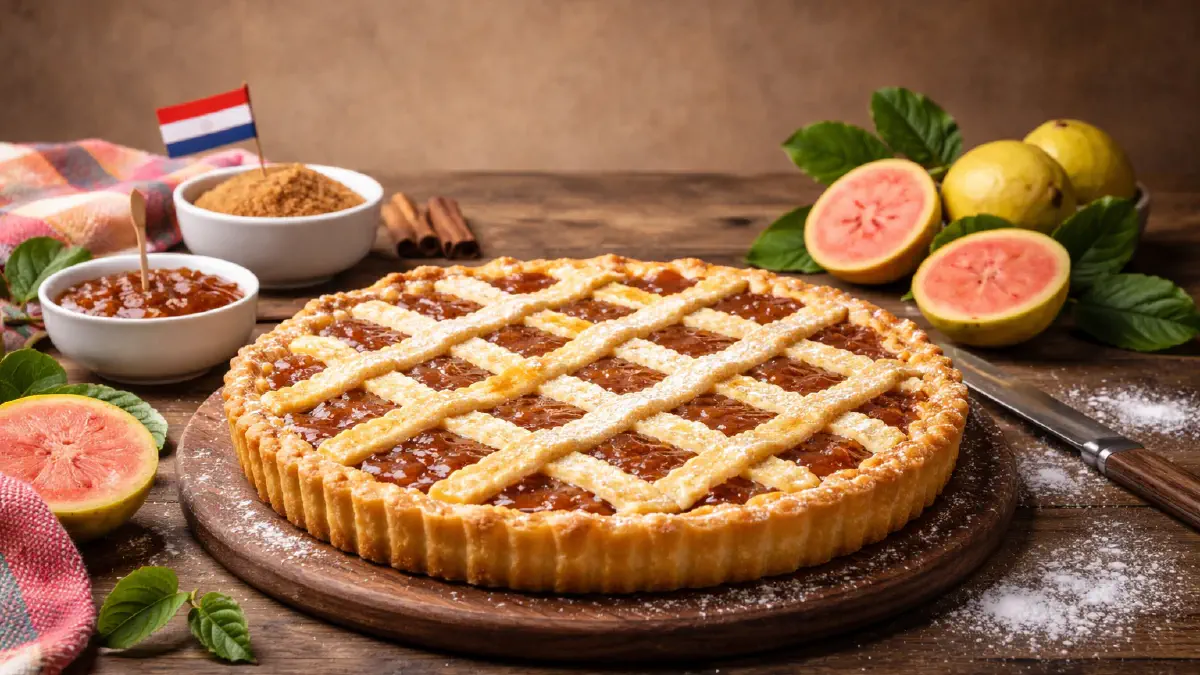
Pasta Frola (also Pasta Frolla or Pastafrola) is a traditional shortcrust pastry tart that can be found in almost every bakery and household in Paraguay. The heart of this tart is a thick layer of fruity guava paste beneath its characteristic pastry lattice. While this specialty is often filled with quince paste (membrillo) in neighboring countries (Argentina and Uruguay), the version with guava (guayaba) is very common here in Paraguay. The pastry is tender and smells wonderfully of vanilla or lemon, which harmonizes perfectly with the intense sweetness of the fruit.
Would you like to try the recipe right away?
Go straight to the recipe🇵🇾 The cultural tradition behind Pasta Frola de Guayaba#
Anyone living in Paraguay comes across this pastry quite quickly. For many people, it is a natural part of merienda and is also often baked when visitors come over or when there is a special occasion.
Historical origin#
Pasta Frola goes back to European baking traditions and is closely linked to the Italian pastafrolla and crostata. With immigrants, the basic idea of the lattice tart came to South America, where it was gradually adapted to regionally available ingredients. In Paraguay, the filling with guava paste became established as a particularly popular version.
Importance in the regional cuisine#
In Paraguayan cuisine, this tart holds an important place because it is inexpensive to make and at the same time keeps very well. It is often the centerpiece of family celebrations or the classic afternoon merienda. The making of the lattice is often passed down from one generation to the next and is considered a small sign of handmade love for baking.
A closer look at the main ingredients#
A good recipe stands or falls with the quality of its ingredients, which in Paraguay are often sourced directly from the local market.
Guayaba - the foundation of the recipe#
Guava, called guayaba in Paraguay, is a real vitamin-rich fruit and forms the aromatic center of Pasta Frola. In everyday cooking, it is usually used as a firm paste called “Dulce de Guayaba.”
Nutrients: Guavas contain a lot of vitamin C and provide valuable fiber as well as antioxidants.
Health aspects: The fruit is considered good for digestion and supportive of the immune system, although with the processed paste you should of course keep an eye on the sugar content.
The consistency of the guava paste is crucial for success, because it must not become too runny in the oven. The best option is firm guava paste in a block (“Dulce de Guayaba”). Soft spreads or liquid guava jam are usually too loose for the lattice.
Other special ingredients#
Besides the fruit filling, the pastry plays the most important role in the mouthfeel.
A real Paraguayan shortcrust pastry for Pasta Frola is characterized by its softness, which comes from a good amount of fat and egg yolks. It must be stable enough for the lattice, but still melt in your mouth.
Local tip: In Paraguay, lard is often used instead of butter, which gives the pastry an especially tender texture.
Recipe for Pasta Frola de Guayaba - step by step#
At a glance
- Difficulty: Medium
- Preparation time: about 75 minutes (including baking time)
- Servings: 12 pieces
📝 Main ingredients#
- 400 g wheat flour (type 405 or Paraguayan “0000”)
- 200 g cold butter or margarine
- 150 g sugar
- 2 eggs plus 1 egg yolk
- 1 tsp baking powder
- 1 pinch of salt
- Zest of one organic lemon or a little vanilla extract
- 500 g Dulce de Guayaba (guava paste in a block)
- A little water to smooth out the filling
Optional ingredients#
- A splash of Paraguayan caña (sugarcane spirit) in the dough or wine in the filling for extra aroma.
- Shredded coconut to sprinkle over the edge after baking.
Substitutions#
Pasta Frola is naturally vegetarian and can be adapted quite easily with a few adjustments.
Different filling: If guava paste is not available, quince paste (Dulce de Membrillo) works very well as a substitute. A very thick plum jam also works, although the flavor is a bit different.
Gluten-free: For a gluten-free version, you can use a universal gluten-free flour blend for cakes. A little xanthan and possibly a bit more liquid help keep the dough more pliable.
Vegan version: Butter can be replaced with plant-based margarine or solid coconut fat. Suitable egg substitutes include ready-made egg replacers, applesauce, or a mixture of chia seeds and water.
Important when using substitutes: Gluten-free doughs are often more fragile, so the lattice is easier to place than to weave. With coconut fat, the dough usually browns faster, so keep a close eye on the baking time.
Required kitchen equipment#
- Large mixing bowl
- Rolling pin
- Round baking pan (about 26-28 cm in diameter)
- Fork
- Small saucepan or microwave-safe bowl for warming the paste
👩🍳 Step-by-step preparation#
Preparation#
First, mix the flour with the baking powder and sugar in a bowl.
Cut the cold butter into small cubes and work it into the flour mixture with your fingertips until you get a sandy consistency.
Alternatively, you can use margarine. The dough will usually be a bit softer and less buttery in flavor.
Then add the eggs, the egg yolk, and the lemon zest and quickly knead everything into a smooth dough.
Let the dough rest in the refrigerator for at least 30 minutes so it will be easier to roll out later.
Preparation / baking process#
Preheat the oven to 180 °C top and bottom heat.
Cut the guava paste into cubes and warm it in a saucepan with 2 to 3 tablespoons of water until it becomes a spreadable mixture.
Roll out about two thirds of the dough and use it to line the bottom and sides of the greased baking pan.
Spread the guava filling evenly over the pastry base.
Roll out the remaining dough and cut it into strips about 1.5 cm wide.
The lattice pattern (“Enrejado”) requires a bit of patience, but it works more easily if the pastry strips are well chilled.
- Lay the strips over the filling in a diamond pattern and press the ends firmly onto the edge.
Make sure the guava mixture has cooled down a little and that the strips are thick enough so they do not sink into the filling.
Tip: Whisk egg yolk with a splash of milk and brush the strips with it - this gives the tart its typical golden, glossy look.
- Bake the tart for about 30 to 40 minutes, until the lattice is golden brown.
🔄 Variations of the recipe#
Regional variations#
A popular variation is a thin layer of cream cheese beneath the guava paste - inspired by the classic combination of guava and cheese. The sweet-salty contrast works very well here too.
Did you know? The combination recalls the widespread pairing of cheese and fruit paste in Latin America - especially well known in Brazil as “Romeu e Julieta.”
Dulce de Leche is also often used as a filling or combined with guava.
Modern interpretations#
In modern cafes, you can also find Pasta Frola with a touch of dark chocolate in the guava filling or with a shortcrust pastry enriched with ground almonds.
What goes well with Pasta Frola de Guayaba?#
To make your meal feel complete, here are a few ideas for side dishes and drinks that pair well with it.
- Lightly whipped or unsweetened cream: Softens the sweetness of the guava and makes the pastry feel a little lighter.
- Mild cream cheese or fresh cheese: Creates a gentle, slightly salty contrast to the sweet filling.
- Vanilla ice cream: Especially delicious when the tart is still slightly warm.
- Fresh fruit: A few slices of fresh guava or orange as a decorative side.
- Café de saquito: A simple filter coffee pairs perfectly with this sweet pastry.
- Mate: A hot mate tea balances the sweetness of the tart nicely with its herbal notes.
- Mate Cocido or Cocido con leche: Works especially well if you want something milder with your sweet pastry.
Nutritional overview#
Per serving (about 80 g):
- Calories: 310 kcal
- Protein: 4 g
- Carbohydrates: 52 g
- Fat: 10 g
- Fiber: 2 g
The nutritional values are averages and may vary depending on the guava paste and type of fat used.
❓ Frequently asked questions (FAQ)#
Can I prepare the dough the day before?
Where can I find guava paste in Germany?
Can I use regular jam instead?
Which pan works best: tart pan, springform pan, or baking tray?
Should I prick the base or blind bake it?
Why does the base turn soft or soggy?
Can I also bake Pasta Frola in a rectangular pan?
My lattice sinks into the filling. What did I do wrong?
Why does my dough crack when I roll it out?
What is the best way to store Pasta Frola?
Can I freeze Pasta Frola de Guayaba?
Conclusion#
Pasta Frola de Guayaba combines simple shortcrust pastry with a filling that feels very familiar in Paraguay. It is precisely this mix of everyday practicality, sweetness, and tradition that makes the tart so popular to this day. Whether for merienda, for visitors, or simply in between - it can be prepared well in advance and suits many occasions.
Did this traditional Pasta Frola de Guayaba recipe inspire you and spark your curiosity about Paraguay? Then feel free to give the post a like and share it with other South America enthusiasts - helping make Paraguay’s culinary diversity more visible