
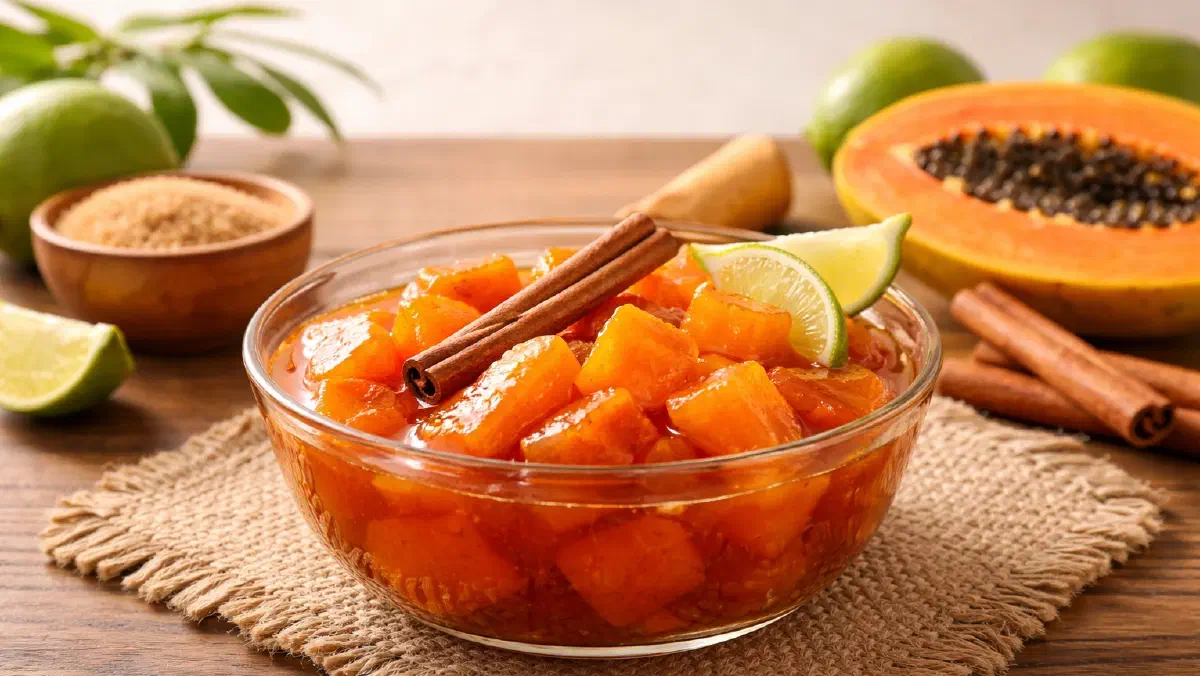

What can you do with a papaya that is still green and far too firm to eat? In Paraguay, it becomes Dulce de Mamón. Slowly simmered in sugar syrup, the firm fruit turns golden and sweet while still holding its shape.
That contrast is what makes this Paraguayan dessert so distinctive: the papaya, commonly called mamón here in Paraguay, softens and absorbs the syrup without turning into jam. The recipe takes a little patience, but needs only a few ingredients and can easily be prepared in advance.
This recipe uses a straightforward baking-soda method and walks you through the process step by step.
📝 Dulce de Mamón Recipe - Step by Step#
At a glance
- Difficulty: medium
- Preparation: about 20 to 30 minutes
- Soaking time: about 1 hour
- Cooking time: about 2 to 4 hours
- Servings: about 10 to 15, depending on serving size
The exact cooking time depends mainly on how ripe the papaya is and the size of the pieces.
🛒 Ingredients for Dulce de Mamón#
For Dulce de Mamón, the most important ingredient is a firm, still-green papaya. You will also need sugar, water and a little baking soda for the soaking step.
Main ingredients#
- 2 kg firm green papaya (mamón)
- 1.5 kg white sugar
- about 2 liters of water
- 2 tbsp baking soda
- enough water to cover the papaya for soaking
Optional ingredients#
- 1 to 2 cloves
- 1 cinnamon stick
- a little lemon or orange peel
- a few drops of lemon juice
- a little vanilla extract
- a small piece of ginger
- a small pinch of salt
Start sparingly with spices. Cinnamon and especially cloves can quickly overpower the mild flavor of the papaya.
What ingredients can you substitute?#
Ingredient alternatives
The basic recipe is naturally vegan and gluten-free.
- Sugar: You can also use brown cane sugar. It gives the syrup a darker color and a deeper, slightly caramel-like flavor.
- Baking soda: A traditional alternative is food-grade calcium hydroxide (E526), also known as slaked lime. In Spanish, look for cal apagada apta para alimentos. It is used as a firming agent. Do not confuse it with cal viva or cal virgen, which refer to calcium oxide or quicklime.
Kitchen equipment#
- large bowl or container for soaking
- large, heavy pot
- vegetable peeler
- sharp knife
- cutting board
- wooden spoon or long-handled spoon
- clean jars with tight-fitting lids for storage
👩🍳 Step-by-step preparation#
Preparation#
- Wash and thoroughly peel the papayas.
Tip: Green papaya can release a sticky, whitish latex when peeled. If you have sensitive skin, wearing gloves can make handling it more comfortable.
- Cut the papayas lengthwise and remove the seeds.
- Cut the firm flesh into roughly 2 to 3 cm cubes, or into strips or slices of a similar thickness.
- Try to keep the pieces roughly the same size so they cook evenly.
- Place the papaya pieces in a large bowl and cover them completely with water.
- Stir in 2 tablespoons of baking soda and let the papaya soak for about 1 hour.
- Drain, then rinse the pieces several times thoroughly with clean water.
Cooking#
Prepare the syrup: Put the sugar and about 2 liters of water into a large pot. Heat gently until the sugar has dissolved.
Add the papaya: Carefully place the rinsed papaya pieces into the syrup. If you are using cinnamon, cloves or citrus peel, add them now.
Cook slowly: Let everything simmer gently over low heat. Depending on the ripeness and size of the pieces, the papaya will need about 2 to 4 hours.
Move the pieces as little as possible: Do not stir constantly. Move the papaya only when necessary and do so gently to keep the pieces from breaking apart.
Watch the liquid: If the papaya is still firm but too much liquid has evaporated, add a little hot water and continue cooking.
Check for doneness: The Dulce de Mamón is ready when the pieces have turned increasingly golden and slightly translucent, while the syrup has thickened noticeably but is still pourable.
Adjust the flavor: Add vanilla, a few drops of lemon juice or other delicate flavors near the end of the cooking time.
Let it cool: Remove the pot from the heat. The syrup will thicken a little more as it cools.
Once completely cool, transfer the Dulce de Mamón to clean jars with tight-fitting lids and store it in the refrigerator. It is best eaten soon after making it. In our house, that is rarely a problem because it usually disappears quickly.
💡 Practical tips for Dulce de Mamón#
Tips for a good result
Choose the right papaya: The fruit should be full-sized, firm and still mostly green. Inside, the flesh should be pale to whitish and noticeably firmer than that of a ripe papaya.
Avoid very ripe fruit: Once the skin starts turning yellow or orange, the fruit becomes fragrant and gives noticeably when pressed. At that stage, the pieces are much more likely to fall apart during the long cooking time.
Adjust the sweetness: This recipe uses 1.5 kg sugar for 2 kg papaya. If Paraguayan sweets are too sweet for your taste, you can reduce the sugar somewhat. The resulting syrup will be lighter and less concentrated.
Cook patiently: Low heat matters more than shortening the cooking time. The papaya should soften while still keeping its shape.
Do not reduce the syrup too far: It continues to thicken as it cools. Take the pot off the heat while the syrup is still easy to pour.
Nutritional overview#
The figures below are a very rough estimate per 100 g of Dulce de Mamón, roughly a small dessert serving.
- Calories: approx. 280 kcal
- Protein: approx. 0.5 g
- Carbohydrates: approx. 68 g
- Fat: approx. 0.1 g
- Fiber: approx. 1.5 g
These values are only estimates. They can vary considerably depending on the amount of sugar, the ripeness of the papaya, cooking time and the final cooked weight.
🍽️ What goes well with Dulce de Mamón?#
A particularly typical pairing in Paraguay combines the sweet syrup with a mild, lightly salted cheese.
Classic: A slice of Queso Paraguay is probably the most typical accompaniment. The sweet mamón and mild, lightly salted cheese complement each other especially well. If Queso Paraguay is not available, a mild queso fresco or another mild, not overly salty cheese works well.
Lighter: Plain yogurt adds a little acidity and freshness to balance the rich syrup.
Creamy: A small serving of Dulce de Mamón also works well with vanilla ice cream or a little unsweetened cream.
Paraguayan: Cocido, a warm yerba mate drink, pairs well with a small serving of Dulce de Mamón, especially at merienda time.
Strong: Black coffee provides a pleasant contrast to the sweetness.
Simple: With a particularly sweet Dulce, a glass of cold water is often all you need.
🔄 Variations of the recipe#
Like many Paraguayan recipes, Dulce de Mamón varies from family to family. Recipes differ in how the fruit is prepared, the amount of sugar used and the flavors added.
Known variations#
Dulce de Mamón rallado with Miel de Caña: In this traditional variation, the peeled mamón is coarsely grated and then cooked with Miel de Caña (sugarcane syrup). Rather than large fruit pieces, the result is a softer, darker mixture with the stronger flavor of sugarcane syrup.
With a citrus note: Some recipes add lemon slices or a little citrus peel during cooking. The light acidity creates a fresh contrast to the intense sweetness.
Modern variations#
Dulce de Mamón can also be used as part of other desserts. Small pieces work well as a topping for cheesecake.
For guests, I like to serve Dulce de Mamón in small glasses with plain yogurt. It takes the edge off the sweetness and is easy to prepare ahead. Toasted nuts on top add a little extra crunch.
🇵🇾 Background on Dulce de Mamón#
Name and spellings#
Mamón is the common Spanish name for papaya in Paraguay. In Guaraní, the form mamóne is also used. It was borrowed from the Spanish word mamón.
The name Dulce de Mamón, also often written Dulce de Mamon without the accent, therefore refers to this dessert made from mamón, or papaya.
What makes Dulce de Mamón special?#
This version of Dulce de Mamón uses a full-sized papaya that is still firm, green and unripe. That is an important difference from preparations made with fully ripe, soft papaya.
As the fruit cooks slowly, it absorbs the sugar syrup, changes color and becomes increasingly translucent. At the same time, the individual pieces should keep their shape.
The result falls somewhere between cooked fruit and jam: the papaya remains clearly recognizable as pieces of fruit and is served together with its syrup.
What role does Dulce de Mamón play in Paraguay?#
Dulce de Mamón is one of Paraguay’s well-known traditional sweets. It is served as a dessert or at merienda time and appears both in family recipes and in traditional Paraguayan cuisine.
As with many traditional recipes, there is no single fixed method. Some families use food-grade calcium hydroxide, others use baking soda, while some use neither. Recipes also vary in the amount of sugar, how ripe the papaya is, the size and shape of the pieces, and the spices used.
One particularly typical pairing is Queso Paraguay. Its mild, lightly salty flavor balances the rich sweetness of the syrup. The same contrast between sweet and salty appears in other Paraguayan desserts as well.
❓ Frequently asked questions#
What kind of papaya should I use for Dulce de Mamón?
A full-sized papaya that is still firm and green works best for this recipe. The skin should remain mostly green and the fruit should barely give when pressed. Inside, the flesh should still be pale to whitish and firm.
A soft, ripe papaya with yellow or orange skin is much more likely to fall apart during the long cooking time. It is therefore less suitable when you want distinct pieces of papaya in syrup.
Do I need baking soda or food-grade calcium hydroxide?
No. There are several traditional methods. Some use food-grade calcium hydroxide, others use baking soda, and some recipes use neither.
This recipe uses baking soda to help the papaya pieces keep their shape during the long cooking time.
If you want to try the traditional calcium-hydroxide method, use only food-grade calcium hydroxide (E526), also known as slaked lime or cal apagada apta para alimentos. Do not use calcium oxide, quicklime, cal viva or cal virgen, and never use a product that is not explicitly suitable for food.
How do I keep the papaya pieces from falling apart?
Start with a firm green papaya and cut the pieces as evenly as possible. Rinse them thoroughly after the baking-soda soak, then cook them only over low heat.
Avoid unnecessary stirring. If you need to move the pieces, do so gently so they do not break apart.
How do I know when Dulce de Mamón is done?
The papaya pieces gradually become golden and slightly translucent. They should be soft enough to eat while still holding their shape.
The syrup should be noticeably thicker but still pourable. Remember that it thickens further as it cools, so do not reduce it to a very thick consistency while it is still in the pot.
What if the papaya is still firm or the syrup is too thin?
If the papaya is still too firm but there is very little liquid left in the pot, add a little hot water and continue cooking gently.
If the papaya is already done but the syrup is still too thin, carefully remove the fruit pieces and let only the syrup reduce a little longer. This helps prevent the finished papaya from falling apart.
How should I store Dulce de Mamón?
Let the Dulce de Mamón cool completely, transfer it to clean jars with tight-fitting lids and keep it in the refrigerator. It is best eaten soon after making it.
Discard the entire contents if you notice mold, a fermented smell, bubbling or other unusual changes.
Without a tested canning process, the exact shelf life of a homemade batch cannot be stated reliably. Do not assume that the high sugar content alone makes it safe to store for several months.
Conclusion#
Dulce de Mamón is a simple recipe, but it does take a little patience. The slow cooking is part of what makes it special: the firm green papaya gradually turns into golden, sweet pieces of fruit surrounded by syrup.
If you have green papayas to use up or simply want to try a traditional Paraguayan sweet, Dulce de Mamón is a lovely recipe for a quiet afternoon in the kitchen. And I think it is worth trying at least once with a piece of Queso Paraguay on the side.
If you want to see how a similar idea works with a different ingredient, have a look at Dulce de Calabaza. Instead of green papaya, it uses pumpkin. The preparation follows a similar principle, but the finished dessert tastes quite different.
You can find more traditional sweets among our Paraguayan desserts.
Have fun making it and “buen provecho”!
Share & support
Did this Dulce de Mamón recipe make you want to try one of Paraguay’s traditional sweets?
Give the post a like and share it with other South America enthusiasts. That helps make Paraguay’s food and everyday culture more visible.