
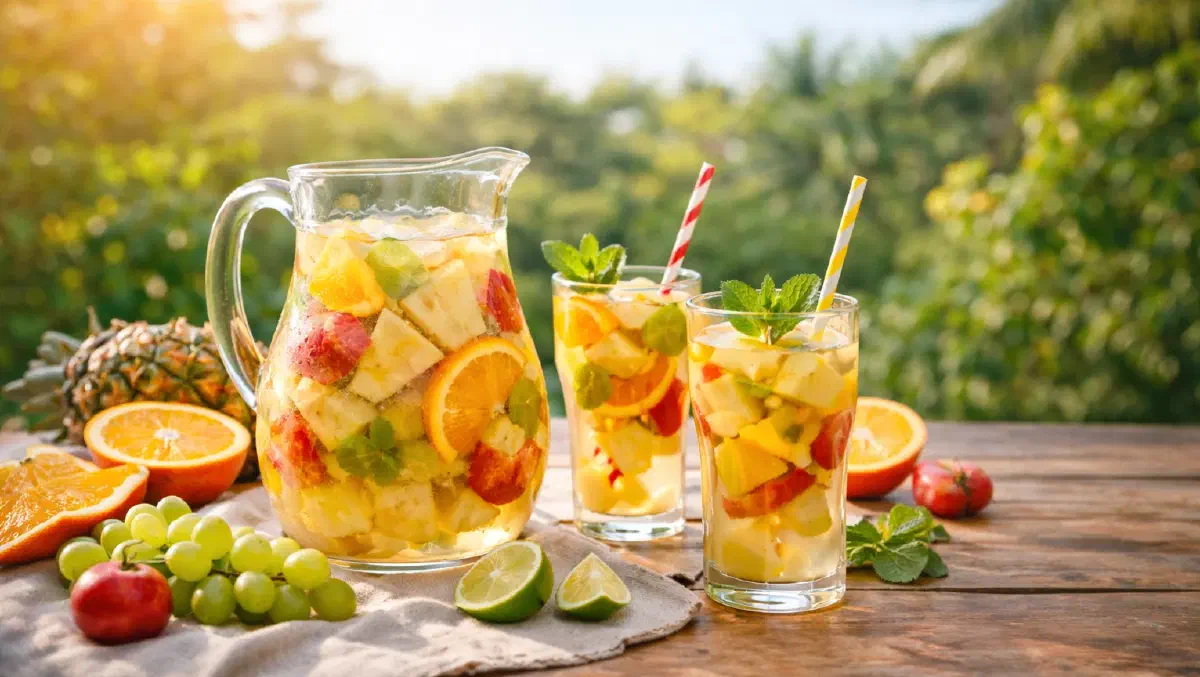

Clericó is one of those drinks you see on many tables in Paraguay, especially around Christmas and New Year. That fits December here: while winter dishes and mulled wine are common elsewhere, Paraguay is in the middle of summer. A well-chilled Clericó with fresh fruit feels just right.
Clericó is a chilled Paraguayan drink with chopped fresh fruit and a base of sidra, wine, or juice. In English, it can be described as both a fruit punch and a fruity cocktail.
The recipe itself is simple and leaves plenty of room for variation. For this version, I use sidra, an alcoholic, usually sparkling drink that is especially easy to find here around the end of the year. Four fresh fruits, a little citrus juice, and ice complete the mix.
📝 Clericó Recipe: Step by Step#
At a glance
Difficulty: Easy
Prep time: about 20 minutes
Resting time: about 20 to 30 minutes
Servings: about 6 large or 8 smaller glasses
🛒 Ingredients for Clericó#
For this basic Clericó recipe, four types of fruit are enough. This keeps the mix fruity without letting all the individual flavors disappear into one another.
Main ingredients#
- 1 bottle well-chilled sidra, about 900 ml
- ½ small pineapple, about 250 g fruit
- 1 medium apple
- about 250 g melon
- 150 g grapes
- Juice of ½ lemon or lime
- 1 to 2 tbsp sugar, only if needed
- plenty of ice cubes
Optional ingredients#
You can replace individual fruits from the basic recipe. Good options include:
- Banana
- Peach
- Orange
- Pear
Banana is quite common in Paraguayan Clericó recipes. It makes the mixture sweeter and softer, but it also turns brown and mushy more quickly. That is why I prefer to list it as an alternative rather than use it in the basic version.
What can you substitute?#
Ingredient alternatives and practical adjustments
Other alcoholic bases: Instead of sidra, you can use white wine, rosé, red wine, or sparkling wine. The sweeter the base, the less extra sugar you will need.
Alcohol-free: Replace the sidra with the same amount of grape juice. If that is too sweet for you, replace part of the juice with mineral water.
Swap the fruit: Melon can be replaced with peach or banana. Instead of grapes, you can use more apple or peach.
Less sweet: Use more apple and citrus fruit, and leave out the extra sugar at first.
Kitchen equipment#
You do not need any special equipment for Clericó:
- Cutting board
- Sharp knife
- Large bowl or punch bowl
- Wide-mouth pitcher or jug
- Spoon for gentle stirring
- Refrigerator
- Glasses for serving
A bowl or wide-mouth jug is especially practical. It makes it easier to add and stir the fruit and later serve some of the pieces with the Clericó.
👩🍳 Step-by-step preparation#
Preparation#
- Peel the pineapple and remove the hard core.
- Wash the apple and remove the core.
- Prepare the melon and remove the seeds.
- Wash the grapes well. You can cut large grapes in half.
- Cut all the fruit into small, easy-to-eat pieces.
- Keep the sidra chilled until you are ready to serve.
Mixing the Clericó#
Place the chopped fruit in a large bowl or wide-mouth jug.
Drizzle with lemon or lime juice. If the fruit is not very sweet, add one tablespoon of sugar to start. Mix gently.
Let the fruit rest in the refrigerator for about 20 to 30 minutes. Some fruit juice will already collect during this time.
Pour in the well-chilled sidra and stir gently.
Add the ice shortly before serving, or put the ice cubes directly into the glasses. This keeps the Clericó from becoming unnecessarily watered down.
Serve some liquid and several pieces of fruit in each glass. A small spoon is useful because the fruit is meant to be eaten as part of the Clericó.
💡 Practical tips for Clericó#
How to get the best result
Less can be more with fruit: Four well-chosen fruits are enough. Ripe fruit and a good balance of sweet, fresh, and juicy flavors matter more than a long ingredient list.
Chill the sidra well: The colder the fruit and sidra are before serving, the less ice you will need.
Be careful with sugar: Many sidras and ripe fruits are already quite sweet. Start with little or no extra sugar.
Add soft fruit later: Banana and very ripe peach break down more quickly. Add them as late as possible and stir gently.
Keep the fruit-to-liquid ratio balanced: The fruit pieces are an important part of Clericó. If you add too much sidra or wine, the fruit can easily get lost in the drink.
Best served fresh: Clericó is at its best when the fruit still has some bite and everything is well chilled. There is no need to prepare it many hours in advance.
Nutrition information#
Based on six generous servings, the basic recipe contains approximately:
- Calories: about 160 kcal
- Protein: about 1 g
- Carbohydrates: about 25 g
- Fat: about 0 g
- Fiber: about 2 g
These values are estimates. The type of sidra, the fruit, and any added sugar can change the nutritional values considerably.
🍽️ What Goes Well with Clericó?#
In Paraguay, Clericó is not usually paired with one specific dish in the way you might pair wine with a meal. It is more often part of the whole gathering, especially around Christmas and New Year.
A few combinations have a particularly strong connection to Paraguay:
| Serve it with | Why it works |
|---|---|
| Pan dulce | Clericó and pan dulce have a historical connection to year-end hospitality. Both were offered to visitors together. |
| Sopa Paraguaya | This savory corn bread is another classic on Paraguayan Christmas and holiday tables. |
| Chipa Guasu | The soft corn casserole is common at family gatherings and year-end celebrations and gives a savory contrast to the fruity Clericó. |
When I serve an alcoholic version, I also put cold water or mineral water on the table. On hot December days, that is a good idea anyway.
🔄 Variations of the Recipe#
Like many Paraguayan recipes, Clericó is prepared a little differently from family to family. The fruit and liquid often depend on what is available and what the guests enjoy.
Common variations#
With red wine: A fuller version with an interesting historical connection. In the past, kleriko in Paraguay was also prepared with red wine.
With white wine: A fresh option that can be drier than sidra, depending on the wine you use.
With rosé or sparkling wine: A lighter, festive variation that also works well with fresh fruit.
Alcohol-free Clericó: Grape juice replaces the alcoholic base. This version is suitable for children and anyone who does not want alcohol.
Modern variations#
For a lighter version, replace part of the liquid with cold mineral water. Fresh mint or a little extra lime can add even more freshness.
Even with modern variations, I would not add too many extras. The fruit should stay at the center of the drink.
🇵🇾 Background and Tradition#
Name and spelling#
On menus and in recipes, you will usually see the spelling Clericó. In Paraguay, you may also come across Clerico without the accent and kleriko. All three names refer to the same fruity drink.
What makes Clericó special?#
Clericó does not have one fixed recipe. You can see that in the many different versions prepared by Paraguayan families. Whatever is available may end up in the jug. Sometimes it is banana and melon, sometimes apple, grapes, pineapple, or peach. Wine and sidra are both common alcoholic bases.
That flexibility makes Clericó easy to adapt. What matters most is ripe fruit, good chilling, and a balance where neither the fruit nor the liquid takes over completely.
And just like a classic fruit punch, the fruit pieces are an important part of Clericó. They go into the glass and are eaten too. So the little fruit snack comes included. 🙂
What role does Clericó play in Paraguay?#
Clericó is especially closely connected with Christmas and the end of the year in Paraguay. That also fits the climate in Paraguay, because Christmas falls right in the middle of summer here. A cold drink with fresh fruit feels much more natural at 30°C (86°F) and above than a winter-style holiday drink.
If you go shopping in Paraguay in December, you will notice the connection quickly. Sidra is stacked in many supermarkets. Nearby you will find pan dulce and the ingredients needed for Sopa Paraguaya, Chipa Guasu, and the big year-end meals.
There is a reason for that. Christmas (Navidad) and the year-end celebrations are, along with Semana Santa, some of the most important times for large family gatherings in Paraguay. Especially on Nochebuena (Christmas Eve) and around Año Nuevo (New Year), extended families often come together. People spend long hours, and sometimes several days, celebrating, eating, drinking, and simply being together. Asado, Sopa Paraguaya, Chipa Guasu, pan dulce, and Clericó are all part of this season for many families.
You can find more about these and other important dates in our guide to holidays in Paraguay.
Kambuchi, kleriko, and a jug by the front door#
While researching this article, I came across an old Paraguayan tradition that I especially liked.
The Paraguayan Ministry of Public Health and Social Welfare ↗ describes how kleriko used to be prepared with red wine in a kambuchi, a traditional clay jug. When visitors were expected, the jug could even be kept near the entrance of the house. Guests were welcomed with a glass of kleriko, together with pan dulce or other sweets.
The drink was therefore not just a way to cool down. It was also part of year-end hospitality.
Whether a kambuchi is still waiting beside someone’s front door today is probably the exception. Clericó itself, however, has kept its place around Christmas and New Year.
❓ Frequently Asked Questions#
Is Clericó a cocktail or a fruit punch?
Can Clericó be made alcohol-free and served to children?
Yes. For children and anyone who does not want alcohol, replace the sidra completely with grape juice. If the mixture is too sweet, replace part of the juice with cold mineral water.
The regular sidra used in this recipe contains alcohol and is therefore not suitable for children.
What fruit is best for Clericó?
Do I have to use sidra in Clericó?
No. This recipe uses sidra, but red wine, white wine, rosé, and sparkling wine are also possible. Each base changes the sweetness and flavor.
Sidra is an alcoholic, usually sparkling drink that is especially common in Paraguay around Christmas and New Year.
How far in advance can I prepare Clericó?
Can I leave out the sugar?
Can I drink Clericó the next day?
Clericó tastes best when it is fresh. Put leftovers back in the refrigerator as soon as possible. By the next day, many fruits will be noticeably softer and the mixture will lose some of its freshness.
If the Clericó has been left out in the heat for a long time, do not keep the leftovers.
Conclusion#
Clericó is simple, fruity, and just right for the hot days around the end of the year in Paraguay. At the same time, there is more tradition behind a jug full of fruit than you might expect at first.
The old story of the kambuchi by the front door, a glass of kleriko for visitors, and a piece of pan dulce alongside it shows how closely food, drinks, and hospitality have long been connected here.
If you are looking for another fresh recipe for a hot day, try Tropical Ceviche with mango and lime next. You can find more ideas among our Paraguayan drinks.
Have fun making it, and “buen provecho”!
Share & support
Does this make you want to try Clericó yourself? Then give the post a like or share it with someone who might also enjoy this fruity Paraguayan drink. That helps make recipes and stories from Paraguay more visible.