
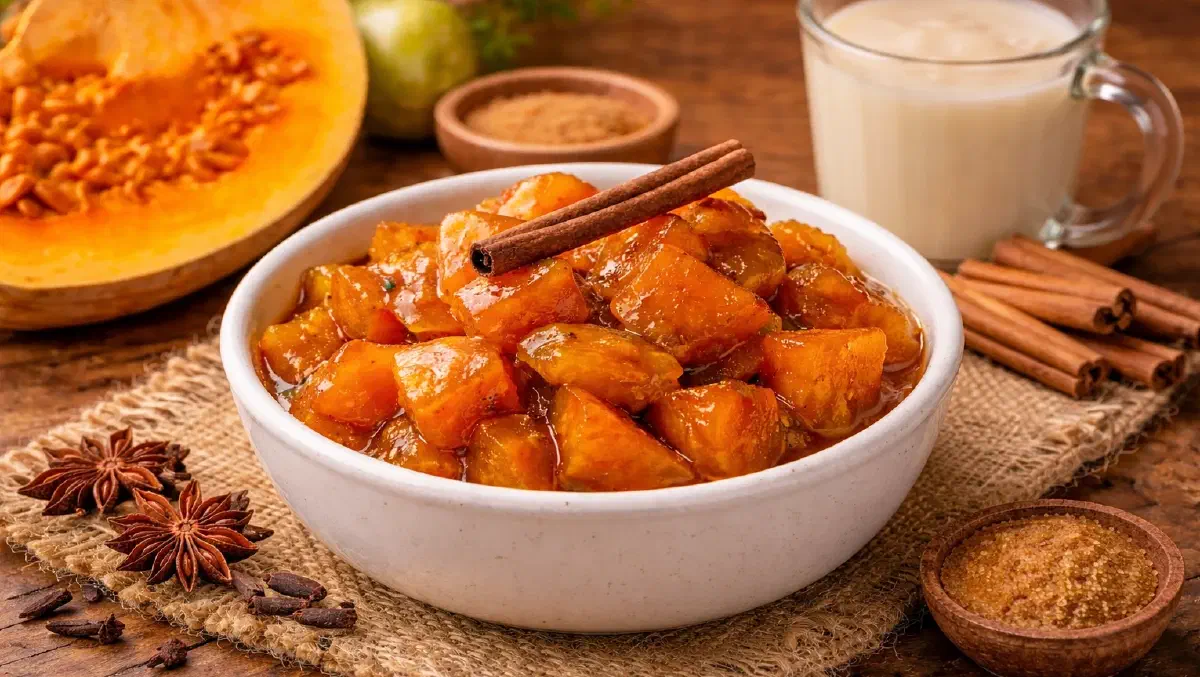

Some years it feels like pumpkins are growing everywhere around us. After a good harvest, several large ones suddenly end up in the kitchen, and I start wondering what else I can make besides another stew. That is exactly how I ended up making Dulce de Calabaza.
Dulce de Calabaza, also known as Andai he’ẽ, is one of Paraguay’s well-known traditional desserts. Pumpkin is slowly cooked with sugar, cinnamon, and cloves until the pieces are soft and surrounded by a sweet, aromatic syrup.
And sweet really does mean sweet here. It took me a while to get used to the sweetness of many Paraguayan dulces, so I usually make them with a little less sugar. That is also one of the nice things about this recipe: you can easily adjust the amount of sugar to your own taste.
📝 Dulce de Calabaza Recipe: Step by Step#
At a Glance
- Difficulty: easy
- Preparation: approx. 15 to 20 minutes
- Cooking time: approx. 60 to 90 minutes
- Total time: approx. 1.5 to 2 hours
- Suitable for: vegan and gluten-free
🛒 Ingredients for Dulce de Calabaza#
For the basic recipe, you only need pumpkin, sugar, a little water, and a few spices.
Main Ingredients#
- 2 kg raw pumpkin
- 500 to 600 g sugar
- 3 to 4 cloves
- 1 to 2 cinnamon sticks, depending on size
- approx. 150 to 200 ml water, or one small coffee cup
Optional Ingredients#
- a little vanilla or 1 vanilla bean
- 1 small cup shredded coconut
- chopped nuts
- 1 to 2 whole star anise or a little cardamom
Start carefully with the spices. Cloves in particular can quickly overpower the other flavors.
What Can You Substitute?#
Ingredient Substitutions
Pumpkin: In Paraguay, Andai is often used for dishes like this. Outside Paraguay, butternut squash is an easy substitute. Muscat squash also works well. Hokkaido squash works too, but it usually becomes softer during the longer cooking time.
Sugar: White sugar gives you a lighter, more neutral syrup. Brown cane sugar also works, but it makes the color darker and adds a slight caramel flavor.
Kitchen Tools#
- large pot
- cooking spoon
- sharp knife
- cutting board
- vegetable peeler, if needed
👩🍳 Step-by-Step Preparation#
Preparation#
- Wash the pumpkin and peel it if needed, depending on the variety.
- Remove the seeds and soft inner fibers.
- Cut the flesh into fairly even, large cubes. About 3 to 4 centimeters is a good guide.
Cooking#
Start with the pumpkin, sugar, and spices: Add the pumpkin cubes, sugar, cloves, and cinnamon sticks to a large pot.
Add only a little water: Use just enough water to barely cover the bottom of the pot. This helps keep the sugar and pumpkin from sticking at the beginning. As the pumpkin warms up, it will release plenty of liquid on its own.
Heat slowly: Warm everything over medium heat until the sugar starts to dissolve and the pumpkin begins to release more liquid.
Simmer gently: Reduce the heat and let the pumpkin simmer gently for about 60 to 90 minutes. Stir carefully from time to time, especially toward the end.
Reduce the syrup if needed: Depending on the pumpkin, quite a lot of liquid can develop while it cooks. If the pumpkin is already soft but the syrup is still very thin, let it simmer uncovered a little longer.
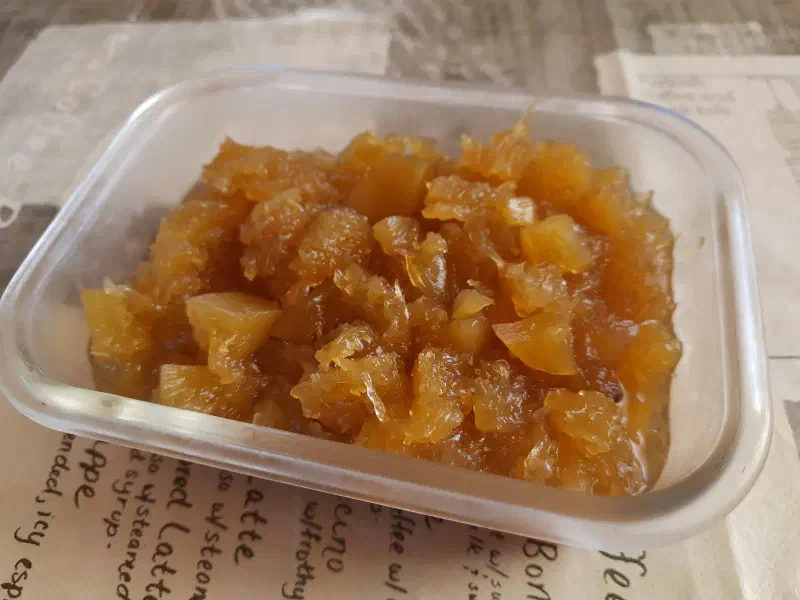
Check for doneness: The Dulce is ready when the pumpkin pieces are soft but still hold their shape as much as possible. The syrup should be noticeably thicker but still pourable. It will thicken a little more as it cools.
Remove the spices and let it cool: Take the pot off the heat and remove the cinnamon sticks and cloves. Let the Dulce cool before serving.
And this is what the sweet pumpkin looks like when it is ready:
💡 Practical Tips for Dulce de Calabaza#
Tips for Getting It Right
Adjust the sweetness: I now use 500 to 600 g of sugar for 2 kg of pumpkin, which gives me a noticeably less sweet version. If you prefer it sweeter, you can increase the amount to about 1 kg. I have made that version too.
Do not rely only on the clock: The type of pumpkin and the size of the pieces affect the cooking time. Soft pumpkin pieces and a visibly thickened syrup are more important than an exact number of minutes.
Storage: If you want to keep the Dulce, refrigerate it promptly in a tightly sealed container. Try to use it within about 3 to 4 days. In our house, the actual shelf life is hard to test because the bowl is usually empty before then.
🍽️ How Can You Serve Dulce de Calabaza?#
Dulce de Calabaza tastes good on its own or with something creamy to balance its strong sweetness.
Classic and simple: Serve well chilled on its own.
With milk: Pour a little cold milk over the sweet pumpkin. This is also a familiar way to serve Dulce de Calabaza in Paraguay. The milk provides a mild contrast to the strong sweetness.
Creamy: Plain yogurt or a small scoop of vanilla ice cream also works well.
Strong: Unsweetened coffee is a good contrast to the sweet syrup.
Paraguayan: Cocido, a hot drink made from yerba mate, also goes well with it.
Simple: With a very sweet version, cold water is sometimes the best choice.
🔄 What Else Can You Make with Dulce de Calabaza?#
Besides serving it on its own, you can also use the finished sweet pumpkin in other desserts.
Sweet empanadas: Mash the soft pumpkin pieces slightly and use them as a filling. For a sweet-and-savory contrast, add a little cream cheese or mild queso fresco inside the empanada as well. Then bake the empanadas in the oven.
Crêpes or panqueques: Dulce de Calabaza works well as a sweet filling for thin pancakes. Depending on the texture, you can mash the pumpkin pieces slightly first.
Cheesecake: Smaller pieces and a little syrup work well as a layer or topping for cheesecake. The slightly tangy cream cheese gives a nice contrast to the sweet pumpkin.
These are not classic Paraguayan variations of Andai he’ẽ, but modern ways to use this sweet dish.
🇵🇾 Background: Dulce de Calabaza and Andai#
What Does Andai he’ẽ Mean?#
In Paraguay, different types of pumpkin and squash are also distinguished by name.
Andai is the Guaraní term for calabaza. Here, it often refers to long, sometimes curved or bottle-shaped squash that can look somewhat similar to butternut squash.
For zapallo, the Guaraní word kurapepẽ is used. In Paraguay, these are often more rounded or slightly flattened types of squash, frequently with green skin.
The word he’ẽ means “sweet” in Guaraní.
Andai he’ẽ therefore refers to a sweet pumpkin preparation and is used for Dulce de Calabaza.
In everyday Spanish, however, calabaza and zapallo are not always used as strictly separate terms. That is why you may also come across this dessert under the name Dulce de Zapallo.
Andai in Paraguayan Cuisine#
Pumpkin, whether Andai (calabaza) or zapallo, are grown in many home gardens in Paraguay, but you can also find them at markets and supermarkets. They are versatile ingredients in Paraguayan cooking and are used in both sweet and savory dishes.
Here are a few examples of what can be made with Andai:
Andai he’ẽ is the sweet version made with pumpkin, sugar, and spices that is featured in this recipe.
Andai Kamby combines pumpkin with milk and sugar. It is softer and milkier than Dulce de Calabaza and is also served chilled.
Kivevé is a little more savory while still being slightly sweet. The pumpkin is mashed and thickened with cornmeal, while Queso Paraguay adds a mild savory note.
Chipa Andai is a savory type of chipa in which pumpkin puree is mixed into the dough with cassava starch and Queso Paraguay.
There are also variations of well-known corn dishes such as Sopa Paraguaya and Chipa Guasu that include pumpkin.
A Similar Idea with a Different Fruit
Dulce de Mamón follows a similar idea: the fruit is slowly cooked in sugar syrup. Instead of pumpkin, it uses firm green papaya. The flavor and texture are still quite different from Dulce de Calabaza.
❓ Frequently Asked Questions#
What kind of pumpkin works best for Dulce de Calabaza?
In Paraguay, Andai is often used. Outside Paraguay, butternut squash works very well, as does Muscat squash.
You can also use Hokkaido squash. It tends to soften and fall apart more quickly during the longer cooking time.
Can I use less sugar?
How do I know when Dulce de Calabaza is done?
The pumpkin pieces should be soft but still hold their shape as much as possible.
The syrup should be much more concentrated than at the beginning and lightly coat the pumpkin while still remaining pourable. It will thicken a little more as it cools.
How long does Dulce de Calabaza keep?
Cool the Dulce promptly after cooking. Stored in a tightly sealed container in the refrigerator, it is best used within about 3 to 4 days.
In our house, that is usually not a problem—it is normally eaten before then.
Can I freeze Dulce de Calabaza?
Conclusion#
For me, Dulce de Calabaza has become a natural part of everyday life here in Paraguay and a good option whenever we once again have a lot of pumpkin in the house. Instead of turning all of it into guisos, some of it ends up as sweet pumpkin.
We like Dulce de Calabaza best with a little cold milk. I also regularly add it to my muesli in the morning now – just two or three tablespoons are enough.
If you still have pumpkin left, try Kivevé next.
You can find more sweet classics in our collection of Paraguayan desserts.
Enjoy making it, and buen provecho!
Share & Support
Did this Dulce de Calabaza recipe inspire you to try it, or do you also have too much pumpkin in the kitchen right now?
Then feel free to leave a like and share it with other people who enjoy Paraguay and cooking. Together, we can help make Paraguay’s culinary variety more visible.